
When dawn breaks over the Bay of Bengal and sunlight scatters across rippling blue, the silhouettes of warships rise on the horizon like iron poetry on water. Masts stand motionless, ensigns breathe with the breeze and a low hum from beneath the waves signals that this is more than a ceremonial display. It is identity. It is intent. It is India at sea.
The International Fleet Review (IFR) is the Indian Navy’s grandest canvas—a moment when the sea becomes a mirror, reflecting not only naval strength but national aspiration. To the casual eye, it may come across merely as a stately assembly of ships. To those fluent in the language of salt, steel and statecraft, it is strategy in motion, which is a measured expression of presence, reassurance and resolve.
India’s connection to the sea has been long-standing. Ancient sailors traded and exchanged ideas across the Arabian Sea and the Bay of Bengal. As India was more focused on the interior in the 19th and 20th centuries, it shifted its focus to the interior with the Navy playing a limited role. However, as global trade and geopolitics increasingly focus on the maritime domain, India has renewed its strategic interest in the oceans.
Indian Navy now serves as a vital tool for diplomacy and influence. It is exemplified by events such as the International Fleet Review and Exercise MILAN. Such events help strengthen partnerships and assert India’s presence at sea.
Fleet Reviews are often misunderstood as a ceremonial display alone, which includes the lines of warships, polished decks and fluttering ensigns. In reality, they are part of a much older and intentionally established tradition. What unfolds on the water is a carefully choreographed maritime theatre of statecraft, where presence reassures partners, protocol builds trust, and capability is signalled without coercion.
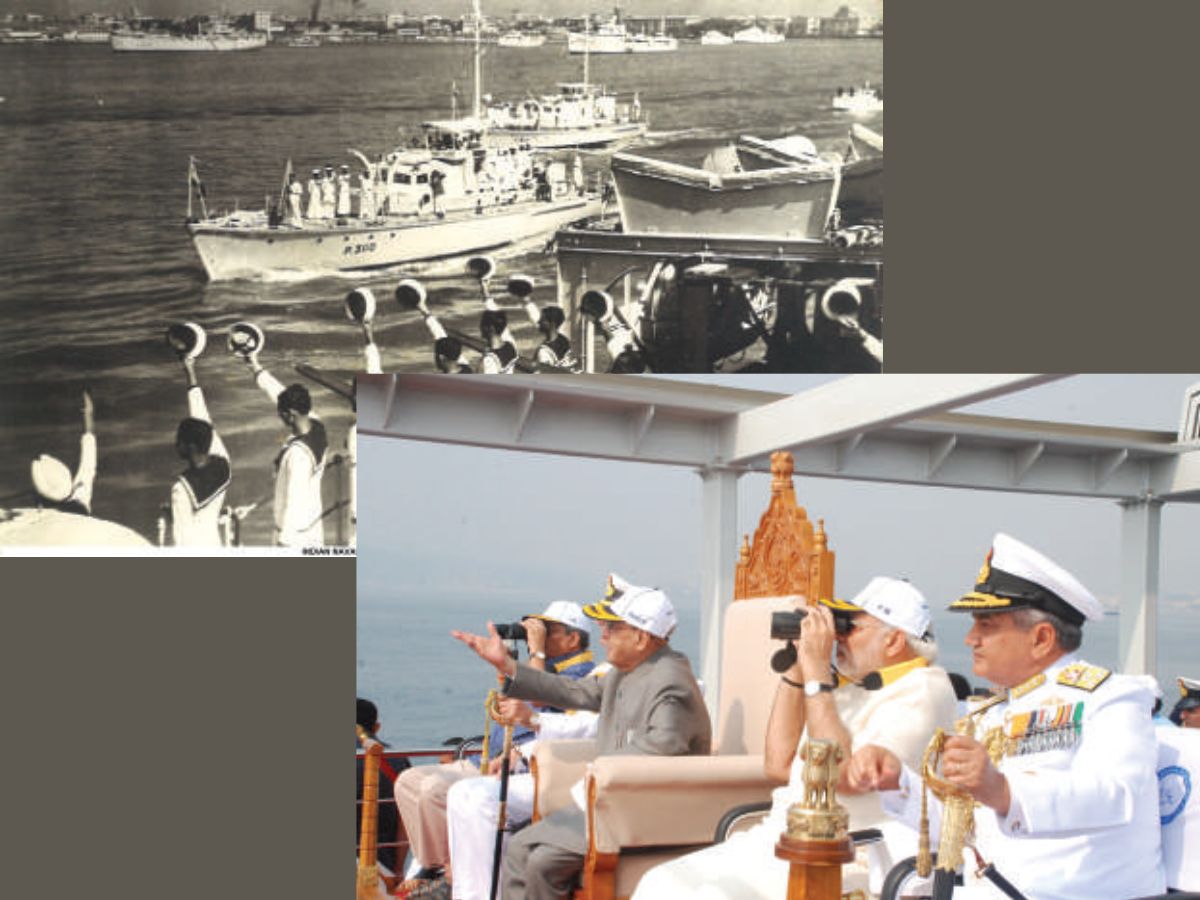
India embraced this tradition early. In October 1953, President Rajendra Prasad reviewed 33 ships off Bombay in the country’s first Presidential Fleet Review. By global standards, it was modest; by national standards, it was transformative. Indian sailors, many of whom had served under colonial command only years earlier, now saluted their own Head of State under the tricolour.
Each subsequent review mirrored the Navy’s evolution. The 1966 Review reflected post-conflict modernisation. The 1976 Review carried the confidence of victory from the 1971 war and the audacity of missile-boat operations that reshaped regional naval thinking. Indigenous Nilgiri-class frigates entered service, signalling India’s entry into the Builder’s Navy club. By 1989, the transformation was unmistakable. Two aircraft carriers and INS Godavari, India’s first indigenously designed missile frigate, stood prominently saluting the Supreme Commander. A nuclear-powered submarine also appeared in formation, quietly announcing India’s arrival in an exclusive maritime club.
India advanced its maritime diplomacy with the first International Fleet Review in Mumbai in 2001, joined by 20 foreign navies. By 2016, the IFR became a significant statement, attracting nearly 50 foreign navies and around 100 ships to Visakhapatnam, the Eastern Naval Command’s headquarters and gateway to the Bay of Bengal and Indo-Pacific. Hosting the event there reflected India’s shift toward an ocean-focused strategy. IFR 2016 also accelerated diplomatic engagement, bringing together naval leaders for meetings, exchanges, and seminars that fostered intensive interaction beyond typical port visits.
EXERCISE MILAN
Just as the international fleet review is a form of diplomatic engagement at rest, MILAN exercise represents diplomacy in action at sea. MILAN began in 1995 when four navies came together in Port Blair to conduct joint seamanship and professional knowledge sharing to foster trust and cooperation among nations. Over time, Milan evolved into more complex, advanced exercises at sea. Following the tsunami in 2004, MILAN expanded its efforts to provide humanitarian assistance and disaster relief services. In 2024, MILAN had approximately 40 international navies from the Indo-Pacific region engaged in activities (seminars, cultural, and professional) and a variety of administrative/tactical exercises enhancing functional coordination and interoperability between members. Its success lies in promoting partnership and capability without provoking tension or displaying aggression, allowing India to lead collaboratively.
WHY CEREMONY STILL MATTERS
Large naval gatherings inevitably attract scepticism. They are costly, resource-intensive and temporarily divert attention from routine operations. Yet history shows that major maritime powers use such events precisely because, when employed sparingly and designed well, they deliver returns disproportionate to their cost. Britain’s Spithead Review in 2005 commemorated Trafalgar while reinforcing alliance cohesion. The United States staged a grand international naval review in New York in 2000, timed to the millennium. China’s 2019 fleet review at Qingdao combined modernisation with multilateral engagement. The pattern is consistent. Fleet Reviews are strategic punctuation marks, not routine drills. They signal arrival without coercion and leadership without dominance.
India’s experience reflects this logic. IFR 2001 reopened doors. IFR 2016 consolidated credibility. MILAN sustains engagement year after year, converting acquaintance into familiarity and familiarity into trust.
INDIA’S MARITIME STATECRAFT
At their core, IFR and MILAN are instruments of maritime statecraft. They blend hard power ships, aircraft and sailors, with soft power: professionalism, transparency and credibility. Navies operate beyond the horizon; these events bring them into public view, reinforcing domestic confidence in long-term naval investment and industrial self-reliance. They also anchor India’s broader maritime vision: Security and Growth for All in the Region, the Act East Policy, the Indo-Pacific Oceans Initiative, and the expanding canvas of MAHASAGAR. The Fleet Review projects these ideas symbolically; MILAN enacts them operationally. One reassures; the other prepares.
AN OPEN HORIZON
As India gears up for International Fleet Review 2026, alongside the next edition of Exercise MILAN and the Indian Ocean Naval Symposium, the strategic context is sharper than ever. The Indo-Pacific is crowded, competitive and contested. In such waters, the ability to convene, reassure and cooperate is as valuable as deterrence.
India’s naval diplomacy has matured from instinct to institution. From ancient trade routes to modern task forces, from ceremonial reviews to complex multilateral exercises, the arc is clear. India is no longer merely guarding the seas around it. It is shaping the currents of cooperation across them. Oceans do not merely separate nations; they connect them. Those who understand this and who combine tradition with strategy, ceremony with substance, will continue to set the course. India’s compass is steady, its sails are full, and the horizon lies open once again.
-
Captain Akhilesh Menon is an alumnus of the National Defence Academy, the Navigation and Direction School, Kochi, and DSSC Wellington. He has commanded IN ships Vidyut and Karmuk, served as Training Captain at the Indian Naval Academy, and Defence Adviser at the High Commission of India, Canberra. He is presently posted in IFR and MILAN Cell at Visakhapatnam.




