
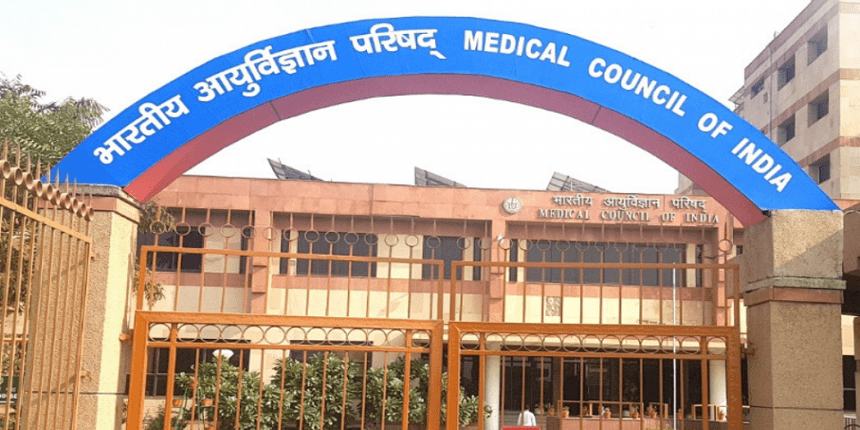
NEW DELHI: In September 2020, the National Medical Commission (NMC) was officially constituted to replace the much controversial and tainted Medical Council of India (MCI), whose name had become synonymous with taking bribes to allow institutions to be declared as medical colleges, admit students and charge fees in lakhs, despite no infrastructure, no teachers, no staff. Before it was shut down, MCI’s notoriety rose with its former president, Ketan Desai.
He was initially removed from the MCI presidency in 2001 by the Delhi High Court on grounds of “corrupt practices and abuse of power,” following revelations of financial irregularities. However, his infamy reached its peak with his dramatic arrest by the Central Bureau of Investigation (CBI) in April 2010. This arrest was on charges of criminal conspiracy and demanding a substantial bribe from a private medical college (Gian Sagar Medical College) to secure a favourable recommendation from the MCI, despite the college’s deficiencies.
Desai was alleged to operate an opaque system that facilitated the manipulation of medical college approvals and seat allocations for illicit gains. During CBI raids, significant amounts of wealth, including 1.5 kg of gold and 80 kg of silver, were reportedly recovered from his premises and bank lockers. After Desai was arrested, MCI was superseded by a Board of Governors in 2010. The board was appointed to take over the MCI’s functions in May 2010. However, the removal of Desai did not stop MCI related controversies.
In May 2017, MCI found significant deficiencies in the infrastructure, faculty, and facilities of the Prasad Institute of Medical Sciences (PIMS) in Lucknow, run by the Prasad Education Trust. Consequently, the college was debarred from admitting students for the academic years 2017-18 and 2018-19. Facing debarment, the Prasad Education Trust sought to overturn the MCI’s decision. They initially approached the Supreme Court.
However, a conspiracy was allegedly hatched involving retired Orissa High Court judge Justice I.M. Quddusi and middlemen, as a result of which the trust withdrew its plea from the Supreme Court to instead move the Allahabad High Court. On 24 August 2017, a writ petition was filed before the Lucknow bench of the Allahabad High Court. The very next day, on 25 August 2017, a division bench, which included Justice Narayan Shukla, heard the plea.
It was alleged by the CBI that on the morning of 25 August, Justice Quddusi and B.P. Yadav (representing Prasad Trust) met Justice Shukla at his Lucknow residence and delivered “illegal gratification.” On the same day, the bench headed by Justice Shukla passed a favourable interim order for PIMS, directing that the college should not be delisted for counselling until the next hearing and also stayed the encashment of its bank guarantee by the MCI.
This order was seen as highly irregular and in contradiction to the Supreme Court’s stance. Subsequently, on 19 September 2017, the CBI launched an investigation and registered an FIR against Justice I.M. Quddusi and other private individuals, including those from the Prasad Education Trust, for alleged corruption and conspiracy to manipulate court orders. However, Justice Narayan Shukla was not named in this initial FIR. In subsequent investigations, the CBI reportedly gathered incriminating evidence, including intercepted conversations, suggesting Justice Narayan Shukla’s direct involvement in allegedly accepting bribes for the favourable order. Following the precedent set by the K. Veeraswami case (1991), which mandates prior permission from the Chief Justice of India before registering an FIR against a sitting High Court or Supreme Court judge, the CBI reportedly approached then CJI Dipak Misra seeking this crucial permission to formally name and investigate Justice Shukla. However, this was allegedly denied.
Instead, based on a complaint from the Uttar Pradesh Advocate General, CJI Misra initiated an “in-house inquiry” against Justice Shukla, comprising a three-member committee of judges. This committee, in January 2018, found Justice Shukla guilty of “judicial irregularities.” Following the in-house report, CJI Misra reportedly asked Justice Shukla to resign or take voluntary retirement. When Justice Shukla refused, CJI Misra directed the Chief Justice of the Allahabad High Court to withdraw all judicial work from Justice Shukla.
This entire sequence of events, particularly the handling of the Prasad Education Trust case and the allocation of other sensitive cases, led to an unprecedented public outcry. On 12 January 2018, four senior-most Supreme Court judges (Justices J. Chelameswar, Ranjan Gogoi, Madan B. Lokur, and Kurian Joseph) held a historic press conference, publicly criticizing CJI Dipak Misra’s administration, especially his alleged role as “master of the roster” and the arbitrary assignment of cases, implicitly referencing the Prasad Education Trust matter.
In April 2018, opposition parties, led by the Indian National Congress, submitted an impeachment motion against CJI Dipak Misra to the Rajya Sabha Chairman, Venkaiah Naidu. Among the five grounds cited, the handling of the Prasad Education Trust case, particularly the denial of permission for the CBI probe against Justice Shukla and Justice Misra’s own judicial and administrative handling of the matter, was a prominent charge. The same, was however, rejected by Venkaiah Naidu stating that it lacked substantial merit and did not meet the criteria of “proved misbehaviour or incapacity.” Eventually, the MCI was permanently dissolved and replaced by the NMC in 2020 by the BJP-led National Democratic Alliance government. Justice Narayan Shukla continued to be stripped of judicial work until his retirement in July 2020.
Significantly, after Justice Dipak Misra’s retirement and with Justice Ranjan Gogoi as the new Chief Justice of India, the CBI finally received the necessary permission. In December 2019, the CBI registered a formal FIR against Justice Narayan Shukla. Subsequently, in December 2021, the CBI filed a chargesheet against retired Justice Shukla and others, including Justice (retd) I.M. Quddusi, and individuals from the Prasad Education Trust, alleging criminal conspiracy and corruption in the Prasad Education Trust case. The chargesheet detailed how bribes were allegedly exchanged for favourable judicial orders. The CBI also filed a separate disproportionate assets case against Justice Shukla.
THE NATIONAL MEDICAL COMMISSION
These three incidents the working of MCI under Ketan Desai, the manipulation regarding the eligibility status of Prasad Education trust and the subsequent impeachment motion against Chief Justice Dipak Misra is a narrative that highlights the deep-seated issues within India’s medical education. Thus, it was expected that with the disbanding of MCI and the birth of NMC, these long-standing deviancies will become a thing of the past. However, the same issue, more than 15 years after the shutting down of the MCI in the form it was run by Ketan Desai, continues to plague the system as the recent First Investigation Report by the CBI against NMC officials shows. The scam, which is being described as one of the biggest medical scams in the country, has exposed how the National Medical Commission, created to reform India’s tainted medical education system, has succumbed to the same corruption that destroyed its predecessor.
Recently, the agency filed an FIR against 35 individuals, including senior government officials, former bureaucrats, and a self-styled godman, for obtaining illegal approvals for substandard medical institutions across six states. The CBI conducted raids at more than 40 locations across Karnataka, Madhya Pradesh, Chhattisgarh, Rajasthan, Uttar Pradesh, and Delhi on 1 July, exposing a sophisticated criminal conspiracy that involved ministry officials, NMC assessors, middlemen, and medical college administrators.
The agency laid a trap and caught six individuals redhanded, including three doctors, accepting a bribe of Rs 55 lakh in lieu of issuing a favourable inspection report for the Shri Rawatpura Sarkar Institute of Medical Sciences and Research in Nava Raipur, Chhattisgarh. The same business group, incidentally, started a news channel in Hindi language that is operating in two states where the godmen is the most popular—Madhya Pradesh and Chhattisgarh. The money trail uncovered by investigators revealed a well-oiled financial operation.
The CBI recovered Rs 38.38 lakh from an aide of the inspection team head and Rs 16.62 lakh from the residence of another official. The bribe was planned and collected through hawala channels and was then distributed among the individuals in the inspection team. In a bizarre twist, a portion of these bribes handled by former Medical Assessment and Rating Board member Jitu Lal Meena was allegedly used to construct a Rs 75 lakh temple in Rajasthan.
At the heart of the scheme, as of now, are eight officials from the Union Health Ministry who allegedly formed a covert unit within the government to provide illegal access to confidential files and regulatory updates. Named in the FIR are Poonam Meena, Dharamvir, Piyush Malyan, Anup Jiswal, Rahul Srivastava, Deepak, Manisha and Chandan Kumar. These officials are accused of photographing internal documents and sharing sensitive information including inspection schedules, file notings, and the identities of designated assessors with intermediaries linked to private medical colleges. In return, they allegedly accepted bribes routed through hawala and legal channels.
The pre-inspection leaks enabled colleges to fabricate conditions of compliance before assessors even arrived. According to the CBI FIR, ghost faculty were temporarily employed or impersonated, fake patients were admitted to appear as operational hospitals, tampered biometric systems were used to fake attendance records, and assessors were bribed or misled into giving favourable reports. The FIR states that such prior disclosures have enabled medical colleges to orchestrate fraudulent arrangements, including the bribing of assessors to secure favourable inspection reports, the deployment of non-existent or proxy faculty, and the admission of fictitious patients to artificially project compliance during inspections, and tampering with the biometric attendance systems to falsify records.
The central figure in the case, as per the agency officials, is Ravishankar Maharaj, popularly known as Rawatpura Sarkar, the chairman of the Rawatpura Institute and a spiritual figure popular in Madhya Pradesh and Chhattisgarh. Born in Chipri village of Tikamgarh district of Madhya Pradesh on July 12, 1968, he was the eldest among his five siblings. At the age of 11, Ravishankar Maharaj left his home and set out on his spiritual journey, which started in a Hanuman temple in Rawatpura village in Lahar, Bhind, Madhya Pradesh. He established the Rawatpura Sarkar Lok Kalyan Trust in 2000, which runs several schools, colleges, hospitals, blood banks, nursing colleges and old-age homes.
The list of persons accused includes high-profile names such as D.P. Singh, Chancellor of Tata Institute of Social Sciences and former UGC Chairman from 2018-2021, Dr C.N. Manjappa, Professor and HOD of Orthopaedics at Mandya Institute of Medical Sciences and his associate Dr Suresh from Bengaluru, and Mayur Rawal, Registrar of Gitanjali University, Udaipur. Three members of the NMC inspection team, namely Dr Chaitra, Dr P. Rajni Reddy, and Dr Ashok Shelke, have been named as accused. The FIR also mentions Sanjay Shukla, a former IFS officer of Chhattisgarh cadre, who is a trustee of the Rawatpura group and has served as the chairman of the Real Estate Regulatory Authority (RERA) and was a former head of the Chhattisgarh Forest Department and Principal Chief Conservator of Forests.
The investigation has zeroed on in intermediaries operating across multiple states, with the CBI examining data related to 40 other medical colleges across the country. Six people have been arrested so far, including Dr Manjappa C.N., Dr Chaitra M.S., Dr Ashok D. Shelke, Atul Kumar Tiwari (Administrative Director, SRIMSR), Sathisha A., and Ravichandra K.
DAMAGING SCANDAL
The scandal is particularly damaging because the National Medical Commission was established in 2020 specifically to replace the corrupt Medical Council of India, which had regulated medical education and practice since 1934 but became synonymous with corruption by the 2000s. The NMC was created with promises of transparent inspections, reduced corruption, better governance, and improved standards to break this cycle of corruption.
However, this investigation reveals that the same corruption patterns that plagued the MCI have resurfaced in the NMC, with the same network of private medical colleges, intermediaries, and corrupt officials simply adapting to the new institutional structure, suggesting that the institutional reforms were insufficient to address the systemic issues in medical education regulation. In its press release after the CBI’s FIR, the NMC stated that it viewed the matter “very seriously” and decided to blacklist the said Assessor, pending investigation and final verdict in the matter.
As an exemplary action, it has been decided that the renewal of the existing number of seats of the said college in Under-graduate and Postgraduate courses shall not be done for the AY 2025-26. Further, the application for increase of seats and starting of new courses for both UG & PG received by the Medical Assessment & Rating Board for AY 2025- 26 shall be cancelled and not processed further




