
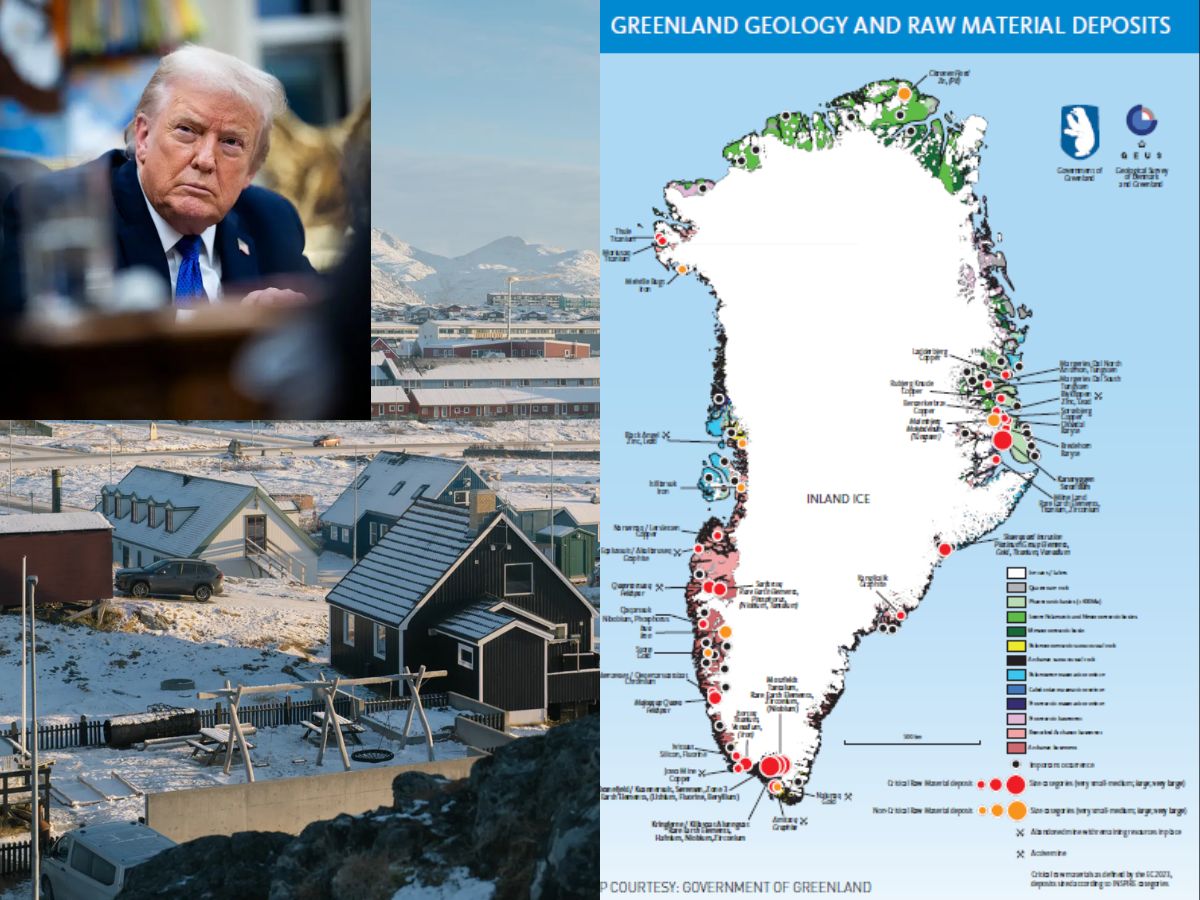
New Delhi: Post Venezuela, Donald Trump has revived his controversial territorial ambitions for bringing Greenland into US territorial control. While it has rattled many in Europe, the overall aim could be prepositioning for the “Arctic Passage”. Greenland lies strategically on the Arctic Circle and its importance to the overall security matrix is indisputable. It is located like a wedge between North America and Europe, straddling the GIUK gap—the maritime corridor linking the Arctic to the Atlantic. Its history is defined by successive waves of Paleo-Inuit migrations from North America, beginning around 2500 BCE, and the medieval arrival of Norse settlers from Iceland led by Erik the Red in 982 CE. “Thule”, ancestors of today’s Inuit successfully established themselves across the island, but Norse colonies vanished in the 15th century due to shifting climates and economic isolation.
Danish influence began in 1721 with the missionary Hans Egede, making the island a formal Danish colony in 1814 and eventually an integral part of Denmark in 1953. Greenland eventually adopted Home Rule in 1979 and expanded self-government in 2009. The indigenous Inuit constitute approximately 90% of Greenland’s total population of roughly 57,000 people. The indigenous population, who generally refer to themselves as Kalaallit, is divided into three distinct ethnographic groups based on geography and dialects.
Below the ice sheets, Greenland holds some of the world’s largest untapped deposits of minerals to include neodymium, dysprosium, and praseodymium. Significant reserves of nickel, copper, zinc, and cobalt have also been identified, particularly in the northern and western regions. The rare earth elements (REE) are concentrated in Kvanefjeld, down south. There are significant deposits of titanium, vanadium, tungsten, and ilmenite, and Greenland is therefore a part of 13 new strategic mineral projects located outside the EU as part of Critical Raw Materials act.
During World War II, Denmark was attacked by Germany. The United States took responsibility for securing Greenland and established military bases. In 1946, President Harry S. Truman offered Denmark $100 million in gold to buy Greenland, but it was rejected. The offer was secret at the time and was first made public in 1991 by a Danish newspaper, two decades after the documents were declassified. By the end of World War II, the US had 15 military bases in Greenland. Most of these sites were abandoned or handed over to Denmark between 1947 and 1958 as long-range aircraft made many smaller refuelling stops obsolete. Pituffik Military Base, formerly Thule Air Base or Bluie West Six, remains an active US military installation on the island.
Greenland is astride the most important Arctic shipping lanes of the world. These shipping lanes have the potential not only to shorten transit time and logistics but also facilitate seamless trade due to inter se distances. The approximate distance between the geographical centres of Greenland and Russia is 3,100 miles.
At their closest points across the Arctic Ocean, the distance is significantly shorter, though they do not share a land border. In context, Greenland’s closest neighbour is Canada, 26 km away, while Russia’s nearest North American neighbour is the United States, which is roughly 3.8 km at Diomede Islands in the Berring Strait.
There are 16 primary seaports and 40 ports and 250 natural harbours, surrounding the Greenlandic coast which are ideal for military usage. Greenland’s primary shipping is managed by the government-owned Royal Arctic Line, which maintains a vessel-sharing agreement with Eimskip to connect the island to global markets. The largest harbours are in the capital cities of Nuuk, Sisimiut, and Aasiaat. They handle close to one million cubic metres of cargo annually, which is close to 70 % of the total cargo coming to Greenland.
China has been involved in the fishing industry of Greenland since 2017 and is the largest export market for Royal Greenland, the island’s state-owned fishing giant. In terms of mining, Chinese companies hold minority stakes in several mining projects, but most are inactive as of 2026. Shenghe Resources holds a stake in Kvanefjeld rare-earth and uranium deposits; however, the project is stalled since 2021 due to Greenland’s ban on uranium mining. The Isua Iron ore Project, which was previously owned by the Chinese General Nice Group, had its license revoked by the Greenlandic government in 2021 due to inactivity. China Communications Construction Company (CCCC) was blocked by the Danish government from building three international airports due to security concerns raised by the United States in 2018.
Russia’s interest has largely been driven by a combination of economic ambitions, military strategy and domination of new trade routes. It has been investing heavily in the Arctic infrastructure to include new ports and military installations to bolster its capabilities in the region. The Russian North Arctic strategic submarine fleets operating from Murmansk in the Kola peninsula, use these routes for power projection, besides area domination and training.
With this “Arctic Push”, the global chessboard becomes very complex. This is likely to initiate Trans-Atlantic fissures and strain US relations with the EU further. There are some EU nations who have also opined that the future of NATO as a net security provider may also undergo a revision. It is of significance that Denmark provides nearly $700 million as subsidies to Greenland’s economy, yearly. Economically, this additional cost along with the accretion costs will also have to be borne by the US if this option is taken, which is an expensive proposition. In the meantime, a whopping $1.5 trillion US defence budget is also being talked about, which will need to be funded, perhaps in the short term from the oil in Venezuela.
While the power play for the Arctic with centricity of Greenland continues, the overall aim of the US clearly aims at disrupting energy lifelines for Russia, China and India, besides others. Will a swift military action mean US power projection in the Arctic, stymie Russian military reach, hamper China’s economic footprint, moving retrograde to a timeline without a global rules-based order or simply cater to midterm elections later this year? While a retribution from China in case of a military action is unlikely, Russia will flex its military muscle due to the sheer scale of the force preponderance in the region.
It seems to be a diplomatic war as of now. Any military action as per the hybrid “Don-roe Doctrine” possesses the capability to alter several geopolitical alliances and create some new ones, between friends and foes alike.
-
Anurag Awasthi is a veteran, and CEO of Escape Velocity Mediaworks. He is a known policy expert and a columnist who writes extensively on critical technologies, security and geopolitics. Views are personal.




