At the centre of Haryana’s progress is a recognition that agricultural practices do not change through appeals alone. They change when states lower the transaction cost of doing the right thing
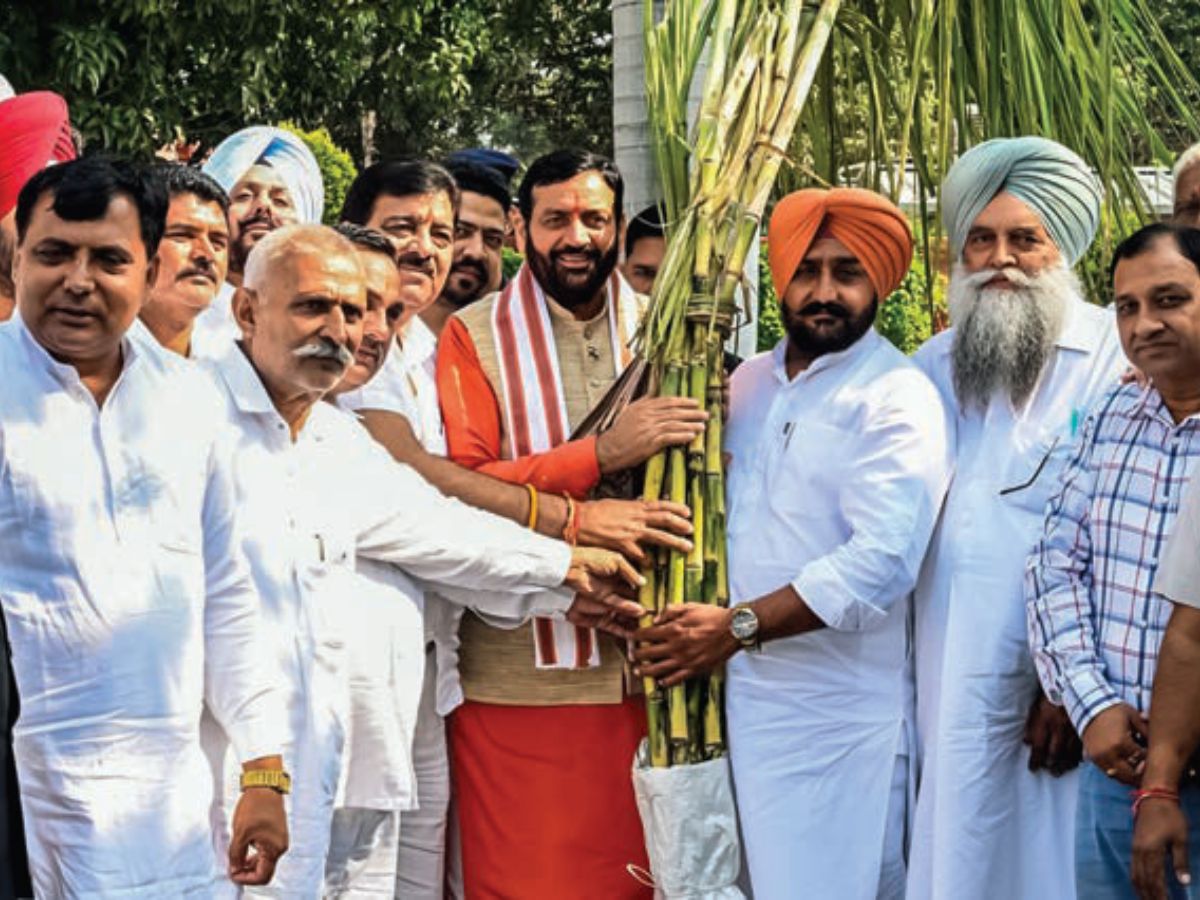
Representational image: This October 23 photo shows Haryana Chief Minister Nayab Singh Saini with sugarcane farmers at the Sant Kabir Kutir, in Chandigarh. @NayabSainiBJP X/ANI
Every harvest season, northern India is forced to confront a policy failure that repeats itself with clockwork regularity. Fields are cleared through fire, the air thickens, and governments return to familiar debates over what could have been done. The science is settled. Crop residue burning is a preventable source of pollution that damages soil fertility, burdens public health systems and pushes air quality far beyond safe limits. What is less settled is the question of state capacity, political will and administrative discipline. In this context, Haryana stands out for having moved the problem from lament to solution. The state has shown that when governance systems are designed with clarity and executed with consistency, even long standing agricultural practices can shift. The “Haryana model” is the outcome of layered interventions that align technology, incentives and enforcement into a coherent policy structure.
At the centre of Haryana’s progress is a recognition that agricultural practices do not change through appeals alone. They change when states lower the transaction cost of doing the right thing. Haryana began by addressing the most basic requirement of crop residue management: access to machinery. Since 2018, the state has built a network of more than 6,700 custom hiring centres, units that make mechanisation accessible even to the smallest farmer. These centres provide happy seeders, super seeders, zero till drills, rotavators and mulchers at subsidised rates, reducing both cost and dependency. More than 80,000 pieces of crop residue machinery have been placed directly in the hands of farmers. For a state with a limited harvesting window between paddy and wheat, this density of machines ensures that sustainable practices are no longer delayed by logistical barriers. It is an example of a supply side intervention that addresses constraints before enforcement begins.
Haryana also worked on the demand side, shaping incentives that alter behavioural choices. The economics of residue management matter deeply in rural settings. Farmers respond quickly to signals that respect their time, labour and risk. The state introduced a structured financial architecture that covers the main forms of residue management. Farmers receive Rs 1,200 per acre for managing residue either within the field or through external processing channels. Those who shift away from paddy cultivation to less water intensive crops receive up to Rs 8,000 per acre under the Mera Pani Meri Virasat programme. Direct seeding of rice, which reduces residue generation, is supported with an additional Rs 4,000 to 4,500 per acre. The transportation of bales to gaushalas is subsidised as well. These payments reshape the cost benefit analysis of residue handling. By directly reducing the financial burden of sustainable practices, the state aligned farmer incentives with environmental objectives.
A third pillar of Haryana’s model is its enforcement architecture. Policy design is only as effective as the administrative system that implements it. Haryana adopted an evidence based monitoring framework that relies on satellite detection, district level command systems and rapid field verification teams. Haryana has relied on HARSAC’s geospatial monitoring system, which uses satellite-based detection of active fire locations and real-time field verification to ensure rapid administrative response, making residue burning far easier to track and deter. All the districts in Haryana have constituted a dedicated “parali protection force”, mandated by CAQM, that brought together personnel from several departments to monitor fields and respond rapidly to any fire signals. Its presence sent a firm message that coordinated, multi-departmental action can reinforce compliance and reduce incidents more effectively.
Beyond incentives and enforcement, Haryana built an industrial ecosystem that gives crop residue a market value. Treating residue as an economic resource rather than an agricultural by-product has been one of the state’s most impactful decisions. Haryana now has more than 30 pelletisation and briquetting units with the ability to process over 8 lakh tonnes of biomass annually. The state also operates 11 biomass power plants producing more than 110 megawatts of energy. Residue supports ethanol production and compressed biogas units as well. This industrial demand absorbs the residue that would otherwise risk being burned. It also provides farmers and aggregators with a supplementary income stream. When residue carries a price in the marketplace, the practice of burning becomes both economically and socially irrational.
The results reflect the strength of this integrated design and the clarity of leadership that has guided it. Haryana has recorded one of the steepest declines in stubble burning anywhere in the region. Several districts have played a critical role in sustaining this progress, with Kaithal, Karnal and Faridabad consistently reporting sharp year-on-year reductions in residue-burning incidents. Kaithal, in particular, illustrates how coordinated field teams, timely machinery access and rapid verification mechanisms can bring the number of violations down to some of the lowest levels. At the state level, assessments for 2025 show only 171 burning incidents in the period that recorded 888 cases in 2024. Over a five-year horizon from 2021 to 2025, active fire locations linked to residue burning have fallen by roughly 97 per cent. What was once seen as an annual crisis has become a managed public policy issue, tackled through institutional planning rather than seasonal firefighting. Such outcomes are inseparable from the strategic direction provided by the Chief Minister and senior members of the state cabinet, who have treated residue management as a structural governance priority rather than a seasonal challenge. Their work has advanced the broader national vision articulated by Prime Minister Narendra Modi, whose emphasis on sustainability, administrative discipline and farmer centred reform has created the policy environment in which these innovations could take root.
In contrast, the situation in Punjab highlights how governance gaps can perpetuate an environmental hazard. Punjab has a proud agricultural legacy, yet its approach to crop residue management has lacked the urgency, discipline and administrative seriousness this issue requires. Burning incidents remain far higher, and reductions have been slow and inconsistent. Farmers routinely report delays in receiving machinery, fragmented implementation of incentive schemes and enforcement systems that activate only after fires become widespread. The outcome is a governance pattern that appears complacent in the face of a predictable crisis. A lackadaisical approach from the state government has allowed residue burning to persist at levels that no longer have any technical or economic justification. This is not a judgment of Punjab’s farmers, who work within complex agrarian constraints and limited institutional support, and whose resilience and hard work continue to sustain the region’s food systems. It is a judgment of the broken system that has failed to provide the conditions necessary for a timely and sustainable transition. The annadata, in Punjab or Haryana alike, sustains this nation with unbroken resolve, and they deserve nothing less than a system that stands firmly beside them, honours their labour and strengthens their path toward adopting sustainable agricultural practices.
The broader lesson is that environmental governance cannot rely solely on awareness. It must reshape incentives, strengthen administrative capacity and create economic value around sustainable behaviour. Haryana’s approach demonstrates that even long standing agricultural habits can change when states build credible structures that make sustainable choices easier than harmful ones. Crop residue management is not a political issue. It is a public health issue and an environmental issue that affects millions across state lines. As we confront the realities of air pollution, soil degradation and climate stress, states must learn from one another. Haryana’s model offers a clear example of how policy design, institutional discipline and scientific planning can produce measurable and lasting change. The challenge now is to carry this learning forward so that the fields of northern India support not only our food systems but also the health and wellbeing of future generations.
Kartikeya Sharma is an Independent Member of Parliament (Rajya Sabha).
