
New Delhi: January 1966 was an eventful month. India’s Prime Minister Lal Bahadur Shastri died in Tashkent (now Uzbekistan’s national capital, then a provincial capital of the Union of Soviet Socialist Republics—USSR) on the night of January 11 soon after signing the Soviet brokered agreement with Pakistan’s Ayub Khan, under which India and Pakistan were to withdraw from each other’s territories occupied during the indecisive war fought in September 1965.
Initial reaction in India to the Tashkent pact was not enthusiastic—withdrawal of forces from strategic Haji Pir Pass and other areas regained from Pakistan in Jammu & Kashmir—threw up questions. However, these were mulled over as tribute to a man who had led the nation in defending its pride and failing Pakistan’s bid to grab J&K through its diabolic Operation Gibraltar. Shastri in 1965 had somewhat retrieved India’s pride, which had been dented on the Tibet border in 1962.
Intense power struggle followed in New Delhi, with senior minister Morarji Desai, who had lost out to Lal Bahadur Shastri 20 months ago in the succession battle which ensued after the demise of India’s first Prime Minister, Jawaharlal Nehru in May 1964, again throwing his hat in the ring. Post-Nehru Desai had conceded on the basis of consensus. This time he insisted on formal polling in the general body of Congress Members of Parliament.
USSR Prime Minister Alexi Kosygin and Pakistan’s President Ayub Khan accompanied Shastri’s body, which was flown in a Soviet aircraft to Delhi. These two dignitaries acted as pallbearer and escorted the casket. Kosygin and Ayub, with their heads bowed in tribute, walked in front of Shastri’s cortege for the entire length of the funeral procession from Janpath to what is now known as Vijay Ghat, located behind the Red Fort.
Congress president, K. Kamaraj, whose three terms—from 1964 to 1967—were marked by major shakeup in Congress organization highlighted by what came to be known as “Kamaraj Plan” (senior leaders quit as ministers, opting for party work) stuck to his stance on Desai, whom he had opted against in 1964 as he was bitterly opposed by a number senior leaders, though Desai had a distinguished record as Union Minister and was a former Chief Minister of the erstwhile composite Bombay state, precursor of the present day Maharashtra and Gujarat.
Kamaraj, a successful Chief Minister of erstwhile Madras (now Tamil Nadu), was elected Congress president at Bhubaneswar in early 1964—the session during which Nehru suffered a stroke, thereby betraying fragility of leadership at the top. A power caucus emerged—K. Kamaraj, S.K. Patil, S. Nijalingappa, Atulya Ghosh and Neelam Sanjiva Reddy—which came to be known as the Syndicate.
The Syndicate had opted for Shastri in May 1964, rejecting Desai. In January 1966, the Syndicate, at the insistence of Kamaraj, opted for Indira Gandhi, who had been inducted as Information & Broadcasting Minister by Shastri in the first post-Nehru Cabinet.
Gulzarilal Nanda, who as Nehru’s Home Minister, had been administered the oath of Prime Minister for the interim period after Nehru’s death, was again sworn in as Prime Minister post Shastri. Nanda served two 13-day terms at the helm. In 1964, he had pitched for the top job. In 1966, he was somewhat reconciled that though the Constitution did not provide for an “Interim Prime Minister”, his elevation was temporary and interim arrangement. The agility of India’s democracy, then just a decade and a half old, was displayed by Gulzarilal Nanda’s sense of political propriety.
Morarji Desai, who had accepted Kamaraj’s decision in 1964, not only challenged him now, but also sought a vote among the 526 Congress MPs spread over the two Houses of Parliament. Voting was held on January 19. Indira Gandhi, polling 355, defeated Desai by 186 votes.
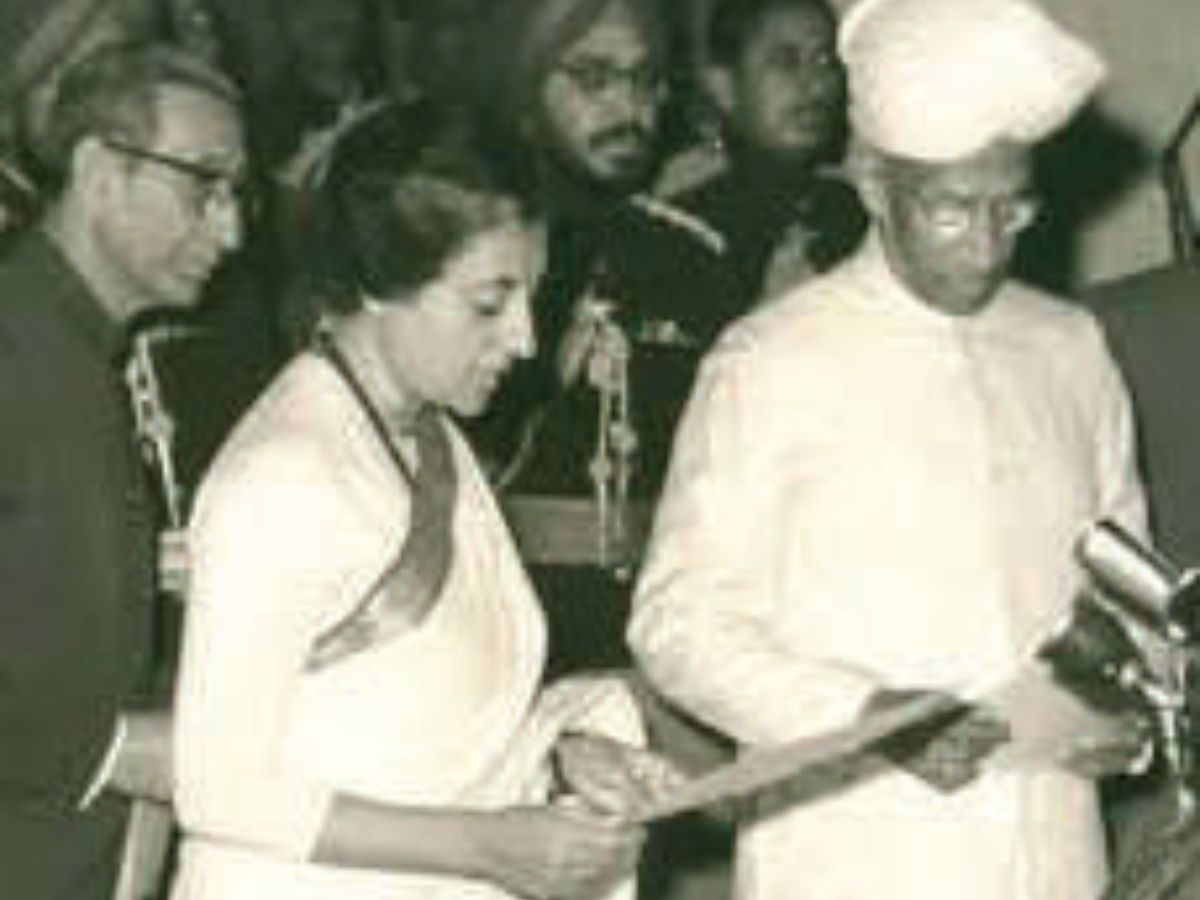
Forty-nine-year-old Indira Gandhi was sworn in as India’s first and the world’s second woman Prime Minister on January 24. There are many prominent women Prime Ministers in the world today, but this subcontinent, having elected Sirimavo Bandaranaike of Sri Lanka in 1960 and Indira Gandhi in 1966 was a decade ahead of the Western world. Britain elected Margaret Thatcher as Leader of the Conservative Party in 1975 and Prime Minister in 1979.
January 24, 1966, is also the anniversary of the crash of a Paris-bound Air India flight which killed the father of India’s nuclear programme, Dr Homi J. Bhabha. The aircraft crashed into the Mont Blanc in France on the Swiss border. The mystery of Dr Bhabha’s death has not quite been resolved. There have been conjectures about the role of Western cloak and dagger agencies.
Prior to embarking on his journey to Europe, Dr Bhabha had said India could make an atom bomb in three months (China had exploded its bomb in October 1964).
Thus, Indira Gandhi’s turbulent tenure as Prime Minister began in the shadow of death. India’s nuclear programme was left leaderless. Eight years later, in May 1974, the Buddha smiled and India entered the nuclear arena with a peaceful nuclear explosion at Pokhran.
Indira Gandhi’s tenure, scarred by the Emergency and Operation Blue Star, ought to be recalled also on the score of the 1971 December liberation of Bangladesh and the resultant dismemberment of Pakistan and the consequential demolition of the two-nation theory (which Pakistan’s Asim Munir seeks to revive); as well as May 1974 Pokhran nuclear test—even while going nuclear India chose to espouse peace, not war.




