
NEW DELHI: An imaginary tale set in the closing days of World War II, “Catch 22” is a satirical novel written by Joseph Heller that examines the absurdity of war and military life through highly improbable events, comic reactions and outlandish observations of a motley group of US Air Force personnel stationed at a base on an island in the Mediterranean, off Italy. The title of this novel refers to an imaginary air force rule that is both absolute as well as non-negotiable and a logical acknowledgement of the undisputed fact that a concern for one’s safety in the face of dangers that are real and immediate is the process of a rational mind. Accordingly, “Catch 22” stipulates that any pilot who was crazy could be grounded and all that he had to do was to ask. However, as soon as a person refused to fly due to fear of physical harm, he was sane and hence would have to fly more missions. This implied that anyone flying bombing missions would be crazy to do so, and sane if they didn’t. Resultantly, a pilot who flew combat missions was crazy and hence didn’t have to; but if he didn’t want to do so, he was sane and had to.
MUNIR’S ‘MANDATE’
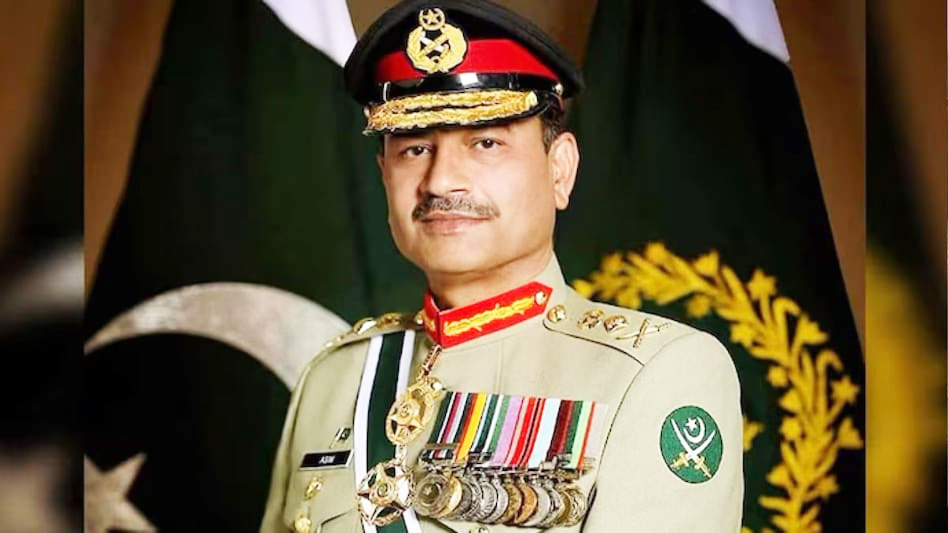
Enunciated by newly promoted Field Marshal Syed Asim Munir who besides heading the army is also the de facto ruler of Pakistan, his version of Catch 22 [hereinafter referred to as Munir’s Mandate] stipulates, “Muslims are distinct from Hindus in all aspects of life—religion, customs, traditions, thinking as well as aspirations due to which there can be no meeting point between the two and that’s why our forefathers gave immense sacrifices for the creation of Pakistan and this story should be told to our children so that they don’t forget what our forefathers thought.” Munir’s Mandate implies that promoting Indo-Pak amity by citing the centuries-old history of harmonious coexistence between the two communities ridicules the sacrifices of Pakistan’s forefathers and is therefore tantamount to treason. Conversely, anything that advances communal animosity and breeds religious intolerance is an unqualified act of patriotism.
So, even though Islam is a religion of peace, when you talk about peace in Pakistan, you are a traitor and hence need to change your outlook; but when you go against this basic tenet of Islam and advocate hatred, you are considered a patriot. Though fictional, “Catch 22” has today become the standard phrase to describe a dilemma or difficult circumstance from which there’s no escape because of mutually conflicting or dependent conditions. By putting the people of Pakistan in a similarly perplexing predicament, Munir’s Mandate has turned this imaginary statute into reality, as have some of wacky incidents in this novel, thanks to Rawalpindi’s crazy actions.
REWARDING INCOMPETENCE
In the novel there’s an incident wherein Colonel Cathcart, the ambitious group commander of the US Air Force base is in a quandary. Though a vital bridge held by the enemy had been successfully bombed and destroyed, the main protagonist Yossarian achieved this by going over the target the second time as he had failed to release his bombs during the first run, since he was not sure about the target. Col Cathcart is upset because he’s of the opinion that mentioning this “looks so lousy on the report” and was worried as to how he was “going to cover up something like this in the report?” When Yossarian timidly suggests that he should be given a medal, Col Cathcart is livid, but his second-incommand Colonel Korn endorses Yossarian’s request. After skilfully turning Yossarian’s lapse into an act of extraordinary valour, Colonel Korn ends his justification by adding, “You know, that may be the answer- to act boastfully about something we ought to be ashamed of,” and emphasising, “that’s a trick that never seems to fail.” Rawalpindi seems to have taken a cue from the genius of non-existent Colonel Korn.
During Operation Sindoor/Bunyan Marsoos briefings, the spokesperson of the government/ Indian armed forces refrained from theatrics and substantiated their assessment with satellite imagery showing the extensive damage caused to Pakistani assets that had been targeted. On the other hand, since Pakistani armed forces’ spokespersons made tall claims but failed to substantiate their phantastic assertions through any physical evidence like satellite photographs, they obviously had no other choice but to adopt the “act boastfully about something we ought to be ashamed of” ploy to save face.
PLAYING SAFE
Returning to the novel and the bridge bombing incident, when Colonel Cathcart asks his secondin-command whether the stratagem of awarding Yossarian with a medal to cover-up his folly of failing to drop bombs during his first run would work, Colonel Korn replies that he’s sure that it would. However, he suggests that “just to make certain,” Yossarian should also be given a promotion. When Colonel Cathcart queries “Don’t you think that’s going a bit farther than we have to,” Colonel Korn replies “No I don’t think so. It’s best to play safe.” And so in the novel, Yossarian gets a medal as well as a promotion and no questions are asked. A reader would perceive this highly improbable fictional occurrence as intentional over-exaggeration to highlight the absurdity of army ways.
However, by faithfully following Colonel Korn’s “it’s best to play safe” proposition and promoting himself to the rank of Field Marshal so that no questions are raised on Rawalpindi’s inability to provide any credible evidence of the extensive damage that it claims to have inflicted on its eastern neighbour, hasn’t Gen Munir turned the fictional bridge-bombing incident in “Catch 22” into a fact? * Col Nilesh Kunwar (Retd) served in the Indian Army.




