Ukraine’s war reveals how drones, data, and AI—not tanks—are redefining 21st-century warfare.
London: The Dnipro Delta, located in southern Ukraine where the Dnipro River meets the Black Sea, is a rich and diverse wetland ecosystem, consisting of a complex network of channels, lakes, reed beds, marshes, and islands. The delta is an important bird migration stopover and breeding ground, a haven for ornithologists. Nowadays, it’s a haven for Russian military corpses. Since Ukrainian forces liberated the southern city of Kherson in November 2022, the Dnipro River to the south of the city has become a de facto frontline in the war, one of the most perilous battlefields of the conflict. It’s here that some units of Russia’s 98th Airborne Division, alongside marines from the 61st Separate Brigade, are known to be operating on a number of islands that litter the area. Supplying and rotating these forces has become a nightmare for the Russian command, as in the low-lying area surrounded by water, their troops are exposed and vulnerable to Ukrainian drones.
Since January this year, some 5,100 Russians have been killed by Ukrainian drones in the Dnipro Delta alone, according to Ukrainian intelligence, their bodies spread over a wide area. Chilling footage taken by the Ukrainians shows Russian soldiers wrapping themselves in vegetation, trying to avoid detection by drones as they try to flee the death zone in tiny dinghies. Others, cloaked in makeshift camouflage made of reeds and mud, are seen lying low in the water, hoping the narrow channels will conceal their escape back toward Russian-occupied territory. But Ukrainian drones are tracking their every move. Doomed Russian soldiers hear the ominous buzz of suicide drones before they swoop on their boats and detonate, instantly killing everyone onboard.
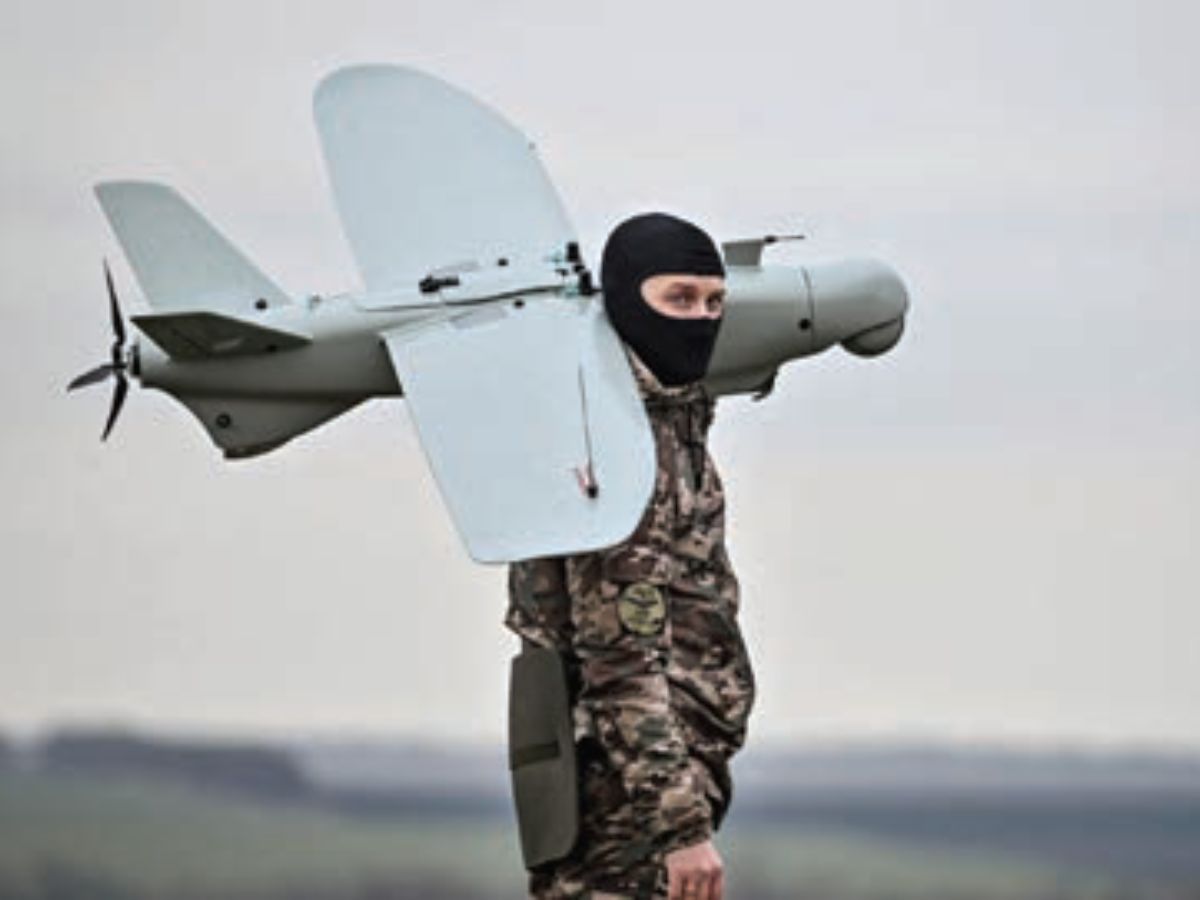
The war in Ukraine has been deeply transformed by the extensive and innovative use of unmanned systems — aerial, ground, and naval drones — which have shifted the balance in many ways. Drones have enabled faster reconnaissance, caught enemy forces under fire more quickly, allowed cheaper precision strikes, forced changes in how ground and air operations are planned, and acted as a major force-multiplier for Ukraine against a numerically and materially stronger opponent. Drones are showing how modern conflicts are increasingly about connectivity, sensor-to-shooter timelines, and leveraging unmanned systems, rather than purely massing tanks or aircraft.
While drones are transformative, they are not magic. Some analysts caution that they do not replace all conventional capabilities or instantly guarantee victory. Drone operations face countermeasures, such as jamming, electronic warfare, and anti-drone systems, but as one expert recently said, “the one huge advantage drones provide on the Ukrainian battlefield is ‘democratising’ precision firepower.” When Russia began to hurl growing waves of explosive “suicide drones” at Ukrainian cities, for example, Kyiv quickly manufactured cheap interceptor drones to stop them. Interceptor drones, like many Russia-Ukrainian battlefield innovations since 2022, were born out of desperation.
Ukraine first considered interceptor drones in early 2024 as a cheap way to counter Russian reconnaissance drones that typically cost upward of $100,000 and quietly cruise at up to 23,000 ft to surveil the battlefield. Urgency grew when winter came and Russia began unleashing waves of Shaheds, Iranian-designed attack drones that fly toward a target and detonate. Ukraine was running low on expensive surface-to-air missiles, partly due to dwindling US arms support, and was relying heavily on truck-mounted machine guns to take down Shaheds. Those defences couldn’t keep up. Russia’s attack drones were slipping through, knocking out power grids and forcing rolling blackouts as temperatures in Ukraine fell below zero. Hospitals worked in the dark and often without water, and civilians scrambled to stockpile firewood and coal.
Ukrainian drone engineers, a fast-growing breed, quickly moved into action and started redesigning their quadcopters, small commercial drones purchased on Amazon that use four rotors to achieve lift and control their movement, into vehicles that could take down Shaheds. It took nearly a year to build such low-cost interceptors that can fly as fast as 115 mph, but once they did, they were quickly deployed on the battlefield and so far have successfully downed more than 5,000 expensive Russian Shaheds.
A recently developed Ukrainian interceptor drone which has proved effective against Shaheds is the Sting, a quadcopter with a “bullet-shaped” frame optimised for high speed and agility, rather than endurance. The Sting can reach speeds of up to 200 mph and can operate at altitudes of around 3,000 m. One of its attractive features is low cost — estimates range from $1,000–$5,000, depending on variant and payload. Stings are piloted by an operator from the ground, called “first person view” (FPV), but they also have an AI-assisted target tracking system, and recent models are equipped with thermal-imaging cameras for night operations. Stings resemble a handheld missile and are small enough to fit inside a duffle bag. The crews that deploy them must react instantly to threats, racing out at night on tips from reconnaissance teams, with only 10 minutes to catch incoming Russian drones before they slip out of range.
Russia has also massively increased drone production over the past year, although Western sanctions and restrictions have forced Moscow to import components from third countries, such as China. According to the Moscow Times, drone output from dozens of factories around Russia increased by 17 percent between April and May this year alone, all the result of help from China. Beijing has officially declared neutrality in the conflict, but data indicates large amounts of dual-use items and components such as camera systems, engines, sensors, metal alloys, and optical items flowing from China to Russia. One study found that of the foreign components in three Russian drone models, about 67 percent came from China. The Kremlin still imports thousands of drones from Iran, of course, and the two countries are said to be cooperating on a factory in Russia’s Alabuga Special Economic Zone in Tatarstan, which is producing drones on Iranian designs. Iran is therefore both a direct exporter of drones to Russia as well as being its technology partner.
To any observer, the war in Ukraine has become far more than a brutal territorial conflict. It’s also a live laboratory for a new generation of military technology — a place where drones, artificial intelligence, and digital warfare are being tested, refined, and reinvented under fire. The dominance of drones is, perhaps, the most striking feature. Both Russia and Ukraine are using unmanned aerial vehicles on a massive scale, for reconnaissance, artillery spotting, and direct attacks. Ukrainian engineers have transformed off-the-shelf hobby drones into deadly precision weapons. The rise of FPV drones, guided by operators using virtual-reality goggles, has turned the sky over Ukraine into a swarm of low-cost, high-impact machines.
The drone revolution isn’t limited to the air. Unmanned surface vessels, essentially sea-borne drones, have been used to target Russian ships in the Black Sea. On the ground, robotic vehicles are also being tested for logistics and combat support. The battlefield has become a real-time test environment for how cheap, adaptable, and expendable machines can outperform traditional military hardware.
What’s unfolding on the Ukrainian battlefield is rewriting the playbook of modern warfare and shaping how wars will be fought for decades to come. It has proven that dominance no longer depends on tanks, jets, and missiles, but on data, networks, and the ability to evolve technology faster than the enemy. The lessons being learned in Ukraine will ripple far beyond Eastern Europe, shaping how militaries, policymakers, and technologists think about war in the 21st century.
