
London: During a speech earlier this month, former British Prime Minister Boris Johnson was reported to have said in his characteristically colourful way: “if a common or garden snail had set out across Russia’s border with Ukraine at the same time as Putin dispatched his 115 battalion tactical groups in February 2022, the snail would now be in Poland”. Russian troops have advanced at different rates along the 600-mile line of battle in Ukraine, from a few miles in places to as much as 80 miles in others, but whatever you choose, the snail has clearly won the race.
When Vladimir Putin launched his full-scale invasion of Ukraine on 24 February 2022, most observers predicted it would be only a matter of days before Ukraine was conquered by the mighty Russian army and Putin would have realised his dream of forcing his Slavic neighbour back into the Russian empire. Putin certainly thought so. His soldiers were ordered to pack their ceremonial uniforms in preparation for a march through Kyiv and told they would be showered with flowers by a grateful nation for having delivered them from their Nazi leaders. Even the Ukrainian oligarch and close friend of Vladimir Putin, Victor Medvedchuk (Putin is his daughter’s godfather), was lined up to replace President Zelenskyy, so certain was Putin of winning.
More than three and a half years later, an embarrassed Russia has only conquered about 19 percent of Ukraine, including Crimea which it seized back in 2014. These modest gains have come at immense cost of more than 1 million Russians dead and wounded. According to one US assessment, Russia is suffering at least 5 casualties for every Ukrainian, and in some battles, the ratio is said to be as high as 12 to 1.
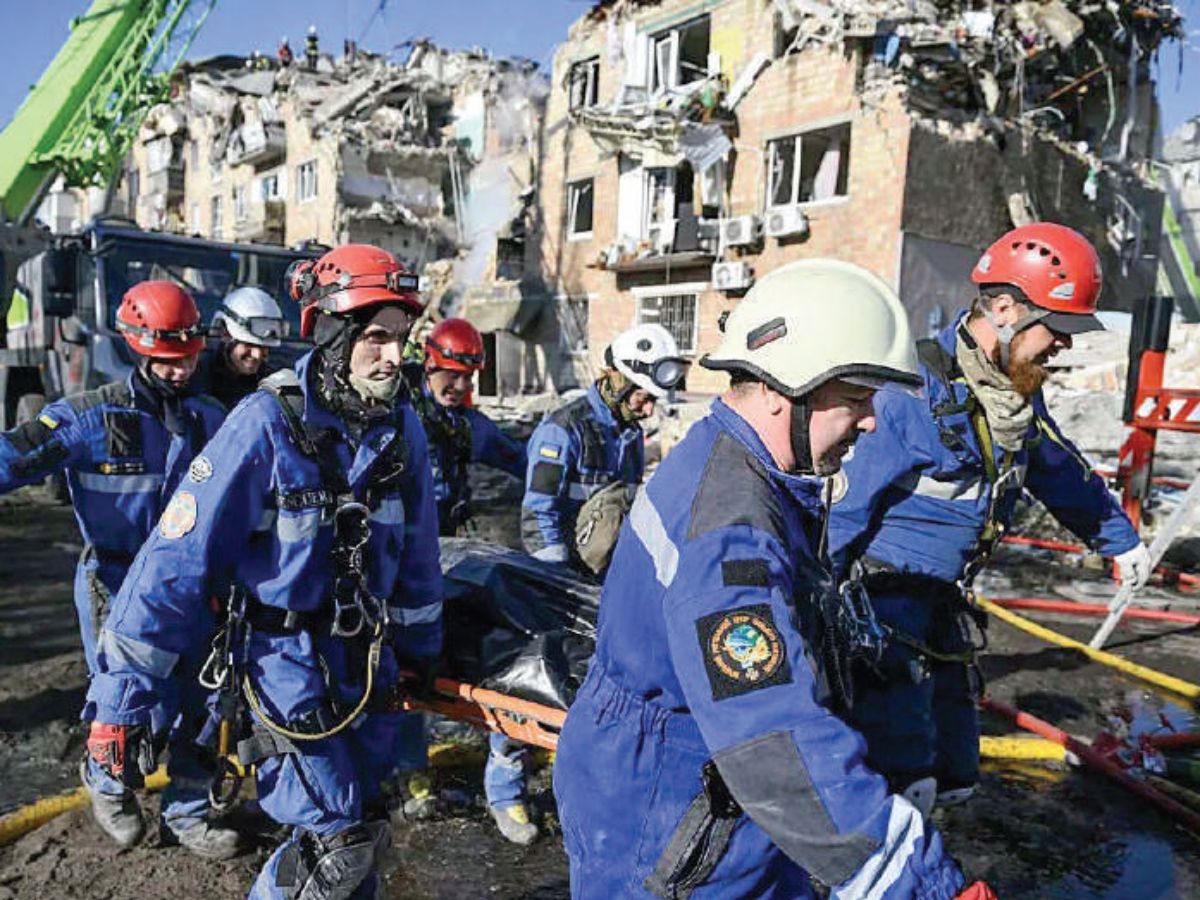
In addition to the human loss and suffering, resulting from Putin’s incoherent and cruel decision to invade Ukraine for no other reason than his personal legacy, is the extensive damage done by Russian missiles, artillery and drones across Ukrainian territory. Although the Kremlin repeatedly insists that it targets only Ukrainian military infrastructure, about 13 percent of Ukraine’s total housing stock has been damaged or destroyed, with more than 2.5 million households affected. This will require some $84 billion to reconstruct or repair, according to the UN. Roads, highways, bridges and other transport links have also been heavily damaged, requiring some $78 billion to restore. In addition, Russia has caused massive damage to Ukraine’s energy generation, transmission and distribution systems, which will require $68 billion, as will the repair of factories and farmland machinery and storage facilities. The UN estimates that just clearing the debris and removing unexploded munitions will add some $13 billion to the bill. Altogether, the total estimate for full recovery and reconstruction needs in Ukraine currently stands at about $524 billion and rising. Where will this money come from?
Ukraine is raising revenue in the normal way through taxes where possible, but this is challenging in wartime. Much of the government’s fiscal resources are going towards defence which inevitably creates large budget deficits. Last week, Ukraine’s newly appointed Prime Minister Yulia Svyrydenko announced a draft 2026 budget aiming for a deficit of 18.4 percent of GDP, allocating even more funds for defence. “The key budget priority is security and defence, our social resilience,” she said, adding that “now all of Ukraine must be in the army or for the army.”
Since Russia’s invasion in 2022, Ukraine has received substantial external financial support. To date, the European Union has provided a total of 169 billion euros in all forms of support: military, financial, economic and humanitarian. Of this, Germany was the biggest donor with over 20 billion euros from January 2022 to mid-2025, followed by the UK with over 18 billion euros. United States aid in the same period amounted to $135 billion, of which $76 billion was military aid. Altogether Kyiv has received a total of more than $365 billion from at least 41 countries as of mid-2025.
The arrival this year of Trump 2.0 brought a different US tone towards Ukraine. Although direct US assistance is under review, there is evidence that Washington has begun approving military aid to Ukraine under a new funding arrangement involving NATO allies. The mechanism is called the “Prioritised Ukraine Requirements List” (PURL) which allows US weapons from its stockpiles to be sent to Ukraine using allied funding. This is classic “others must pay” Trump, insisting that US supplied weapons must be funded by foreign contributions.
In recent months, however, an alternative method of funding Ukraine’s war with Russia is gaining traction — using Russian money. After the 2022 invasion, around $300 billion in Russian Central Bank assets were frozen by Western countries, together with tens of billions from Russian oligarchs and sanctioned entities. Most of the central bank assets are held in the EU, especially via Euroclear in Belgium. In June last year, the EU agreed to use the interest earned on the frozen Russian assets, but not the principal, to fund aid to Ukraine, potentially worth some 3 billion euros per year. Now some countries are proposing that the whole $300 billion should be used, subject to certain conditions.
But what about the ethics of such a solution? Many argue that as Russia has caused so much damage in Ukraine, it’s only fair and just that it should help pay for its reconstruction. Forcing Russia to cough up the money would also act as a deterrence to other countries, sending a strong signal to those aggressive states considering an attack on their neighbour. On the other hand, some countries worried about the rule of law say that seizing sovereign funds could undermine legal norms. Others are apprehensive that such action could be a slippery slope which would weaken trust in the global financial system. It could also create some collateral harm, they say, punishing Russian citizens or investors not involved in the war.
In the past few months, however, a way around the ethical issues is being seriously considered among Ukraine’s allies, built on the UN General Assembly’s call for Russia to pay reparations for its attack on Ukraine — a “Reparation Loan”. Here’s how it works. Virtually all international legal scholars who have considered the issue of reparation agree that Russia is obliged under international law to pay damages, but the problem is that it would take years before any claims commission could issue a ruling. So, as Kyiv needs the cash urgently, why not give Ukraine a “reparation loan” now using the frozen capital, and Moscow only gets its money back if it pays reparations after the claims commission’s ruling. From a legal standpoint, it’s incestuous: if Moscow meets its obligations, the loan will be paid in full; if not, the only party that will be injured by that default will be Russia itself.
The Kremlin would inevitably complain that its assets were being invested in loans to Kyiv rather than safer assets. But the only way Moscow would lose money is if it refused to pay war damages after the claims commission ruled that it must do so. This would not be because anyone confiscated the funds, but solely because it failed to pay reparations. In other words, Russia would be the author of its own losses. Put simply, this is how to justifiably repair Ukraine using Russia’s money!
John Dobson is a former British diplomat, who also worked in UK Prime Minister John Major’s office between 1995 and 1998. He is currently a visiting fellow at the University of Plymouth.




