ASEAN’s shifting dynamics highlight India’s growing role in restoring regional equilibrium.
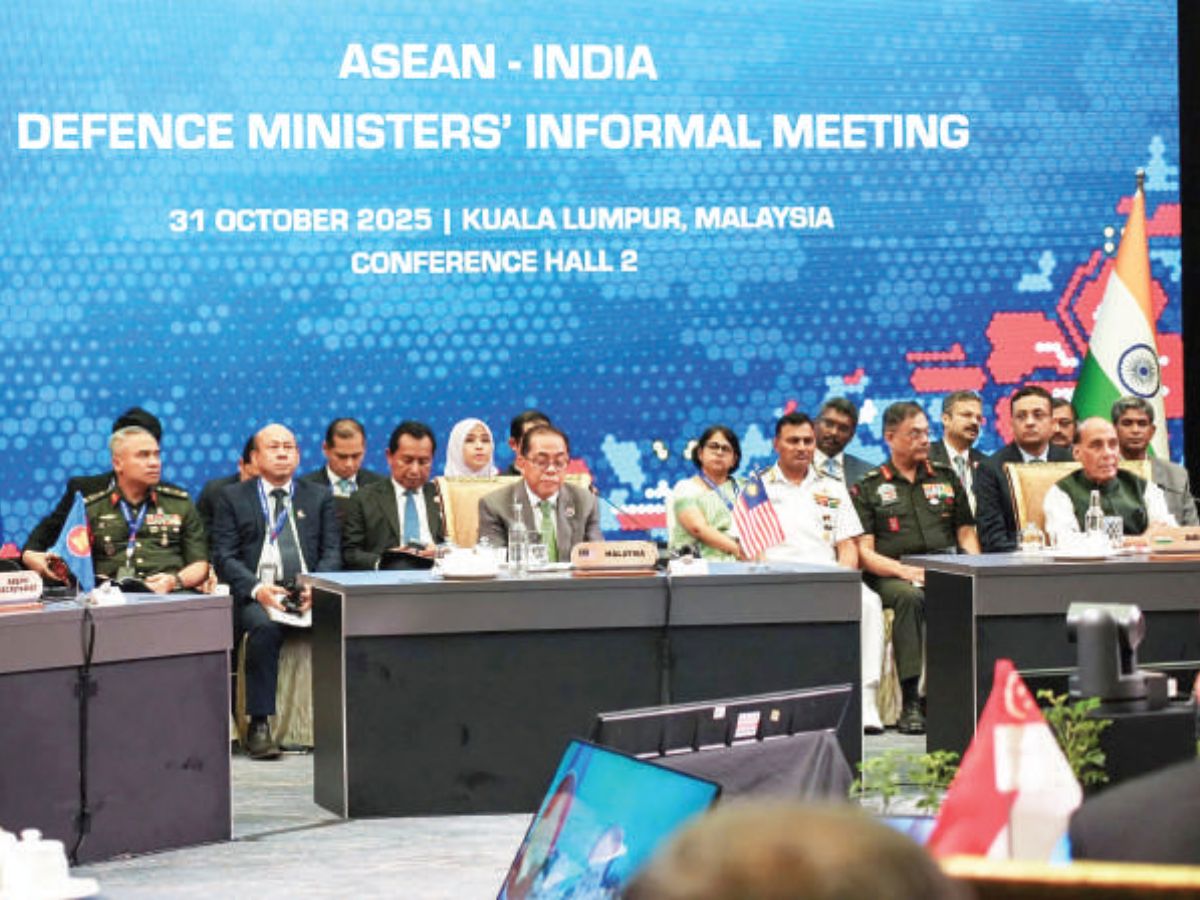
Defence Minister Rajnath Singh and Defence Minister of Malaysia, Dato’ Seri Mohamed Khaled Nordin chair the second India ASEAN Defence Ministers Informal Meeting, in Kuala Lumpur on Friday. (ANI)
A new phase of fragmented power consolidation is unfolding in the global order, catalysed by the United States’ tariff war with several European and middle powers — a trend distinctly reflected in the recent ASEAN Summit held from 26 to 28 October 2025 in Kuala Lumpur, Malaysia. The ASEAN member countries were upbeat in echoing their consensus and success, that highlighted their ever-growing internal activity. However, beneath optimism lies a quiet unease undercurrent— the sense that the global equilibrium is shifting faster than the region can adapt.
The political consolidation of Gen Z in Bangladesh and Nepal raises an alarm, as manipulation of certain political tools seemed rather easy with the uncertain outcomes. It offers neither stable governance nor a genuinely democratic or populist alternative, reflecting a broader reshuffling of established democracies often aimed at destabilising India’s neighbourhood. Such developments, widely viewed as externally influenced, have deepened public cynicism and global unease over the erosion of democratic autonomy. In this uncertain climate, the search for reliable and balanced partners has grown urgent — a role India increasingly seeks to fulfil.
Trump’s renewed tariff games, targeting friends and rivals, clearly indicate a more destabilised world order. The uncertainty in Bangladesh and the sudden shedding of bonhomie towards an unstable Pakistan also do not reflect the region’s political stability well. The evolution of the modern construct of the “Indo-Pacific” — once seen as a counterbalance to China’s rising influence and belligerence — does not seem to be gaining the traction it once promised.
In this context, Prime Minister Narendra Modi’s reaffirmation of ASEAN’s centrality in the Indo-Pacific assumes deeper meaning. His emphasis on ASEAN’s independent nature subtly signalled two things: first, that India views ASEAN not as a strategic pawn in a larger geopolitical chessboard, but as a partner with intrinsic value; and second, that ASEAN’s own cohesion, though often tested, remains the key to the region’s stability.
A Fragmented Consensus and the Uneasy Fraternity
By its very formation, ASEAN is an organisation that thrives on consensus — yet, in matters involving the “big bull” (read: China), this consensus often turns fragile. The bloc’s internal fragmentation is becoming increasingly visible. China’s growing belligerence in the South China Sea continues to sow disquiet among its members. While Vietnam and the Philippines press for a stronger collective stand, others, like Cambodia and Laos, appear reluctant to challenge Beijing. This defragmented outlook within ASEAN is perhaps its most significant challenge today.
At the same time, several ASEAN leaders are consciously seeking to rebalance their external partnerships. The Filipino President, Ferdinand “Bongbong” Marcos, at the 22nd ASEAN–India Summit, pressed for closer cooperation with India. Malaysian Prime Minister Anwar Ibrahim, too, described ASEAN–India relations as a “force for stability and mutual prosperity.” Such remarks are not mere diplomatic courtesies — they reflect a recalibration of trust, a recognition that India offers a stable, non-hegemonic alternative in a turbulent strategic environment.
India’s Rising Trust Factor
India’s gradual emergence as a trusted Southeast Asian partner is not accidental. Over the years, New Delhi’s engagement with the region has moved beyond rhetoric. The Act East Policy (AEP), far from being a cosmetic upgrade of the Look East Policy, is holistic in its design and intent. It engages ASEAN as part of a greater civilisational family bound by shared values, intertwined histories, and common objectives.
Recently, Indonesian commentator M. Waffa Kharisma, writing in The Hindustan Times (October 2025), described India and Indonesia as potential architects of a “Southern Consensus.” His argument — that cooperation between the two largest democracies in the region could build a development-oriented order grounded in fairness and inclusivity — captures a mood quietly reshaping the Indo-Pacific. It also mirrors the deeper spirit of India’s AEP: to build an ecosystem of cooperation, not competition; partnership, not patronage.
A Call of the Time
In the wake of intensifying U.S.–China rivalry and a tariff-driven fragmentation of global trade, the call to restore equilibrium through trust and inclusivity is unmistakable. India’s inclusive and measured diplomacy through forums like the East Asia Summit and BIMSTEC with its non-coercive developmental approach have been received well across ASEAN. Unlike the transactional overtures of major powers, India’s engagements are rooted in shared heritage, people-to-people linkages, and a developmental ethos that respects local autonomy.
China’s vast investments along its border with India and its growing military assertiveness in the Taiwan Strait and the South China Sea are reshaping power equations and unsettling smaller regional players. While Washington’s response oscillates between strategic ambiguity and protectionist nationalism, India’s quiet diplomacy offers a middle path that combines civilisational confidence with pragmatic restraint.
The United States and its allied groupings, increasingly inward-looking, are gradually losing moral legitimacy in the eyes of many in the Global South. What is emerging instead is a circle of trust built around India — a country that neither coerces nor colonises but connects with an inclusive approach. Even as India faces economic headwinds, including tariff pressures to destabilise its export-driven sectors, its commitment to regional stability remains steadfast.
Towards a Shared Future
Today, the global community is faced with challenges such as slow erosion of multilateral institutions and the rise of transactional and manipulative geopolitics. In such a scenario, ASEAN’s partnership with India is a stabilising pillar. The “ASEAN centrality” that India emphasizes upon is not merely a slogan but an acknowledgement that Southeast Asia’s choices and challenges must shape the regional future.
For ASEAN, engaging India more substantively is not just an option but a strategic necessity. For India, deepening its relationship with ASEAN nations not only opens prospects across a wide range of sectors in bilateral trade but also reinforces a shared civilizational belief in Asia’s ability to chart its own course. Hence, the moment calls for both sides to move beyond episodic summits and advance toward sustained collaboration in digital innovation, maritime security, education, and sustainable development.
In an age of fragmented power and fractured consensus, this partnership — anchored in trust, guided by shared civilizational ethos, and driven by collective destiny — can restore a semblance of order in a world adrift.
Gautam Kumar Jha, Centre for Chinese & Southeast Asian Studies, Jawaharlal Nehru University
Email: guatamkjha@jnu.ac.in
