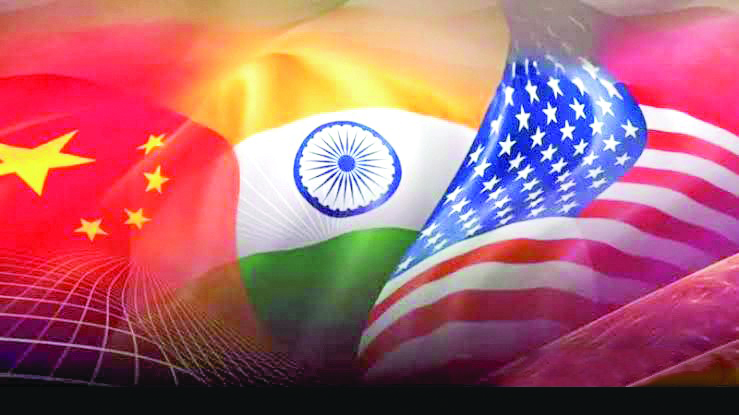
NEW DELHI: Great power relations are in a tailspin and the competition-cooperation balance is in a quandary. Stable multipolarity at this juncture seems distant, and the crisis for multilateralism is a daunting reality. The threat from China’s aggression and transgression has relegated to the background, with the sound and fury of Trump’s economic and security policies quite literally shaking and stirring international relations, in ways not seen hitherto.
It has merely been eight months since Trump entered the White House for his second term as the US President, but the avalanche of executive orders and policies that he has unilaterally pushed ahead, has every country on their toes and fastening their belts. While Trump’s foreign policy and national security team harped on how important the Indo-Pacific region is in US grand strategy and how significant regional partners are in “re-establishing deterrence” vis-a-vis China, Trump’s tariff salvos are making allies and partners question America’s resolve to put its skin in the game, and help them hedge against China’s coercive practices.
With President Trump giving scant executive attention to the strategic exigencies, and consumed by winning short term tariff battles, a region once central to US grand strategy, now seems a glaring blind spot. Speaking of the IndoPacific region, a country that through successive US presidencies in the last two decades has built a defining and multi-pronged partnership, is on the wrong side of Trump’s shenanigans and mercurial tendencies. In the midst of bureaucratic negotiations over a mine trade deal, acerbic comments from President Trump calling India “a dead economy” and big “tariff abuser” have touched raw nerves, and exacerbated calls for protecting India’s autonomy in the face of a bullying United States.
India-US bureaucratic wrangling over market access and intellectual property rights are nothing new and the World Trade Organisation (WTO) has been the platform for much elbowing between the two countries. However, with trade dispute settlement platforms like the WTO becoming increasingly redundant in Trump’s times, bilateral spat and that too, the use of the Truth Social platform for megaphone diplomacy has constrained the traction for behind door hard-nosed bargaining between the two economic partners.
When the India-US strategic partnership took birth under the lurking shadow of a rising China, intent on unilaterally remaking Asia in its own image, the strategic rationale overwhelmed differences over “nut and bolt” issues. The negotiation of the monumental civil nuclear agreement in 2008 has hardly resulted in any tangible nuclear commerce, but the habits of cooperation that the two complex democracies developed gave more ammunition to the budding strategic partnership. Starting in the second term of the George W. Bush presidency, the defence trade between the two countries have grown by leaps and bounds, resulting now in vision of co-development and co-production and in jointly managing the outcomes of Artificial Intelligence and new technologies.
Despite not being treaty allies and India insistent on practising autonomy, the level of interoperability achieved across the all the services between the armed forces has been formidable. From Asia-Pacific to the Indo-Pacific constructs, the strategic alignment, even if found wanting in several areas of mutual expectations, has rather been inspiring and forward looking. Therefore, is the current low in bilateral downturn, potent enough, to backpedal more than 20 years of persistent relationship building? As often quoted, the countries had learned to disagree without being disagreeable.
Have things taken a turn for the worse, wherein the details of the relationship have overwhelmed the broader picture of strategic congruence for a “free, open, inclusive and rules based” Indo-Pacific? India, aspiring for its own place under the sun in the international system would have to navigate the messy world of great power threat perceptions, responses and counter-responses. The Achilles heel of India-US partnership has been the differing priorities of threats in Delhi and Washington’s strategic calculus.
At what point India’s balancing act would have to pass through a stress test, and how wellequipped India is in walking this tightrope in times of heightened great power tensions has always been a moot point. The outbreak of the Russia-Ukraine war and the growing tragedy of the China-Russia-US dynamics injected a new dilemma for India. In America’s threat assessment, a new axis between China, Russia, North Korea and Iran is fast emerging to challenge US primacy in the international system.
Washington and Delhi have a relatively convergent lens to view the China threat, with the latter having to deal with persistent and heightening levels of Chinese territorial transgression even though both might employ different playbooks to derisk Beijing. While North Korea has largely been a non-issue in India-US relationship, the case of Russia and Iran present a different level of dilemma, with Delhi and Tehran sharing an amicable relationship and Russia’s importance in Delhi’s strategic viewpoint and more particularly as a defence partner being still formidable. Despite India going closer towards a strategic embrace with the US and the West in recent times, the notion of Russia as a time-tested friend of India, is more than a mere rhetoric and shared widely in the Indian public imagination.
Every time Washington, or any western county for that matter, overplays its hand on matters of Indian foreign policy and dons the bully suit trying to corner Delhi in uncomfortable corners, the voices who doubt a USIndia partnership become louder. From non-alignment to multi-alignment, India’s foreign policy traction or the lack of it has been largely shaped by the subterranean undercurrent of practising autonomy. While largely subsumed under idealist principles of an inclusive world order, India’s foreign policy prudence is also highly informed by a deeper understanding of realism, and both the extent and limitations of what its material capabilities can achieve.
Global responses and more particularly the American response to India’s actions during Operation Sindoor, also reflect the task ahead for Delhi beyond the optics of foreign official statements and diplomatic niceties. It requires a deeper introspection of the return of investments in strategic partnerships across the world, and building internal capabilities that will be germane in withstanding sudden jolts as well as the long trend structural challenges. There will be geopolitical forces that are beyond Delhi’s control that will shape and test India’s preparedness to deal with the tragedy of great power politics.
As powers, more materially capable than India, shape shifts in order to protect and promote their own respective interests, Delhi needs to take the long view of the shape of things to come, and build its own economic and military capabilities. That will be the greatest deterrence Delhi can build against threats that keep either erupting like active volcanoes and those that lie inactive and dormant but have the potential to shake up and question the direction of India’s foreign policy trends and orientations.
Monish Tourangbam is a Senior Research Consultant at the Chintan Research Foundation (CRF), New Delhi The Ministry of External Affairs (MEA) has welcomed the progress made at the Alaska Summit between the United States and Russia, highlighting India’s position of dialogue and diplomacy being the way forward as the world looks to see an early end to the conflict in Ukraine.
In a statement, MEA spokesperson said that India welcomes the Summit meeting between US President Donald Trump and Russian President Vladimir Putin and that their leadership in the pursuit of peace is highly commendable. It said that the way forward can only be through dialogue and diplomacy. “India welcomes the Summit meeting in Alaska between US President Donald Trump and Russian President Vladimir Putin. Their leadership in the pursuit of peace is highly commendable,” the statement said.
“India appreciates the progress made in the Summit. The way forward can only be through dialogue and diplomacy. The world wants to see an early end to the conflict in Ukraine,” it added. India has time and again emphasised that dialogue and diplomacy is the way forward. Prime Minister Narendra Modi’s message for peace, when he emphasised “this is not an era of war”.
