The India-EU FTA stares at complex geopolitics. It gives India a deep trade avenue amid tariff tantrums by the United States and diversify the supply chain dynamics, as both are looking to remove their dependency on China.
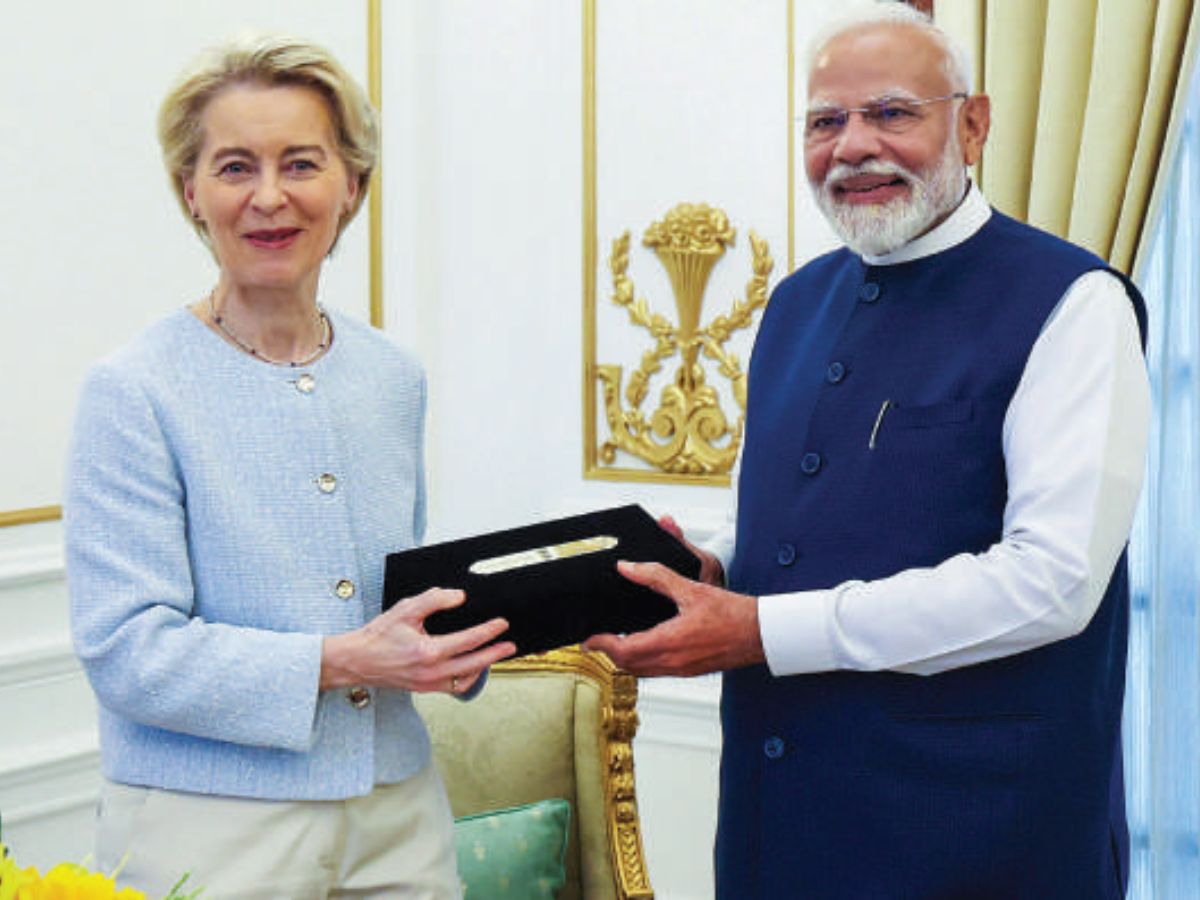
Representational image: PM Narendra Modi presents a memento to European Commission President Ursula von der Leyen, at Hyderabad House in New Delhi on February 28. ANI
The initial years of Cold War saw blocs, alliances and pacts. The 70s and 80s saw treaties and conventions taking shape. The 90s saw frameworks and protocols. Agreements, partnerships and “deals” are in vogue now. Is lexicon dictating the course of geopolitics?
An economic “blitzkrieg” could be in the offing. The German Chancellor’s visit earlier this month, strained transatlantic relations, trade and tariff sparring, the Greenland imbroglio, low growth rate and rapidly changing demographics of Europe, China dependence metrics, protracted Ukraine war effort with its imbalanced funding are a reality. A dire access to a large market, growing rapidly with democratic credentials and a huge military muscle brings India to the centre stage. With the first ongoing global reset after WW II, it looks like the geopolitical movie script of the century.
The negotiations for a Free Trade Agreement (FTA) between India and the EU began in 2007. Multiple rounds of negotiations were held from 2007 to 2013, but disagreements came up over market access, intellectual property rights, labour standards and sustainable development. In 2013, the negotiations were suspended due to disagreements over tariffs on automobiles, wine, spirits, data security for Indian IT firms and public procurement. Efforts were made to revive the negotiations, but there was scant progress. On 17 June 2022, the EU relaunched negotiations with India for an FTA and launched separate negotiations for an Investment Protection Agreement and an Agreement on Geographical Indications (GIs). India and the EU are now close to finalising the agreement. Ursula von der Leyen, President of the European Commission, on 19 January, while speaking at the World Economic Forum at Davos called it the “Mother of all deals”. One that would create a market of two billion people, accounting for almost a quarter of global GDP. Numerically, it will be the 19th trade deal for India. A formal announcement is expected at the India-EU Summit on January 27, 2026. The trade deal could cut tariffs between India and EU to about 90% while providing offset to current tariffs imposed by Trump. It will also render a first mover advantage for EU to the Indian market in the increasingly fragmented global economy.
President of European Council, Antonio Costa, and President of the European Commission, Ursula von der Leyen, will be the Chief Guests for the Republic Day Parade on 26 Jan 2026. Economics and security are two sides of the same coin, irrefutably.
India’s bilateral trade with the EU was $136.53 billion in 2024-25, in which exports were worth $75.85 billion, and imports were $60.68 billion, making it the largest trading partner for goods. The EU market accounts for about 17% of India’s total exports, and the bloc’s exports to India constitute 9% of its total overseas shipments. In 2023-24, India exported $76 billion in goods and $30 billion in services to the EU, while the EU exported $61.5 billion in goods and $23 billion in services to India.
India’s major exports to the EU are petroleum products such as diesel and ATF (Aviation Turbine Fuel), electronics including smartphones, textiles, machinery and computers, organic chemicals, iron and steel, gems and jewellery, pharmaceuticals, and auto parts. The EU countries export machinery, computers, electronics to include integrated circuits, aircraft, medical devices, scientific instruments, rough diamonds, organic chemicals, plastics, steel, cars, and automotive parts.
Statistically, India’s cumulative FDI (Foreign Direct Investment) inflows from the EU from April 2000 to September 2024 were $117.4 billion. FDI from the EU represented 16.6% of the cumulative amount of FDI equity inflow from all countries, which stood at $708.6 billion. According to GTRI (Global Trade Research Institute), India’s FDI outflows to the EU were valued at about $40.04 billion from April 2000 to March 2024.
The FTA between India and the EU stares at complex geopolitics. It gives India a deep trade avenue amid tariff tantrums by the United States and diversify the supply chain dynamics, as both are looking to remove their dependency on China. The FDI could also increase from the EU to India as there are over 6,000 EU firms present in India, doing some cutting edge work in technology as well as manufacturing segments. The FTA will enable India, and the EU can cooperate in the field of artificial intelligence and semiconductors, which will be the building blocks for myriad technological applications of the future.
Security and defence is one of the areas where cooperation could be enhanced by this enabling agreement. India is a large importer of weapon systems, besides being a formidable exporter in the recent past. Joint ventures in cutting edge technologies and import of weapon systems to tide over present voids while catering to dynamic force restructuring is likely to augment capabilities of India and capacities of the EU.
There are some points of friction, such as the protection of domestic companies of wine, spirits and automobiles by the Indian government. The EU’s Carbon Border Adjustment Mechanism (CBAM) has the objective of reducing carbon emissions, but CBAM imposes a carbon price on imported goods, introducing non-tariff costs related to emissions reporting and compliance. The removal of GSP (Generalised Scheme of Preferences) is likely to affect India’s exports to the EU. GTRI has commented on this aspect that it will impact India as it would have to pay a higher import tariff due to the suspension of GSP benefits. The points of discord can however be ironed out for a larger gain and shared future.
Technology, security and geopolitics are deeply intertwined. The recent signatories of Board of Peace agreement have been a stark reminder of the changes, which are quiet in nature but loud in dimension. It did not have any known European powers of EU and importantly NATO as signatories. In the present circumstances, the four T’s—Trade, Trunk infrastructure, Talent and available Technological expertise—are in India’s favour, which provide an opportunity to EU for diversifying the supply chains and relocation of critical technology. This can be a harbinger of future collaborations and loftier bar charts of trade, which have the power to shape the technological future and seamless trade mechanism of the world.
It also seems that lately some economic visionaries all over the world have realised that “If you don’t have a seat at the table, you’re probably on the menu.” Strategic autonomy is not sitting on the fence—it is long term insurance.
Anurag Awasthi is a veteran, and CEO of Escape Velocity Mediaworks. He is a known policy expert and a columnist who writes extensively on critical technologies, security and geopolitics. Views are personal.
