
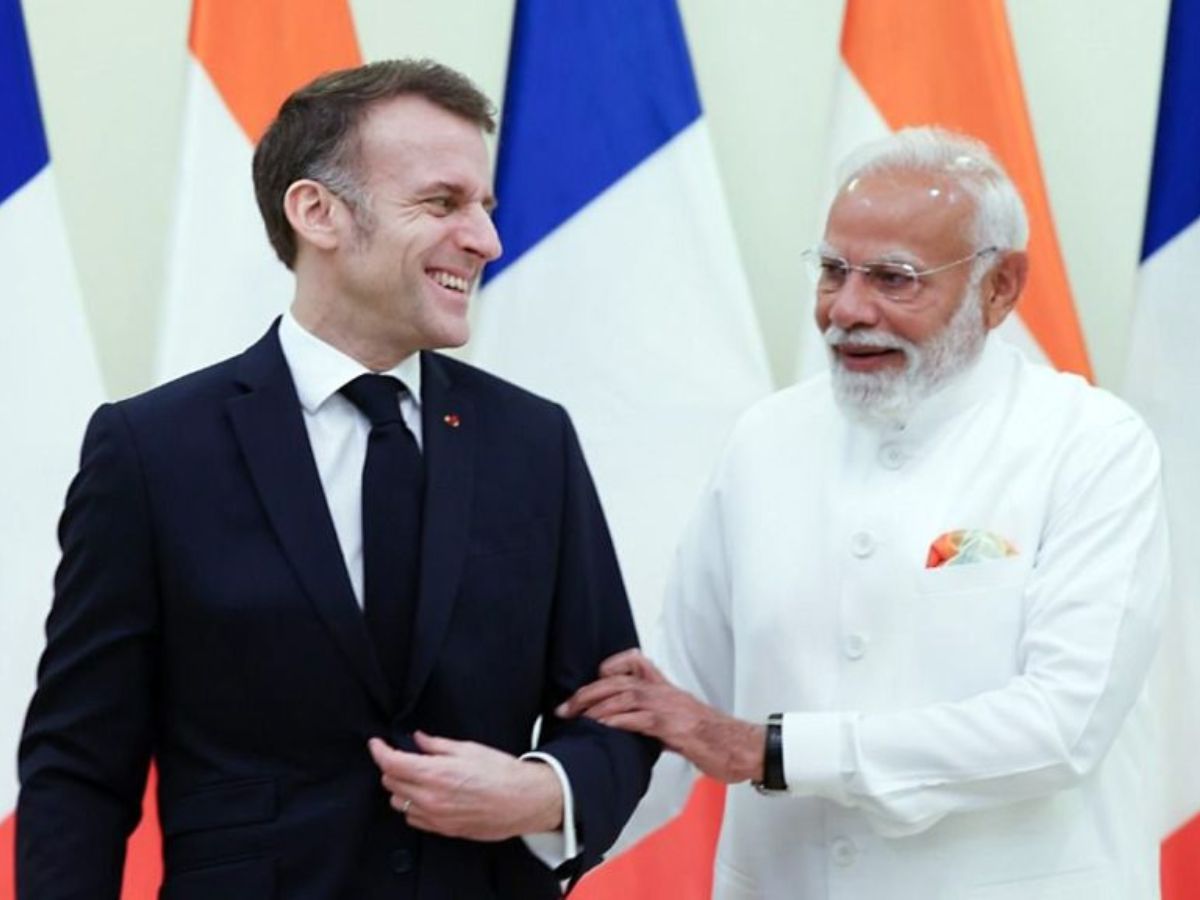
As the French President Macron’s three-day sojourn to India concludes, there are several key takeaways from the visit about ways to further broaden and deepen their bilateral cooperation and also to collaborate on key issues and agendas plaguing the global community. The starting point is the elevation of their strategic partnership to “Special Global Strategic Partnership”. In this era of unpredictable global dynamics, this partnership will provide global stability and progress.
India-France relations have become stronger and more resilient in the past decades, and their cooperation has been further accelerated because of three broad events. Firstly, the recent geopolitical tectonic shifts, thanks to the unilateralist approach of the US under President Trump, the conflict in Russia, Gaza and possible areas of contestations in Iran, and over Taiwan and South China Sea, which could further cripple the global order into chaos and uncertainty. President Macron said the shift came in response to the “changing international order”, adding that both countries did not want to “be subjected to any form of hegemony” or the “conflict of a few”. Both India and France treasure their strategic autonomy where both nations do not back an international system of “overlord to vassal”.
Secondly, AI leaping ahead and disrupting all existing infrastructure. Therein cooperation between India and France is becoming critical. President Macron participated in the AI Impact Summit 2026 in New Delhi, where he praised India’s digital rise, highlighting digital transactions and inclusive digital ID system. He called AI a force for responsible innovation, urged banning social media for under-15s, and backed sovereign AI cooperation, something that is also echoed by India.
Thirdly, leveraging and learning from each other’s digital infrastructure and entrepreneurial ecosystems, thereby driving innovation and growth. India and France can pool in their skill-sets to scale up not only for themselves but for global good. In this context, both leaders acknowledged the importance of advancing scientific knowledge, research and innovation, and the long and enduring engagement between India and France in these areas, and jointly inaugurated the 2026 India-France Year of Innovation. This year will feature a series of high-impact collaborations in India and France, spanning diverse sectors such as innovation, science and technology, cyberspace, healthcare, sustainable development among others.
This is a departure from the cooperation between India and France that overwhelmingly focuses on the troika of defence and security, civil nuclear energy and space and aviation sector. Where the former was at the receiving end in terms of its needs, with the latter benefiting from its technological prowess and commercial opportunity for its economy and industries. To broaden and diversify their areas of cooperation, India and France are exploring mechanisms and multiple avenues of collaborations, such that the partnership evolves and shifts from a “transactional to more of a transformational relationship” between the two.
Nonetheless, defence and trade remain key pillars of present and future collaborations. Both leaders virtually inaugurated the assembly line of Airbus H125 helicopters. The production of HAMMER missiles in India was announced. Just last week India’s Defence Acquisition Council approved the purchase 114 Rafale fighter jets from Dassault, one of the largest defence deals done by India to date. Both sides concluded the Security and Defence Partnership, which will contribute to the strategic autonomy of the EU and India, and will provide a framework for in-depth exchanges and cooperation on common security challenges such as maritime security, cybersecurity, hybrid threats, space and counterterrorism, and for promoting mutually beneficial defence industrial collaboration.
Another development was the Memorandum of Understanding between Adani Ports and Special Economic Zone Ltd (APSEZ)—the largest commercial ports operator in India and the Port of Marseille Fos, one of Europe’s largest integrated multi modal port ecosystems and Mediterranean’s premier gateway. The objective is to deepen cooperation on trade facilitation, port innovation, and energy transition. This partnership is critical as it strengthens coordination among key ports along the “India Middle East Europe Economic Corridor” (IMEC) route, reinforcing connectivity between India and the Europe. With the recently concluded negotiations of India-EU FTA, trade between the participating countries is expected to grow manifold.
The relationship is also expanding in the field of academic and cultural linkages. Approximately 10,000 Indian students chose to pursue higher education in France, the aim is to triple this number in the next 4-5 years. France has signalled its openness to relax visa and mobility norms for Indians, this will enhance people to people connect and strengthen cultural and social ties between the two nations, especially boosting tourism and air connectivity further.
The French President’s visit to India provides a boost to multifaceted and all-weather friendly ties between India and France, from deepening progress on the Horizon 2047 goals with more than 20 outcomes to pioneering AI for humanity, inclusive growth and a sustainable future. As Macron suggested, Delhi and Paris “know no boundaries” and that it “can reach from the deep oceans to the tallest mountains”.
India and France relations are not just complementary by nature, but more so are compatible by choice. With convergence of strategies, visions and ideas between the two vibrant democracies, it will not only benefit their bilateral relations but will have greater and favourable consequences for the future of the global order.
-
Dr Mohit Anand is Professor of International Business and Strategy at EMLYON Business School, France. Rajesh Mehta is an International Affairs expert working on innovation & public policy.




