
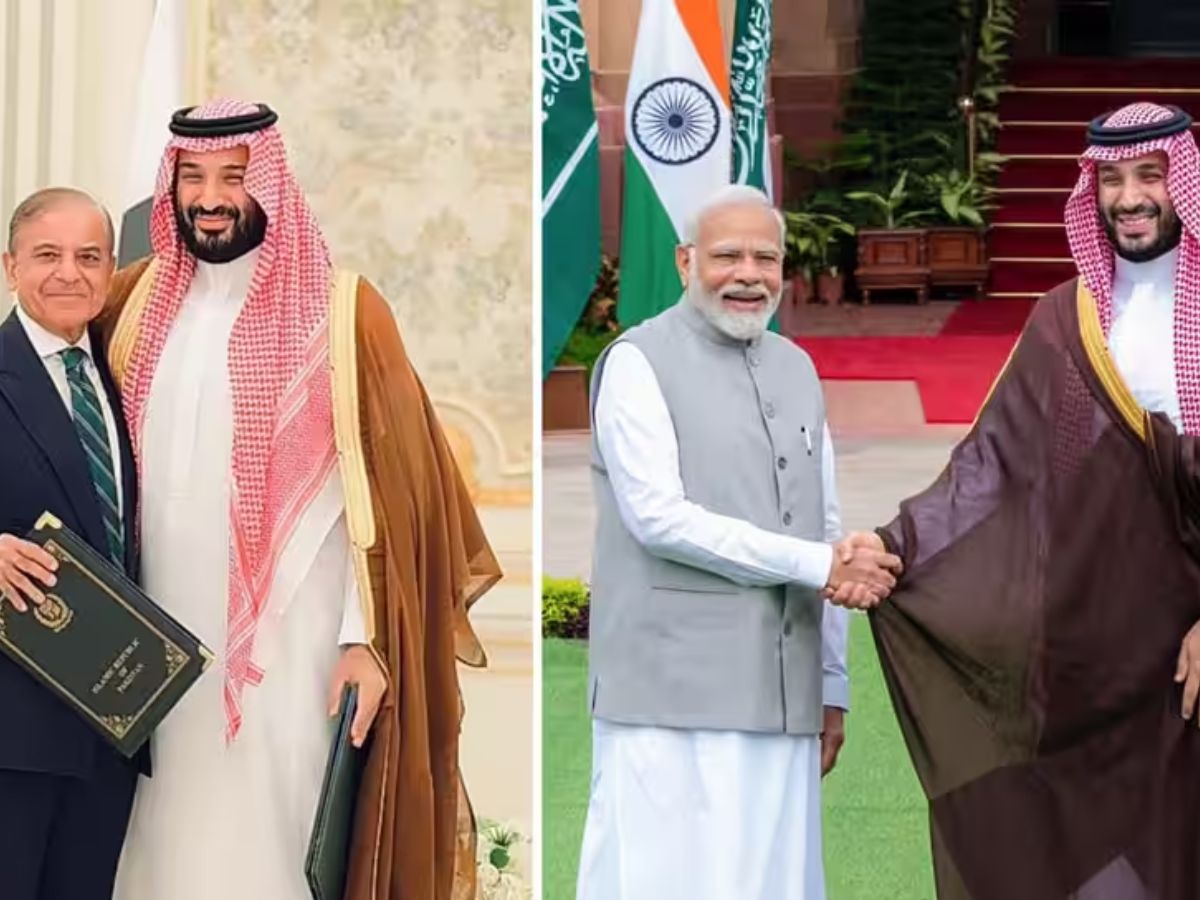
New Delhi: On 17 September, Pakistani Prime Minister Shehbaz Sharif signed a “strategic mutual defence agreement with Saudi Crown Prince Mohammed bin Salman” (SMDA). The ceremony at the Royal Court in Al-Yamamah Palace in Riyadh was witnessed by senior officials from Saudi Arabia, alongside representatives from Pakistan including the Army Chief Field Marshal Asim Munir.
To quote the joint statement: “This agreement, which reflects the shared commitment of both nations to enhance their security and to achieve security and peace in the region and the world, aims to develop aspects of defence cooperation between the two countries and strengthen joint deterrence against any aggression.” The deal comes at a critical moment. Regional politics have been upended by two years of Israeli aggression including its war on Gaza and strikes on neighbouring states capped by last week’s Israeli attack on Doha, Qatar’s capital, which borders Saudi Arabia. In the Indian context it has been signed soon after Operation Sindoor.
Describing the deal as the culmination of “years of discussions,” a senior Saudi said that “this is not a response to specific countries or specific events but an institutionalisation of longstanding and deep cooperation between our two countries.” “This is a comprehensive defensive agreement that encompasses all military means”, while declining to specify if it includes Pakistan’s nuclear arsenal.
PAK-SAUDI MILITARY RELATIONS
The agreement builds on nearly eight decades of close partnership between the two nations, rooted in shared Islamic heritage and long-standing defence cooperation. Saudi Arabia was one of the first countries to recognise Pakistan after its independence. In 1951, the two nations signed a “Treaty of Friendship,” laying the foundation for decades of strategic, political, military, and economic cooperation.
Pakistani troops went to Saudi Arabia in the late 1960s amid concerns about Egypt’s war in Yemen at the time. The military cooperation deepened after the 1979 Grand Mosque seizure in Mecca, when Pakistan’s Special Forces helped Saudi troops.
In 1982, the two sides institutionalised security ties through a Bilateral Security Cooperation Agreement further cemented this cooperation by ensuring the “deputation of Pakistan Armed Forces personnel and military training” in Saudi Arabia. According to reports, over 8,000 Saudis have been trained by Pakistan since 1967.
Brigadier Feroz Hassan Khan, in his book “Eating Grass: The Making of the Pakistani Bomb,” said Saudi Arabia provided “generous financial support to Pakistan that enabled the nuclear programme to continue, especially when the country was under sanctions.” But the pact comes at a time when the Middle East’s geopolitical chessboard is in flux. Saudi Arabia has two primary adversaries Iran and Israel and relies on the US for its security needs. However, the fallout from Israel’s war on Gaza and its strikes on regional neighbours has made Gulf states uneasy, as America remains Israel’s closest ally.
Incidentally, Qatar which was attacked by Israel on 09 September for hosting Hamas leaders, serves as the forward headquarters for US Central Command. Apparently, approximately 40,000–50,000 US troops are stationed across the Middle East, deployed in large bases and smaller forward sites including Prince Sultan Air Base outside Riyadh.
While the deal is being viewed as a landmark moment in the decades-old alliance between the two nations whose ties stretch back nearly eight decades. But Zalmay Khalilzad, a former US diplomat with long experience in Afghanistan and Pakistan, expressed concern over the deal, saying it comes in “dangerous times.”
“Pakistan has nuclear weapons and delivery systems that can hit targets across the Middle East, including Israel. It also is developing systems that can reach targets in the US” Khalilzad wrote on X.
AGREEMENT STRENGTHENS RELATIONS
Pakistan’s Ministry of Foreign Affairs said the agreement with Saudi Arabia reflects the “shared commitment” of both nations to strengthen security and promote regional peace, while also pledging to “strengthen joint deterrence against any aggression”. However, the clause to strengthen defence cooperation and joint deterrence across various military and defensive means is important. “The agreement states that any aggression against either country shall be considered an aggression against both”. This NATO style wording will be viewed in Islamabad as a major diplomatic victory.
In his 2024 book “War”, American journalist Bob Woodward recounted a conversation in which Saudi Crown Prince Mohammed reportedly told US Senator Lindsey Graham that Riyadh planned to enrich uranium only for energy purposes. When Graham expressed concern about the prospect of a Saudi bomb, Woodward wrote, Salman replied: “I don’t need uranium to make a bomb. I will just buy one from Pakistan.” However, the clarity about the ambit of the agreement signed between Pakistan and Saudi Arabia with regard to nuclear weapons remains unclear. Husain Haqqani, former Pakistan Ambassador to the US, posted on X, “Most likely, Pakistan will now be able to buy US weapons it needs, with Saudi money, which Trump administration seems willing to sell.”
IMPLICATIONS FOR INDIA
While the deal appears to be aimed at Israel, Yemen and Iran, it has implications and consequences for India. The present state of Indo-Pak relations necessitates that Pakistan entering into a formal defence pact with another country could affect India’s security, diplomatic, and foreign policy calculus and external backing could also lower Pakistan’s threshold for confrontation.
The Agreement could rebalance the Pakistan-Saudi relationship, which in recent years has been defined by Saudi financial bailouts for a struggling Pakistani economy, even as Saudi Arabia and India have got closer in recent years. The question remains as to whether Saudi Arabia has committed itself to Pakistan’s disputes with India, and potentially with the Taliban-led Afghanistan.
No wonder, MEA spokesperson Randhir Jaiswal said, “We will study the implications of this development for our national security as well as for regional and global stability. The government remains committed to protecting India’s national interests and ensuring comprehensive national security in all domains”.
While there are many unanswered questions regarding the pact specifically regarding what it does or does not cover, including deterrence, resource commitment, operational details, but that does not diminish the significance of this pact. The India-Middle East-Europe Economic Corridor, which passes through Saudi Arabia, could also now face headwinds, as the defence pact with Pakistan complicates India’s efforts to deepen strategic and economic ties with the kingdom.
But it seems that the pact is likely to have a limited role as India is a close business partner of Saudi Arabia, which has invested billions of dollars and plans to invest more than $100 billion in five years. In fact, Saudi Arabia is India’s fourth-largest trading partner, while India ranks as the Riyadh’s second-largest partner. The annual trade in 2024–25 reached USD 42.98 billion whereas trade between Saudi Arabia and Pakistan is much smaller, at about USD 3–4 billion. India is also one of the biggest importers of Saudi oil. This makes it unlikely that Riyadh would take steps that might not be in India’s interests.
A senior Saudi official, who spoke on condition of anonymity, said “Our relationship with India is more robust than it has ever been. We will continue to grow this relationship and seek to contribute to regional peace whichever way we can.”
In the immediate term, this agreement will consolidate and formalise multipronged defence cooperation already under way, and new avenues to expand it via joint trainings, defence production and potential expansion of Pakistani troops contingent in Saudi Arabia. The political and defence coordination between the two sides will deepen, while strengthening respective military capabilities of both countries.
For India, the agreement has strategic implications which are concerning. Pakistan is India’s main security rival, armed with nuclear weapons. Hence this pact with Saudi Arabia gives Pakistan political backing and financial cover, that could embolden it to escalate tensions.




