Prasenjit Basu’s book is an inversion of cliched mainstream thinking dominated by Western historians and left-leaning Indian academics.
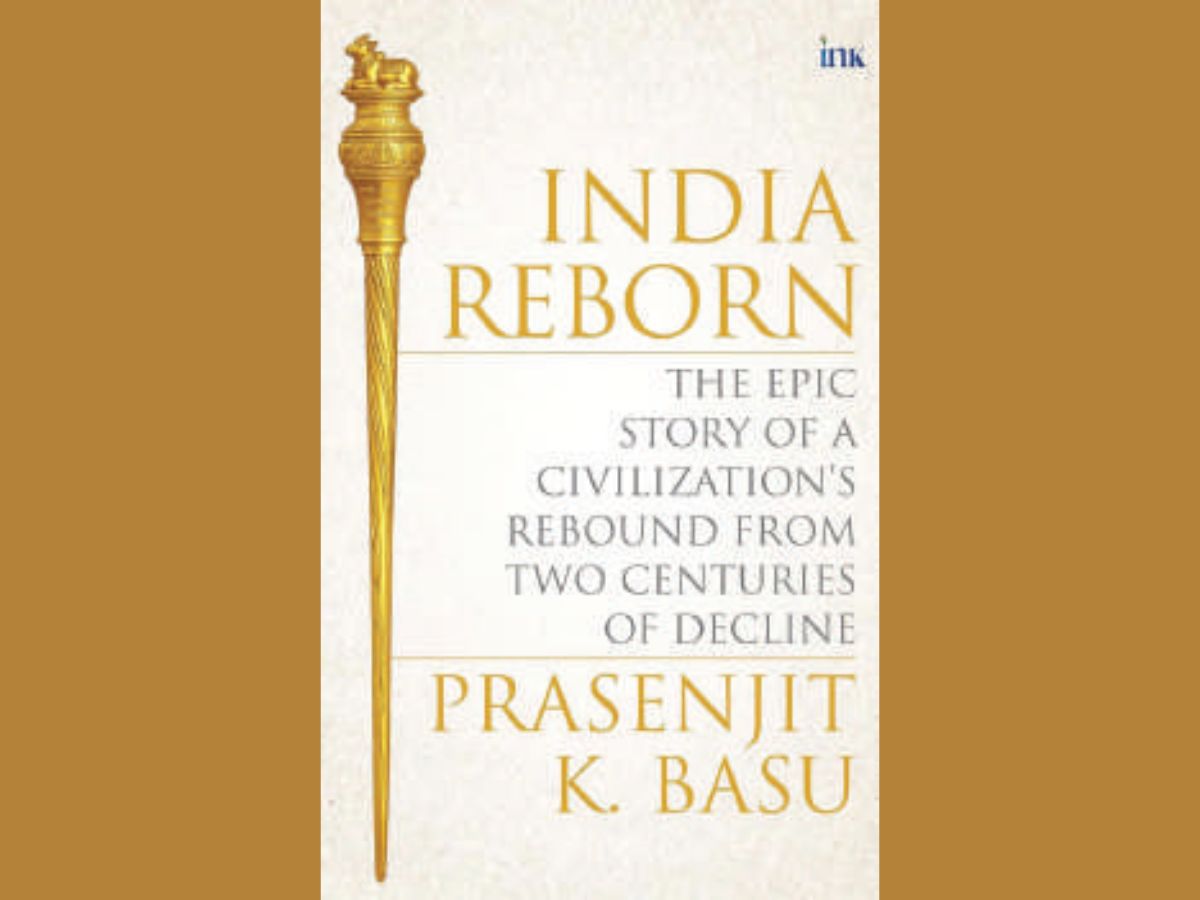
Book: India Reborn: The Epic Story of a Civilization’s Rebound from Two Centuries of Decline Author: Prasenjit K. Basu Page. 442 Publisher: Bluone Ink
Hong Kong: At a dinner party a year ago, an American friend asked me to recommend one definitive book to learn about India. I murmured something about picking up a book by Shashi Tharoor. There really was no easy answer, no accessible treatment either for the novice, or the expert. Now there is. Another St. Stephen’s alumnus, Prasenjit Basu (and like Tharoor, a stalwart of the college’s Shakespeare Society, playing Thersites and Falstaff with aplomb), has done the deed. With “India Reborn”, a follow up to his masterly “Asia Reborn”, Basu has written a magisterial, provocative, deeply researched and inspirational guide to India—its history and its future. Buy it. And read it. Wherever you place yourself on the spectrum of knowledge on India—dilettante to expert—you will walk away satiated, entertained, and educated.
First, and most important, “India Reborn” is a potent destroyer of consensus historical narratives. The Russians have an interesting epigram: “The future is certain; it is the past which is unpredictable.” History is written by the victors, and those who finance its writing. “India Reborn” is an inversion of cliched mainstream thinking dominated by Western historians and left-leaning Indian academics.
Second, the Venn diagram for the intersection of economists and historians normally yields an uninhabited desert. Basu is one of the exceptions, a trained economist who began his long career as an economist at Wharton Econometrics, founded by Nobel Laureate Lawrence Klein. And he knows his history too. Mixing the two disciplines is not easy—Basu does it with verve.
Third, Basu is an expert on wider Asia and emerging markets, his professional focus for the past 30 years. Putting India in the wider Asian and global context is a key strength of this book. Much like William Dalrymple’s latest “Golden Road”, Basu can tell tales of India’s linkages with, and contributions to East Asia, China and West Asia with panache, and depth.
Fourth, you will meet a multitude of fascinating characters—many of whom you’ve never heard of. For those you do know, Basu meticulously uncovers foibles, frailty, bravura, and treachery all in good measure. Try this list as a starter—all deeply connected to the Indian story and deserving their own mini-books: Thomas Pitt, Elihu Yale, Tarabai Mohite, James Skinner, Baji Rao, Baija Bai Shinde, Madan Lal Dhingra, Pandurang Khankoje, Jatin Mukherjee, Governor Evan Jenkins, M.N. Roy, Rash Behari Bose, Sikandar Hayat Khan, V.P. Menon…
Fifth, the book emphasises military strength and the primacy of security policy considerations as key rationales for historical events unfolding the way they did—including the timing of Indian independence/partition and the current geography of Pakistan. This aspect normally gets short shrift in popular discourse in India. Given the current geopolitical challenges India faces, getting security policy right, and understanding its key role in Indian history, is paramount. Basu places non-violence as a sidelight among India’s national objectives.
So what are the highlights of this 442-page tome? For me, there are five. The first is just how influential ancient India was to east Asia and China, and how India’s contributions to science, culture, art and religion were simply breathtaking, yet under-appreciated by the most recent colonizers—the British. And just how massive its economy was. For most of recorded history until 1700, India was the largest economy in the world, when it was 25% of the total global economy. Just after the time the British were done with India (and vice versa) in 1950, it was a paltry 4.2%.
Second, as we know from 1200 AD to 1947, large parts of India were under foreign rule. The Turks, Persians, Afghans, Uzbeks (Mughals), the British among various European powers that came, saw, and conquered. Basu gamely points out various areas of India that were independent, fought the good fight, and highlights the continuity of Indian culture through these centuries. He talks about the magical Nalanda University (burned to the ground), Somnath Temple (destroyed), the depredations of Nadir Shah and Ahmad Shah Durrani, the piracy/loot of the Dutch/British. Nonetheless, the “sedentary civilisation”, the largest economy in the world for most of recorded history, the fount of science and culture, clearly lacked something if it, or most of its constituent parts, could not defend itself. Unlike ancient Persia, Greece and Egypt, Basu shows that Indic civilization never vanished—contracting, but surviving to fight back.
Third, the Indian power that did resist—both the Mughals and the British—was the Marathas. While most Indians know of the heroism of Shivaji, the sheer magnitude of the Maratha Confederacy, who between 1715 and 1818 dominated most of India is relatively unknown, outside of Maharashtra and among history buffs. Characters like Queen Tarabai Mohite, who worsted Aurangzeb, Admiral Kanhoji Angre, and Peshwa Baji Rao I, who fought 38 battles and won them all, are lesser known heroes that Basu covers with detail and insight.
Fourth, independent India’s first PM, Jawaharlal Nehru comes in for trenchant criticism. While hindsight is a convenient tool, Basu’s critiques of Nehru deserve attention. The litany is distressing for any Indian patriot, and bewildering. Among Nehru’s transgressions: He annoyed Jinnah (in perpetuity) by not forming a coalition with the Muslim League in the United Provinces after the 1937 elections; showed up in Assam in 1943 to personally oppose “Mr. Subhas Bose” who was leading the INA against the British; focused on the Spanish civil war in 1936-38 rather than on governance in India after those 1937 elections; was ignorant of the US stance on an undivided and independent India; practised nepotism in his foreign policy; capitulated on a British demand for a referendum in NWFP, run by ally Dr Khan Sahib of the Frontier Congress who opposed joining Pakistan; and allowed the Sterling Balances that Britain owed India for wartime purchases to be frittered away in paying British pensioners, military supplies and imports. If that were not enough, add the failures of Nehruvian socialism, and India’s military defeat by China in 1962. A non-Nehru counter-factual history would be fascinating.
Fifth, Subhas Bose was the true hero of Indian Independence. Basu devotes an entire coruscating chapter to Bose’s contributions. In his view, it was the military option, the INA led by Subhas Bose that credibly challenged British military supremacy. The famous INA trials of three Punjabi officers—Dhillon, Shahnawaz and Sahgal—electrified the nation in patriotic fervour, igniting mutinies in the Navy and Air Force. Once Field Marshall Auchinleck concluded he could no longer rely on the loyalty of the Indian soldier, it was game over for the British. Within weeks, the hasty, abominably discombobulated path to partition and independence was laid out. Basu asserts, quite convincingly, that the creation of Pakistan, and the inclusion of Balochistan and the NWFP in it were key British objectives, driven by military and security considerations. Why? To get a reliable military ally in Pakistan to influence British oil interests in Iran and Iraq, and to watch the new, emerging nemesis—the Soviet Union—from up close.
What are my quibbles? Basu could have spent more time on analysing why a large economy like India was conquered for most of the past millennium. More work on V.P. Menon—the hero of integrating the princely states into India post 1947—would have been useful. Calling the Mughals “Timurids”, while correct, was annoying. Repeatedly calling Muslim League violence “terrorism” was unnecessary and needlessly provocative. Overall, this is a book that should be read by anyone curious about India. I’m sending a copy to the American friend who wanted the definitive book on the Indian story.
Ajay Kapur was global equity strategist for Citigroup, and global emerging markets strategist for Bank of America Merrill Lynch.
