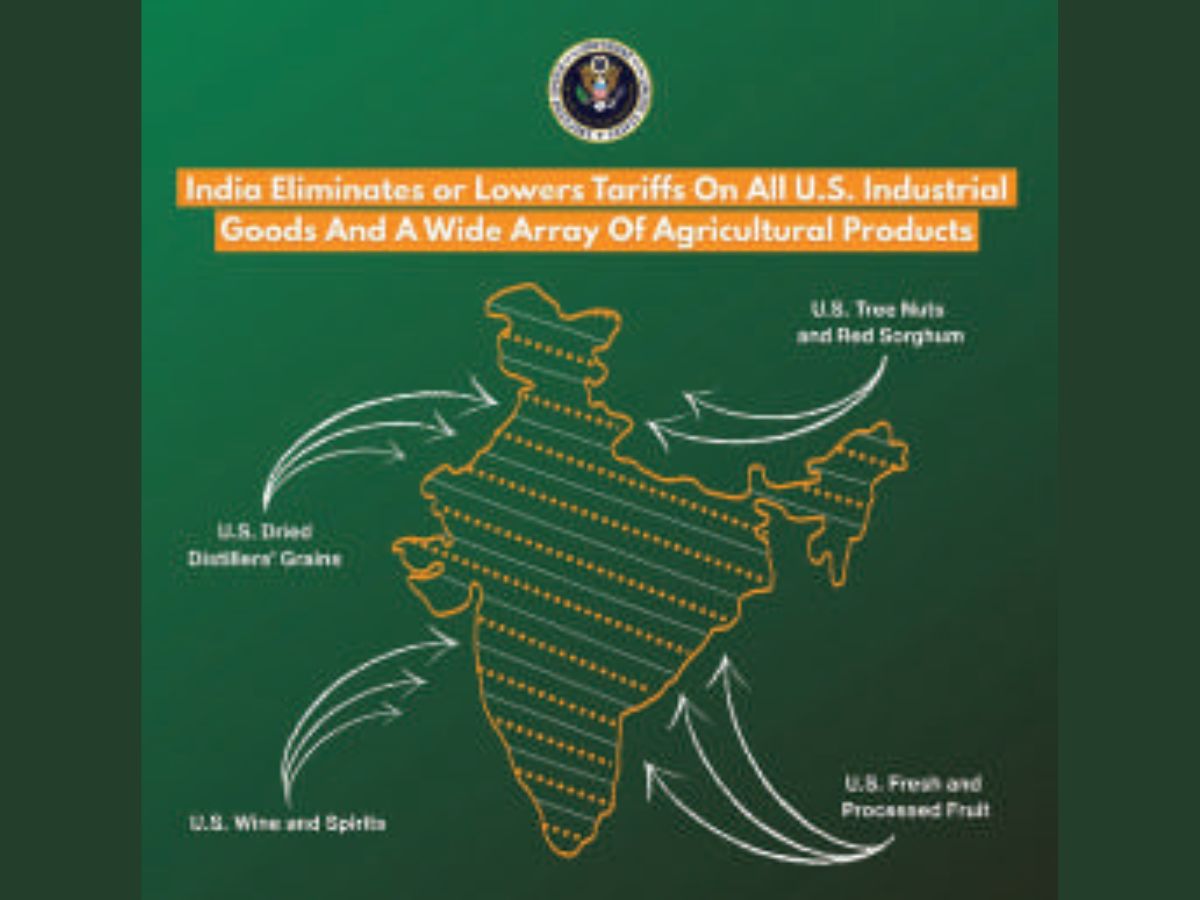
The US Trade Representative’s Office used this image of India’s map, showing PoK as part of India.
The interim trade framework between the United States and India, along with the February 6 executive order removing Russia-linked tariffs on Indian imports, is set to reshape Pakistan’s strategic position in the region.
Taken together, the two developments have established a consolidated model of US engagement in South Asia. Market access, tariff treatment, supply-chain integration, technology cooperation, energy procurement and defence alignment will now be treated as interlinked components of a single policy framework, with India positioned firmly at its centre.
By hard-wiring India into a US-led technology and supply-chain ecosystem, Washington has effectively completed the de-hyphenation of India and Pakistan.
Under the framework, India will face a reciprocal tariff rate of 18 percent on its exports to the United States, as explicitly stated in the joint declaration. Separately, the executive order has removed the additional 25 percent ad valorem duty earlier imposed on Indian goods linked to Russian oil imports, following US findings that India had committed to halt such imports, increase purchases of US energy, and expand defence cooperation. Pakistan, in contrast, remains subject to a 19 percent reciprocal tariff under the general US tariff regime. Beyond tariffs, the framework concentrates US economic and strategic engagement squarely around India. Rules of origin have been structured to ensure that benefits accrue “predominately” to the United States and India, limiting the use of third-country inputs. Standards and conformity assessment discussions have also been aligned with US-developed or international norms. High-value sectors, including advanced machinery, aircraft parts and datacentre-related technology, have been explicitly prioritised. These design choices are expected to shape investment and supply-chain decisions in India’s favour.
For Pakistan, the impact is being viewed as cumulative rather than immediate. As supply chains, standards and technology cooperation gravitate toward India, South Asia’s economic centre of gravity is likely to shift. Firms seeking access to US-aligned markets and regulatory regimes will now have stronger incentives to locate production and investment in India, reinforcing Pakistan’s existing exclusion from Western supply chains. The shift is also expected to affect Pakistan’s position relative to China. As India reduces its reliance on Russian energy and integrates more deeply into US-aligned supply chains and technology ecosystems, China’s regional economic engagement will need to adjust accordingly. Pakistan’s dependence on Chinese capital and financing is projected to deepen, while its ability to diversify partnerships or negotiate leverage is likely to decline.
Over time, these changes are set to alter regional hierarchies. Capital flows, technology access, standards adoption and strategic attention in South Asia are expected to become increasingly India-centric. While Pakistan has not been directly penalised by the US–India framework, it has been indirectly constrained by the reallocation of access, incentives and strategic priority elsewhere.
