India’s silent sentinels beneath and above the waves ensure that the Indian Ocean remains secure, stable, and firmly within the orbit of regional equilibrium.
Mumbai: In the 21st century, the Indian Ocean Region (IOR) has emerged as a theatre of strategic contestations, particularly beneath the waves. At the epicentre, the submarine warfare between giants like India and China is gradually taking place, though still in the developing stage.
DRAGON’S GROWING UNDERSEA CLAWS IN OUR BACKYARD
In this race towards technological advancements, the People’s Liberation Army (Navy) or PLAN has been making steady advancements, without keeping itself confined to Pacific politics, one of which China is geographically a part of. However, its continual deployments of the modern nuclear-powered attack submarines (SSNs) like Shang-class and ballistic missile submarines (SSBNs) like Jin-class in the IOR have been creating areas of concern for New Delhi, considering China’s notorious actions displayed with regard to the South China Sea and the West Philippine Sea.
Though these two countries have had complex relations with each other, experiencing periods of both conflict and detente, increasing Chinese presence in the IOR means a direct threat not only to the security of India but also to its role as the net security provider in its backyard. Back in 2024, the US government reports estimated the number of submarines in the PLAN to be more than 65 by 2025, which stands true to its prediction with the number being 61 as of July of the year, making it the third largest submarine fleet in the world, equipped with advanced quieting technologies and long-range strike capabilities, posing a direct challenge to India’s maritime security.
These submarines, especially the Shang III (Type 093B), are capable of deploying torpedoes, mines, and cruise missiles, threatening India’s 11,098.81 km coastline, critical sea lanes of communication (SLOCs), and offshore energy assets. Additionally, their ability to patrol near Indian waters, coupled with China’s expanding military logistics network across Gwadar, Djibouti, and Hambantota, through the String of Pearls strategy, is reshaping the undersea balance in the IOR.
Furthermore, the deployment of dedicated surveillance ships like the Xiang Yang Hong series, combined with strong suspicions of nascent undersea sensor networks, indicates a deliberate effort by Beijing to establish comprehensive maritime domain awareness in the IOR. The Indian Ocean is no longer solely India’s strategic backyard; it is a shared space, and we must be prepared to contest it in all dimensions, particularly the subsurface.
In response, India has embarked on a bold and comprehensive expansion of its multi-layered antisubmarine warfare (ASW) capabilities, integrating advanced surface vessels, maritime patrol aircraft, undersea surveillance systems, and indigenous submarine programs. Anchored in the SAGAR doctrine (Security and Growth for All in the Region), this ASW framework is not just defensive; it is strategic, deterrent-oriented, and partnership-enabled. This powerful force includes a host of assets.
KAMORTA-CLASS CORVETTES
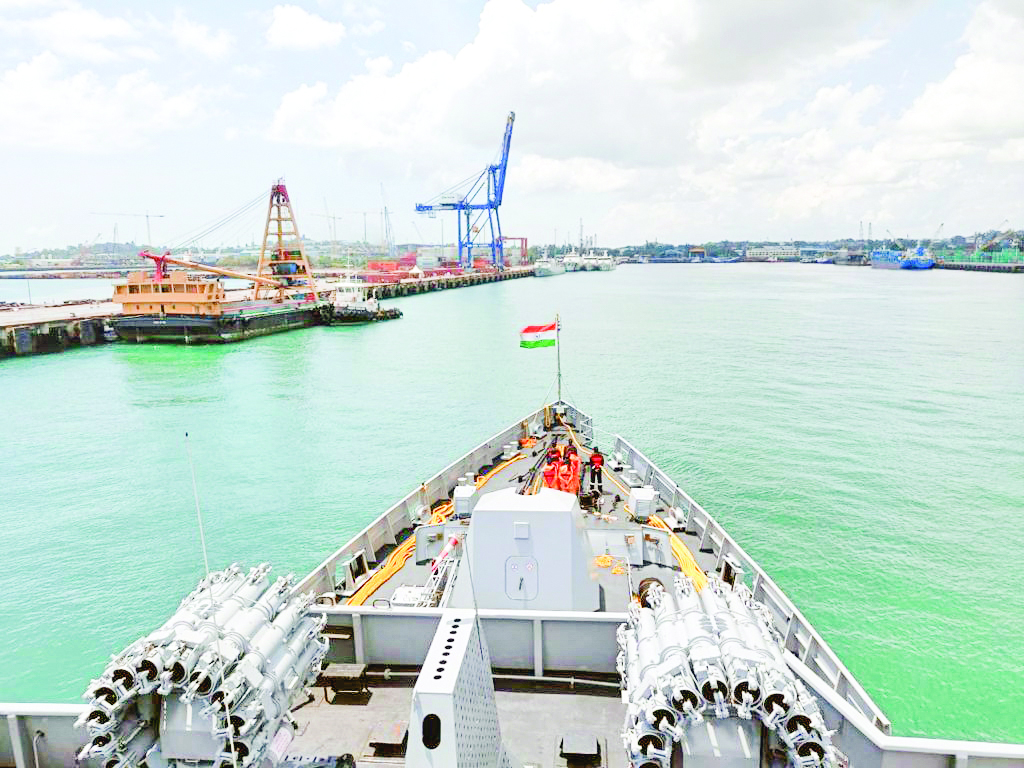
The Kamorta-class corvettes, designed under the Project 28 (2014-2020), represent India’s first indigenously built ASW corvette fleet. This fleet (comprising 3,300-tonne vessels) consists of four such corvettes, namely INS Kamorta, INS Kadmatt, INS Kiltan, and INS Kavaratti (P31), with stealth-optimised hulls, CODAD propulsion, and indigenous Revathi radar and Abhay sonar systems. They are armed with RBU-6000 anti-submarine rocket launchers, 533mm torpedo tubes firing Varunastra torpedoes, and support ASW helicopters like the Sea King Mk.42B or HAL Dhruv.
Designed for deep-sea patrols in the Bay of Bengal, these corvettes are ideal for tracking PLAN SSNs. Their near-90% indigenous content advances the Aatmanirbhar Bharat agenda, while enhancing India’s operational autonomy. Their data-linked interoperability ensures seamless integration with air and underwater assets, vital for real-time submarine tracking.
ASW SHALLOW WATERCRAFT (ASW-SWC)
Launched under a 2019 contract with GRSE and Cochin Shipyard Limited, the ASW-SWC fleet will comprise 16 stealthy, waterjet-propelled vessels under 900 tonnes. The INS Arnala, commissioned on 18th June 2025, was the first (the delivery of the second ship is planned in August 2025). These ships carry lightweight torpedoes, RBU-6000 launchers, mine-laying rails, and advanced sonar systems, including low-frequency variable depth sonar (LFVDS) co-developed with Atlas Elektronik.
Purpose-built for India’s shallow, complex coastal waters, especially the Arabian Sea, the ASW-SWC vessels address the threat of midget submarines and UUVs near ports and offshore installations. Their ability to rapidly “sprint” toward contacts and share data with airborne or surface ASW platforms enhances their role in localised submarine prosecution.
P-8I NEPTUNE AIRCRAFT
India operates 12 P-8I Poseidon aircraft (with more on order) based at INS Rajali and INS Hansa. These long-range maritime patrol aircraft, developed from the Boeing 737-800 platform, are equipped with MAD booms, Harpoon missiles, MK-54 torpedoes, and AN/SSQ-53G/62F sonobuoys. Their APY-10 radar enables broad-area search and multi-target tracking across the IOR.
With endurance exceeding 10 hours and a 1200 nm range per mission, the P-8Is provide India with persistent surveillance from the Malacca Strait to the Arabian Sea. Their integration into QUAD maritime exercises, like Sea Dragon and Malabar, also strengthens India’s interoperability with the U.S., Japan, and Australia. In deterrent terms, they compress the “detect-to-engage” timeline for hostile submarines.
UNDERSEA SURVEILLANCE SYSTEMS
India’s undersea detection network includes the Integrated Underwater Harbour Defence and Surveillance System (IUHDSS), seabed sensor arrays, and very/extra-low frequency (VLF/ELF) communication systems at INS Kattabomman. These platforms integrate hydrophones, sonar arrays, and underwater cameras for round-the-clock monitoring. These static systems are the backbone of India’s maritime domain awareness. They support early warning, enhance SSBN command-and-control resilience, and are particularly critical for chokepoints like the Andaman Sea. New Indo-Australian collaborations in passive sonar algorithms and towed array acoustics signal a new phase of joint innovation.
INDIGENOUS SSN PROGRAM
India’s Project-77, approved in late 2024, will deliver six nuclear-powered attack submarines (SSNs) by the 2030s. These 9,800-tonne platforms (designed by the Directorate of Naval Design) will deploy advanced sonar, cruise missiles, and torpedoes. Drawing on lessons from the Arihant-class SSBN, they will be powered by 190 MW reactors for long-endurance stealth patrols. Unlike leased SSNs like the INS Chakra, these platforms will grant India independent deep-sea strike and patrol capabilities. Operating from forward bases like the Andaman & Nicobar Command, they will act as apex predators, shadowing PLAN assets, protecting carrier groups, and enforcing deterrence across the IOR.
STRATEGIC SYNTHESIS OF DETERRENCE AND PARTNERSHIPS
India’s ASW build-up is not simply reactive; it reflects a deliberate shift toward credible maritime deterrence in a contested Indo-Pacific. The sheer presence of capable ASW systems, surface, subsurface, airborne, and seabed-based, raises the threshold for PLAN submarine operations in Indian waters, embodying deterrence by denial.
This force architecture operationalises the SAGAR doctrine, securing not only Indian coastlines but also the economic lifelines and sea lanes vital to the region. India’s ability to monitor, track, and potentially neutralise subsurface threats directly supports the vision of a rules-based maritime order.
Finally, this ASW posture strengthens Indo-Pacific partnerships, especially through platforms like Quad and bilateral pacts with the U.S., France, and Australia. Defence collaborations now extend beyond exercises to co-development of sonar, UUVs, and even shared undersea surveillance in chokepoints like the Lombok and Sunda Straits.
A SHIELD FORGED IN STRATEGY AND STEEL
By 2030, India’s ASW architecture, anchored in Kamorta-class corvettes, ASW-SWC vessels, P-8I aircraft, undersea sensors, and nuclear attack submarines, will form a formidable and multi-domain shield. It is a shield forged not just from steel, but from strategy, science, and sovereignty.
In an era of shifting naval balances and expanding threats, India’s silent sentinels beneath and above the waves ensure that the Indian Ocean remains secure, stable, and firmly within the orbit of regional equilibrium. The race for undersea dominance is on, and India is no longer a spectator.
Commodore (Dr) Johnson Odakkal is a maritime scholar, strategic affairs analyst, and Indian Navy veteran. He serves as Faculty of Global Politics and Theory of Knowledge at Aditya Birla World Academy, Mumbai, and Adjunct Faculty of Maritime and Strategic Studies at Naval War College, Goa.
