Airlines are private firms. But aviation mobility is a public network good. India’s economic geography rests disproportionately on one carrier’s operational discipline. When that carrier stumbles, the effects ripple across GDP, not just holiday plans.
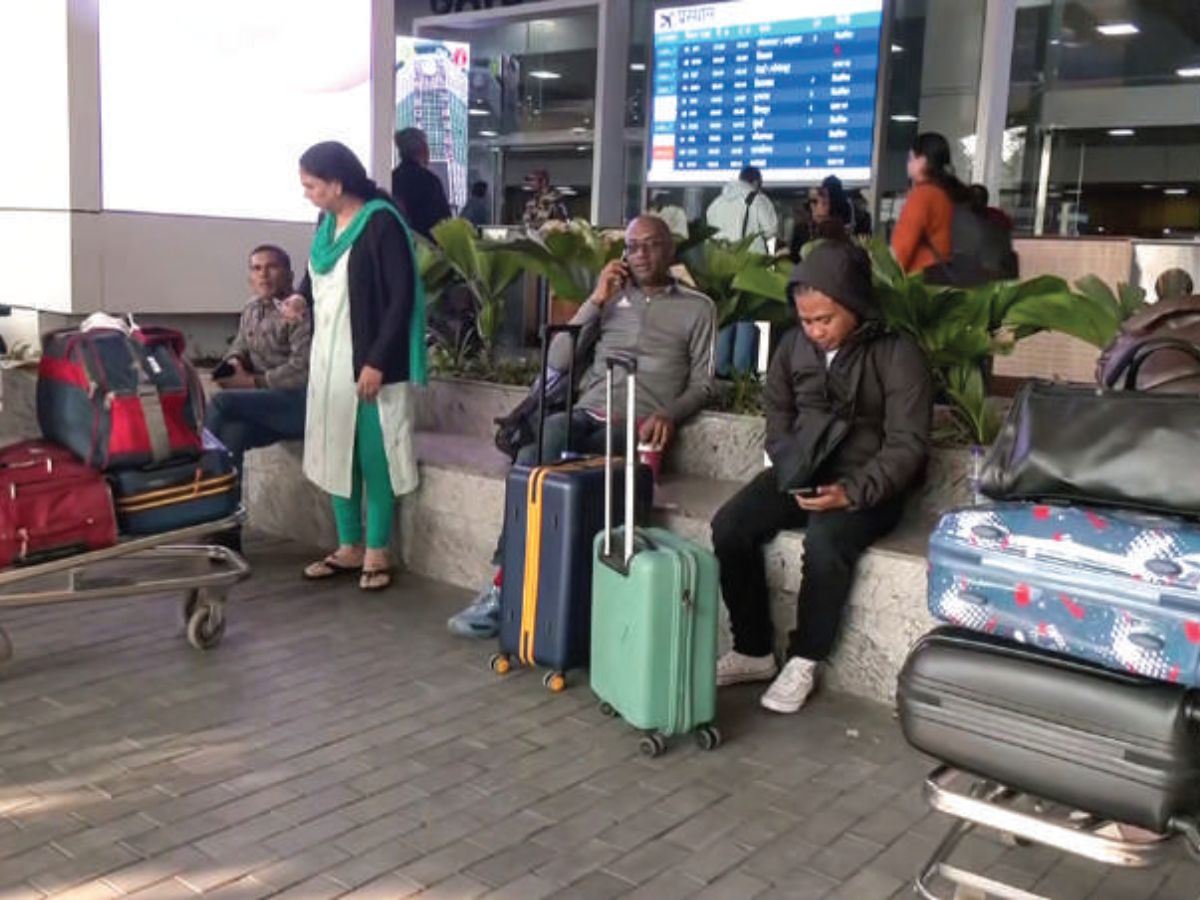
Passengers wait with their luggage as many IndiGo flight services stand cancelled at Lokpriya Gopinath Bordoloi International Airport, in Guhawati on Saturday. ANI
New Delhi: India’s aviation collapse this week did not begin with a software glitch or an unexpected change to crew-rostering norms. It began years earlier, when a market with too few players allowed its largest airline to optimise for cost, market share, and punctuality metrics, while hollowing out the buffers that make a complex network resilient. What is unfolding today is an oligopolistic failure, textbook and predictable.
IndiGo cancelled nearly 600 flights in three days, and over 1,300 across November-December. It is the culmination of a structural equilibrium in which the largest airline behaves as if passengers cannot go anywhere else, competitors cannot catch up, and regulators will always blink. When an airline commands more than half the domestic market, its internal misjudgements become macro-level disruptions. Unfettered dominance breeds fragility, not strength.
In concentrated markets, firms often face muted incentives to invest in resilience. Oligopolists optimise for cost minimisation even when it increases systemic vulnerability, because the downside is diffused across consumers and regulators rather than borne privately. High entry barriers allow incumbents to under-invest in quality and redundancy without losing market share. The IndiGo crisis validates all three insights. For years, the airline engineered itself around razorthin utilisation margins, high aircraft productivity, and aggressive crew rostering. This model works exquisitely, until it doesn’t. One software advisory, one night of delays, or one regulatory change becomes enough to tip the entire system into failure. Winter schedules, with fog, congestion, holiday peaks, and tight turnaround times, were the worst possible moment to run these margins. Yet IndiGo chose to expand capacity while freezing pilot hiring and resisting structural adjustments demanded by FDTL (Flight Duty Time Limitations) norms that were notified long in advance.
In high-utilisation service systems, reliability engineering and queueing theory both warn of the same phenomenon. When utilisation consistently rises above 85-90%, even small delays cascade into exponential disruptions. IndiGo operated at, or above, these thresholds throughout its network.
The Airbus A320 software patch should have been a manageable inconvenience. Instead, delayed flights triggered mandatory crew rest periods under new FDTL rules, which then cascaded into cancellations because the airline lacked sufficient spare crews. It is a predictable outcome of a system designed with too little slack, in an industry where slack is a safety and reliability variable, not an inefficiency. IndiGo failed because it built a network that could not withstand the slightest stress.
The more troubling question is why IndiGo misjudged its roster requirements so badly. A two-year transition window existed for the new FDTL norms. Implementation was deferred repeatedly, at the industry’s request. The technical details were known. Fatigue-risk management systems exist globally. Any reasonably sophisticated airline IT system could have modelled the crew shortage months ago.
Yet IndiGo acted as though the rules might be diluted again. Pilots allege that hiring was deliberately frozen, non-poaching agreements quietly maintained, and pay structures kept artificially tight. If correct, this reflects what Leibenstein called “X-inefficiency”: dominant firms optimising their political and regulatory environment instead of their internal efficiency. The fact that DGCA has now paused weekly rest requirements and relaxed duty-time caps only reinforces this concern. When a firm becomes large enough, its operational pain becomes regulatory pressure.
Airlines are private firms. But aviation mobility is a public network good. India’s economic geography, the distribution of labour markets, the functioning of supply chains, the viability of tourism and services, now rests disproportionately on one carrier’s operational discipline. When that carrier stumbles, the effects ripple across GDP, not just holiday plans.
This is the paradox of oligopolies in network industries. Efficiency gains accrue privately, fragility costs are socialised. IndiGo’s market power became a substitute for resilience. For years, passengers tolerated narrow seats, rigid service models, and ultra-lean operations because the airline offered punctuality and predictability. But punctuality achieved through aggressive scheduling without adequate buffers is not operational excellence; it is deferred risk. And this week, deferred risk arrived all at once.
It is tempting to frame the solution as more competition. India certainly needs more viable carriers. But entry barriers in aviation, capital costs, airport slots, fuel taxes, and economies of scale, make competitive dynamism slow. In the near term, the regulator must adapt its philosophy.
First, rules on pilot duty time cannot be negotiable under operational distress. Fatigue is a safety variable, not a business preference. Rolling back norms to accommodate poor planning creates moral hazard.
Second, penalties for mass cancellations must be automatic, proportionate to market share, and unavoidable. A 60% airline should face stricter reliability mandates than a 6% airline, because its failures impose systemic costs.
Third, rostering and fatigue-risk systems must be auditable. If IndiGo’s models failed to anticipate shortages, the DGCA must audit the models, not rely on the airline’s self-assessment.
Fourth, minimum resilience buffers must be mandated during peak-risk periods (winter, fog season, holiday travel). This is standard in other network industries like electricity and telecom. Aviation is no different.
Finally, DGCA must develop the capacity to conduct forward-looking stress tests of airline schedules, staffing, and network design, just as financial regulators stresstest banks.
IndiGo will recover; dominant players almost always do. But the episode reveals an unsettling truth. India allowed a single airline to become too central to fail without insisting that it also become too competent to fail. It is the complacency that allowed operational fragility to be normalised under the banner of efficiency.
The IndiGo meltdown is not an accident. It is a structural warning. Dominance is not a guarantee of excellence. It is an invitation to scrutinise more deeply, regulate more intelligently, and demand that essential network providers build resilience, not merely market share.
India deserves an aviation system where consumers are not the shock absorbers of miscalculation by the airlines.
Aditya Sinha (x:@adityasinha004) writes on macroeconomic and geopolitical issues.
