
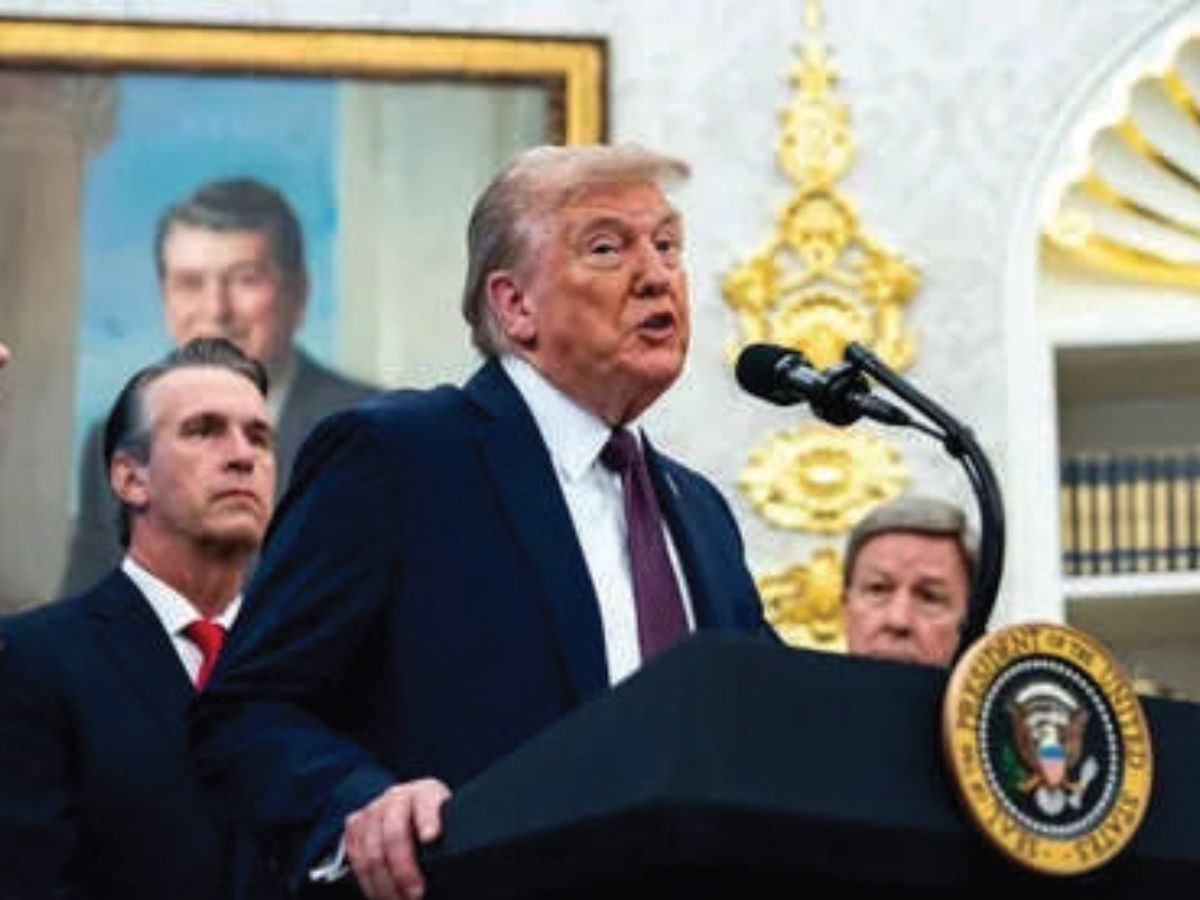
London: What began as a routine Cabinet meeting nearly two weeks ago, turned into a striking public display of presidential rhetoric that many observers say crossed long-standing political lines. According to people in the room, President Donald Trump launched into a two-minute denunciation of Somali immigrants and Somali Americans, claiming they “contribute nothing” and should “go back to where they came from.” He reportedly described Somalia as a place that “stinks”, said Somali Americans “bitch and complain,” and singled out Minnesota Congresswoman Ilhan Omar, calling her and her allies “garbage.” Rather than prompting discomfort, the comments were met with loud applause. Vice President JD Vance pumped his fist; Secretary of War Hegseth responded, “Well said.” A senior administration spokesperson later described the exchange as “an epic moment” and praised the president’s “political courage.” For many, however, the scene underscored just how dramatically the boundaries of acceptable political speech have shifted at the highest levels of government. For decades, both major parties maintained distinct guardrails around race-based or dehumanising, xenophobic language. Public officials who crossed those lines often faced swift consequences. In 2002, Senate Majority Leader Trent Lott stepped down after praising a segregationist presidential campaign, and in 2019, Representative Steve King lost his committee assignments after comments embracing white nationalism.
Today, the calculus appears dramatically different and the guardrails have all but vanished. Within Trump’s administration, statements once considered beyond the pale now draw cheers rather than criticism, suggesting a rapid expansion of the political “Overton window”, the range of ideas considered acceptable in public life. What was once disqualifying, or the exclusive domain of on-line trolls, is now a fixture of national political discourse.
Trump’s comments this week also carried a different weight compared with his earlier controversies. He vaulted into political prominence by promoting the racist conspiracy theory that President Obama wasn’t born in the US. His 2015 remarks portraying Mexican immigrants as “rapists,” or his 2018 reference to African nations as “shithole countries,” drew days of bipartisan condemnation. Then came the 2024 election campaign in which all norms on race and identity were blown away. Trump declared that unauthorised immigrants were “poisoning the blood of our country” (echoing a Nazi theme) and amplified the false claims that Haitian migrants in Ohio were devouring their pets! Following his win that year, which his devoted MAGA movement heralded as a “sweeping cultural mandate”, Trump grew more explicit in his mission to “defend Western civilisation” and “preserve white Christian identity”. It came as no surprise, therefore, that this latest episode, delivered in a formal Cabinet meeting in the White House, brought no pushback from within his own team. One historian described the moment as the “institutionalisation of rhetoric that once lived on the political fringe”.
The impact is especially acute for Somali Americans, many of whom have spent decades building roots in Minnesota and across the country. The Somali community in Minnesota, one of the largest in the U.S., includes business owners, teachers, health-care workers, and members of the armed forces. Community leaders say the president’s assertion that Somali immigrants “contribute nothing” not only ignores reality but casts doubt on their belonging as Americans. The comments arrive just as the Trump administration prepares new enforcement actions reportedly directed at Somali communities in the St. Paul area of Minneapolis, raising concerns that harsh rhetoric may be laying the groundwork for aggressive policy. By conflating crime, welfare fraud and national security with ethnicity and origin, Trump gives the appearance of making preparations for institutional exclusion on a mass scale. When government policy of arrests, deportations and citizenship revocations is justified in the language of “we don’t want these people here”, it becomes far easier to expand those measures, minimise due process and shift public opinion.
For many Somali Americans, Trump’s remarks also felt deeply personal, drawing shock and condemnation from Minneapolis to Mogadishu. Omar called Trump’s “obsession” with her and Somali-Americans “creepy and unhealthy”. “We are not, and I am not someone to be intimidated”, she said, “and we are not gonna be scapegoated.” Local officials and business leaders expressed anger and fear, with one Somali entrepreneur saying simply, “I am not garbage.” Community members worry that such language from the nation’s highest office could fuel harassment, encourage suspicion, or legitimise discrimination, which could then justify enforcement actions affecting families, livelihoods, and even citizenship status.
Trump’s comments also fit into a broader pattern. Throughout his political career, he has cast various immigrant groups as threats or burdens. What has changed, critics say, is the alignment between words and policy. In recent months, the administration has tightened immigration from several Muslim-majority and African countries, floated proposals to revoke certain naturalised citizens’ status, and expanded deportation operations in major cities. Trump’s imposition of a one-time $100,000 fee on H-1B visas, a category that Indian workers dominate (about 70% + of recipients) has caused widespread fear, uncertainty and upheaval among skilled workers and their families. Indian-American organisations condemned it as part of a “xenophobic agenda”, targeting immigrant success and contribution to the economy. The combined effect is a message that some immigrant communities are not simply unwelcome, but inherently unworthy of American citizenship.
International reaction to Trump’s words on Tuesday was swift. Somali officials and members of the global Somali diaspora condemned the comments, and some said they were reconsidering travel to the United States. Anti-immigrant and racial hostility content targeting Indian and South Asian communities has surged on social media, often linked with debates over visas and jobs. Many Indian Americans report xenophobic slurs and negative stereotypes about job-stealing and general hostility. There is a growing feeling in the Indian diaspora that their long-held aspirations in the US are now fraught with risk and instability, even for legal residents and citizens. The perception of being “unwelcome or under attack”, whether through rhetoric, policy or social backlash, has been cited as a key consequence of Trump’s words and approach to immigrants. Alarmingly, domestic civil-rights groups warned that the Cabinet meeting signalled a new phase of the administration’s immigration agenda, one that could bring heightened surveillance, profiling, and enforcement against entire communities.
Tuesday’s meeting may ultimately be remembered as a defining moment for this administration, a point at which rhetoric once considered fringe became part of official government discourse. It was a moment when a US president publicly used dehumanising language to describe a community that includes U.S. citizens, and his senior advisers applauded. The episode raises pressing questions not only about the policies that may follow, but about the country’s political and moral direction. For a nation that has long celebrated its identity as a place shaped by immigrants, including the president’s own family history, the implications are far-reaching. When the language of exclusion becomes embedded in the language of governance, the consequences extend beyond any single group. They touch the core ideals on which the United States tells its story about itself.
John Dobson is a former British diplomat, who also worked in UK Prime Minister John Major’s office between 1995 and 1998. He is currently a visiting fellow at the University of Plymouth.




