Joining this initiative will certainly improve AI and semiconductor infrastructure and develop a robust supply chain. It could also enable India to harness advanced technologies not only from the US but countries like Japan, South Korea and Israel.
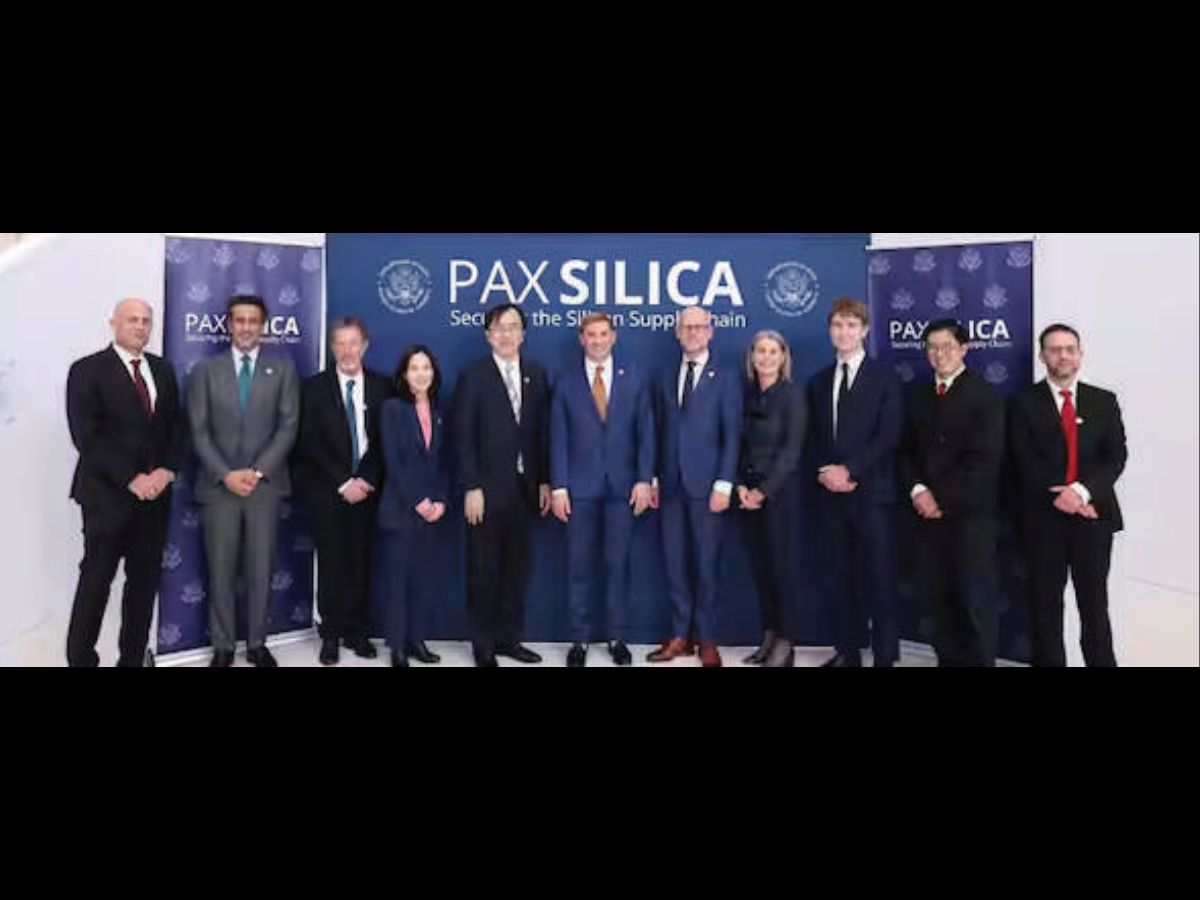
US Undersecretary of State Jacob Helberg convenes the Pax Silica Summit at Donald J. Trump Institute of Peace on December 12, 2025 in Washington, DC. File Photo
New Delhi: PAX SILICA draws its origins from the Latin word PAX, which means peace, stability and long-term prosperity. SILICA, also known as silicon dioxide, is a compound which is found in sand and rocks. SILICA is refined into silicon by a complex process and used for fabrication of semiconductors with myriad options in electronics manufacturing and solar systems.
This US-led initiative was announced by the US State Department in December 2025 and the first PAX SILICA Summit was held on 12 December 2025. Eight countries—Japan, South Korea, Singapore, Netherlands, Israel, United Arab Emirates, United Kingdom, and Australia—participated in this inaugural summit along with guest participations from Taiwan, the European Union, Canada, and OECD (Organisation for Economic Co-operation and Development)
The stated purpose of the initiative is to build a secure, prosperous, and innovation driven silicon supply chain. Not only that it includes robust supply chain for critical minerals and energy inputs to advanced manufacturing, semiconductors, AI infrastructure, and logistics.
Qatar has become the eighth country to sign the PAX SILICA declaration this month. UAE is the next country likely to sign the declaration. Sergio Gor, the newly arrived US ambassador to India has recently made a statement that India will be invited to join this US led strategic initiative next month. While this appears to be an afterthought and akin to belated wishes, the overall purpose could be well beyond mending fences or tariff tantrums.
Cutting edge technology is difficult to innovate with a complex cycle of processes and investment, a large scope and margins for failure and effort in sustaining the scale and volumes with IP management, quality, continuous product upgradation, handling, logistics, etc. While the overall process to a packaged product is time and process intensive, it transcends geographies and various other parameters—both structural and geopolitical. Dislocation of such critical technologies come with a caution and cost. While this is a technological reality, there are environmental realities which need to be factored in as well.
Global supply chains are the fulcrum of any technological ecosystem. To this end, global semiconductor manufacturing primarily consists of three pillars of equipment, materials and services. This inherently powers the global chip ecosystem. Equipment comprises precision equipment for manufacturing in fab facilities/ foundries to include assembly, testing, marking and packing (ATMPs)/ outsourced semiconductor assembly and test (OSATs). Materials comprise chemicals, minerals and gases, all of which are critical to the manufacturing processes. Services denote the overall value chain of logistics, packaging and distribution.
While manufacturing is capital and talent intensive, it is presently restricted to a small set of global players along with the materials. This “materials market” essentially utilises more than 150 varieties of chemicals and more than 30 variants of gases and minerals. It is thereby pivotal to the entire process chain for any established or an aspiring semiconductor entity. Contextually, it remains to be seen if Taiwan is included as part of this initiative in the future.
Indian prowess in the chemical industry is well known with its significant contribution of 7% to the overall Gross Domestic Product (GDP). It is statistically sixth largest in the world and third largest in Asia. As per the available data, the market size of this industry in India is $220 billion and is expected to grow to $300 billion by 2030. In addition, as per the latest trends, there is a significant shift in production and consumption, as seen in Asia, leading to a higher demand statistic.
India possesses unmatched talent and presently stands at the inflection of scale and speed of manufacturing of diversified product lines for a wide range of applications in future. It also has the cerebral prowess, intent and capacity to become a global R&D hub. The world has taken notice that a future ready skilled workforce for electronics as well as manufacturing sectors is available in India. This Human Resource is being changed into “Human Capital” by the enabling schemes of the present government rapidly since 2014.
Government of India launched the National Critical Mineral Mission (NCMM) last year to establish a robust framework for self-reliance in the critical mineral sector.
Under this mission, the Geological Survey of India (GSI) has been tasked with conducting 1,200 exploration projects from 2024-25 to 2030-31.
With several government initiatives, top talent, technological orientation, rapid advances in renewable energy production and high consumption metrics make India a bright spot in the overall matrix. Regardless of the current rhetoric, Microsoft plans to spend $17.5 billion to expand its artificial intelligence (AI) infrastructure and cloud computing capacity in India over the next four years. Google has also announced approximately $15 billion (USD) over the next five years (2026-2030). These high technology investments are indicative of the overall potential of India in the long run.
Joining this initiative will certainly improve AI and semiconductor infrastructure and develop a robust supply chain. It could also enable India to harness advanced technologies not only from the US but countries like Japan, South Korea and Israel. Dependence on China for critical minerals could also be reduced with technology to extract critical minerals but the same could apparently be a slow process.
This initiative is at its expansion stage, and more countries are likely to join in the future. Prima facie such initiatives will facilitate countries to reduce dependence on China, which has nearly monopolised the supply chain of critical minerals. It is an opportunity for India to enhance its cooperation with the members in the field of critical minerals and artificial intelligence.
Ideological conflicts and nuclear arsenals led to the erstwhile cold war. Technology, while driving Industry 5.0, possesses the potential to unleash the “coldest war”. Diversification, to include sourcing, establishment of new facilities, innovation and distribution, if deemed plausible will take time as it is a complicated and time intensive process. Suitable geographies and economies of scale are critical for ease of logistics and transit.
Natural disasters reflect our lack of control over nature, but technological disasters of the future will reflect our lack of control over what was once under our control.
Since the initiative looks at an inter-ministerial and multiple domain intersections, it will have to be carefully vetted to ascertain whether this is a trapdoor or a collaborative opportunity.
Anurag Awasthi is a veteran, and CEO of Escape Velocity Mediaworks. He is a known policy expert and a columnist who writes extensively on critical technologies, security and geopolitics. Views are personal.
