The event remains a paradox: a moment of national triumph for Beijing, yet a story of displacement, radioactive fallout, and enduring coercion imposed by the People’s Liberation Army.
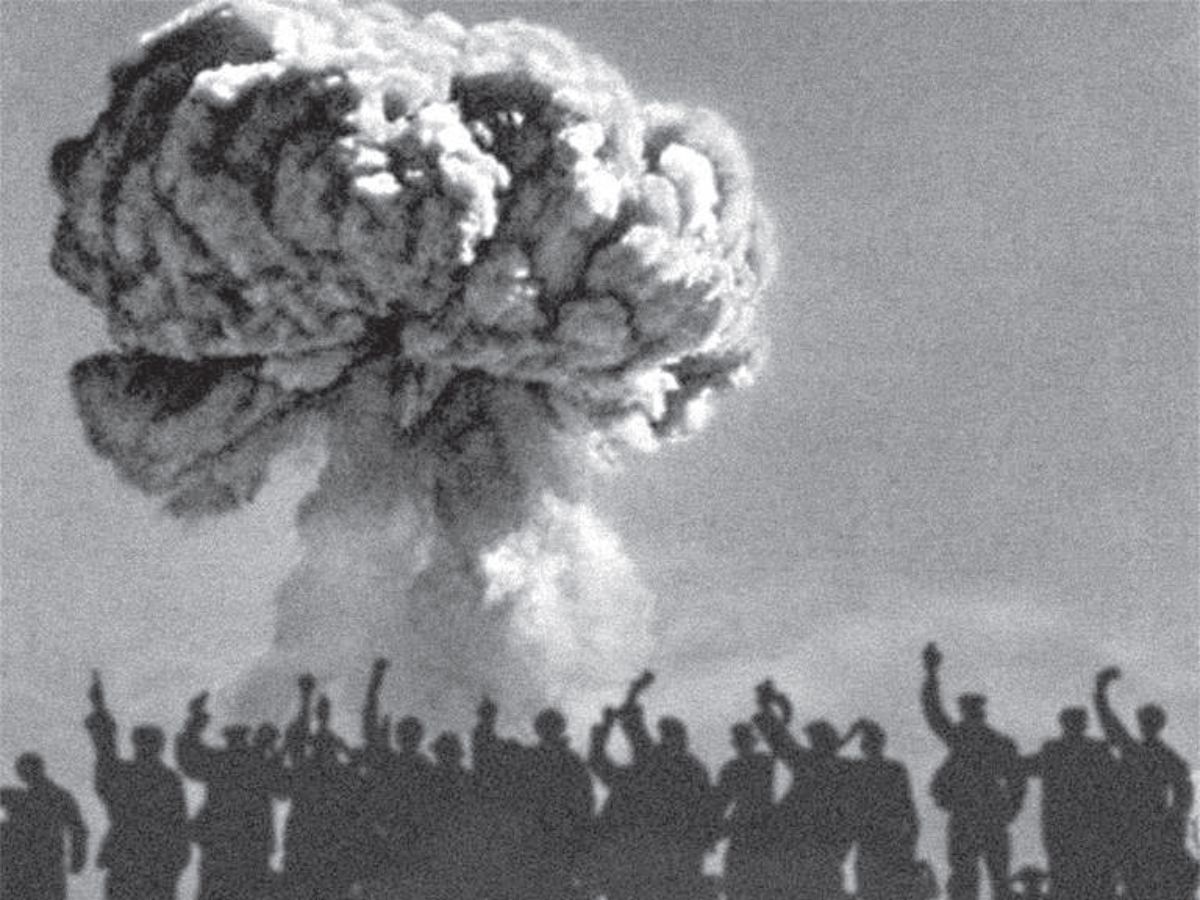
China’s first nuclear test in 1964, while marking a scientific and strategic milestone, caused widespread displacement, radiation exposure, and health crises in Xinjiang. (Image: File)
New Delhi: On 16 October 1964, the People’s Republic of China (PRC) detonated its first atomic bomb at Lop Nur in Xinjiang, under the secretive codename Project 596. The test catapulted Beijing into the global nuclear club, reshaping Asian geopolitics. But beneath the narrative of “catching up with the superpowers,” the human and environmental costs were borne by Xinjiang’s Uyghur and Kazakh populations, who became silent victims of a programme that militarised their homeland. The event remains a paradox: a moment of national triumph for Beijing, yet a story of displacement, radioactive fallout, and enduring coercion imposed by the People’s Liberation Army (PLA), the Communist Party’s instrument of power projection.
PROJECT 596: A MILITARY FIRST, NOT A CIVILIAN ACHIEVEMENT
China’s atomic bomb programme began in the 1950s with Soviet assistance, though Moscow withdrew support in 1959 amid the Sino-Soviet split. Determined to pursue nuclear independence, Beijing prioritised the project under Mao Zedong. By 1964, despite famine and economic chaos, resources were funnelled into building the bomb. The decision to test in Lop Nur, Xinjiang, was not coincidental. Isolated deserts made it a convenient site from Beijing’s perspective, but for local populations, it meant forced displacement and exposure to radiation. Villages in the vicinity were never informed of the risks, and many communities were later erased to secure the test zone. Unlike other nuclear powers that justified their programmes in terms of deterrence, China framed Project 596 as a political tool, a demonstration that the PLA could challenge Western and Soviet military superiority. It was, from the outset, an army-first project, designed to expand coercive capacity rather than ensure strategic stability.
XINJIANG: FROM HOMELAND TO MILITARY LABORATORY
For centuries, Xinjiang had been home to Uyghurs, Kazakhs, and other Turkic peoples. The arrival of the PLA in 1949 brought waves of militarisation, land seizures, and surveillance. The nuclear programme deepened this trend. Lop Nur was transformed into a vast testing ground, estimated to cover 100,000 square kilometres. Eyewitness accounts suggest that Uyghur herders and farmers were displaced with little compensation. Many were left in radiation zones, leading to widespread health crises: cancers, birth defects, and unexplained illnesses that persist even today. Independent researchers estimate that hundreds of thousands may have been affected over three decades of nuclear testing. Yet Beijing has never allowed transparent epidemiological studies, and information remains tightly controlled. The Party’s narrative celebrates “scientific progress,” while the lived experience of local populations is one of dispossession and neglect.
PLA’S INSTRUMENT OF COERCION
China’s nuclear test at Lop Nur was hailed domestically as proof that the PRC had caught up with the United States, the Soviet Union, the UK, and France. Internationally, it triggered both alarm and grudging recognition. But crucially, the test was conducted under the PLA’s direct supervision. For the Communist Party, the PLA is not a national army but the Party’s instrument of coercion. The nuclear programme served this dual purpose: ensuring deterrence against foreign powers, while reinforcing control over frontier regions like Xinjiang. Nuclear secrecy justified heavy militarisation of the province, creating garrisons and bases that subordinated local populations. In contrast, the Indian Army, though facing its own nuclear-armed neighbours, has consistently positioned itself as a professional, doctrine-led force. Its approach is rooted in stability and restraint, aimed at preventing escalation rather than enforcing political control over domestic populations. This distinction underscores the fundamentally different civil-military balances in Beijing and New Delhi.
GLOBAL REACTION AND PRC’S NARRATIVE OF POWER
When news of the 16 October test broke, world capitals reacted with concern. The United States and the Soviet Union condemned the development but privately acknowledged China’s technical leap. Many Asian countries worried about an arms race, especially after Beijing’s boast that it had joined the ranks of “great powers.” For the PRC, the test was folded into its propaganda arsenal. State media painted it as a victory for socialism, scientific ingenuity, and national dignity. Yet the underlying reality remained: the so-called victory was built on the silent suffering of Xinjiang’s people. The Party’s pride was Xinjiang’s pain.
HUMAN AND ENVIRONMENTAL COSTS THAT ENDURE
The radioactive fallout from Lop Nur tests contaminated soil, water, and livestock across wide swathes of Xinjiang. Generations have reported health complications, but medical studies remain censored. Environmental activists who have tried to investigate have faced repression. Unlike the public debates and compensations seen in the United States, France, or even the Soviet Union post-Chernobyl, China has never acknowledged responsibility. For Beijing, admitting the cost would undermine the myth of progress and expose the PLA’s exploitative use of frontier populations.
POWER AT WHAT PRICE?
On 16 October 1964, when Lop Nur lit the sky, the PRC announced itself as a nuclear power. But history demands we remember both sides of the story. For Beijing, it was a triumph of science and sovereignty. For the people of Xinjiang, it marked the beginning of dispossession, illness, and a landscape poisoned for generations. The PLA’s control over Xinjiang through nuclear militarisation illustrates the coercive foundation of China’s rise. In contrast, India’s doctrine-led military lays threadbare how nuclear weapons can be integrated with stability, not domestic suppression. Sixty-one years on, the question endures: at what price did China secure its place in the nuclear club, and who continues to pay it?
Ashish Singh is an award-winning senior journalist with over 18 years of experience in defence and strategic affairs.
