
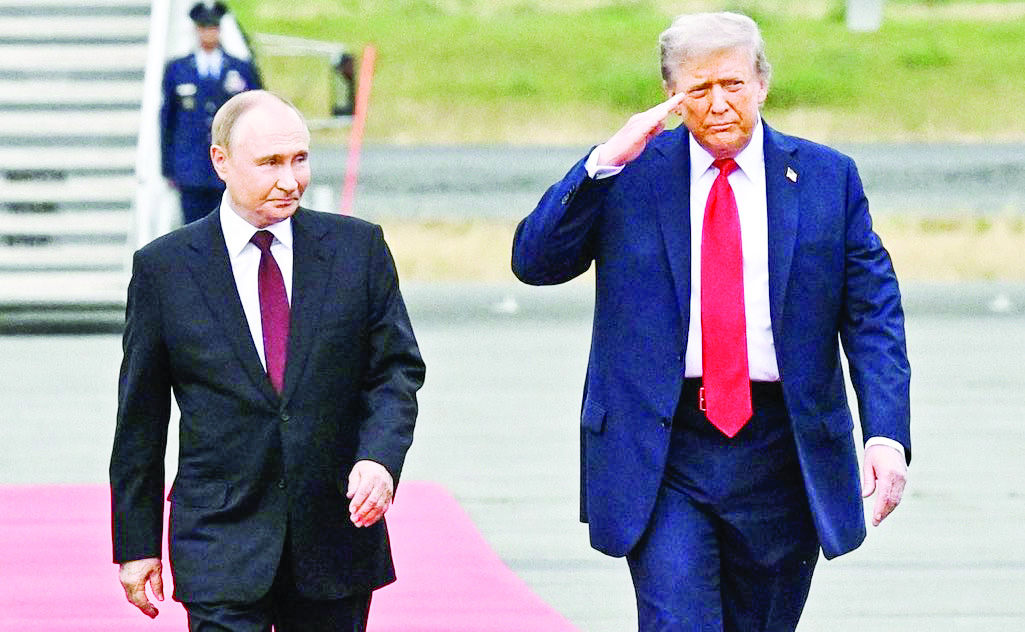
PUNE: When Presidents Donald Trump and Vladimir Putin agreed to meet at Anchorage in Alaska, the aim seemed more to provide the optics for an elusive Nobel Prize for Trump, than for securing a just, durable and lasting peace in Ukraine. The much-hyped meeting in Alaska—a piece of land that was once Russia’s—had been announced and conducted with much fanfare, with fighter jets flying overhead, red carpets laid out, a joint ride in the presidential limousine, and the hopeful slogan of “Pursuing Peace” plastered across the town.
The slogan formed the backdrop to the traditional photo of the two leaders smiling and shaking hands, but the two and a half-hour meeting between them produced little else. No joint statement, no outcome, no deal. As Trump himself put it, “There is no deal unless there is a deal.” But the inconclusive result was only to be expected. It was Putin’s first visit to the USA since 2015, and the first meeting between the two leaders since 2018 (during Trump’s first term.) This meeting was largely to end the three and a halfyear long Ukraine war which Trump boasted he could end in 24 hours, and which Russia now dominates completely.
Yet, the very meeting was a victory for Putin. He had demonstrated conclusively that he had broken the shackles of isolation which the world tried to impose upon him and Russia. Foreign Minister Sergei Lavrov landed in a white T-shirt with CCCP—the letters for the erstwhile USSR—emblazoned on it, indicating that Russia was here as its rightful successor. And even as the meeting was being held, Russian drones continued attacking Ukraine, tanks and infantry continued inching forward in the Donbas. And whether by design or default, the arriving Russian dignitaries were served chicken ala Kiev during their flight.
The symbolism was telling. It was hoped that a temporary ceasefire or exchange of prisoners would be announced after the meeting. The last round of peace talks between Russia and Ukraine in Istanbul in June had, at least, attained that. But, this meeting, though conducted in a “constructive and mutually respectful manner,” produced not even a joint statement. It only had a vague indication that the leaders would meet again, and this time perhaps Zelenskyy and European leaders—the major stakeholders— would also be included. Zelenskyy had not been invited and the decisions would have taken place without Ukraine’s concurrence.
This implies that peace—if it does come— would be purely on Russian terms. And their terms are coldly clear-cut. They will retain the provinces of Kherson, Zaporizhzhia, Luhansk and Donetsk which they have already occupied. Ukraine is to profess neutrality and abjure all intentions of joining NATO; sanctions on Russia are to be revoked. It is no surprise that before the summit, Russia launched a major push in the Donetsk province to capture the 9,000 km² of territory there which is still not under its control. Over the past few weeks, Russia has made unprecedented military gains.
They shifted tactics from launching headon attacks with massed artillery on Ukrainian positions, to using small groups of infantry to infiltrate through the gaps and attack targets deep in the rear, breaking down the defences. The infiltrating squads were guided and even resupplied by drones, with mechanized forces following only after the breakthrough had been attained. Using this method, they have captured the coal mining town of Dobropillia, and closed in on the crucial towns of Pokrovsk and Kostyantynivka. There are fears that once it gets full control of the Donbas, they can use it as a springboard for further actions westwards, perhaps up to the Dnieper River.
Militarily, it is in a much stronger position and Ukraine stands to lose even more, if they don’t accept its terms. For Zelenskyy, it is a realization that his nation has been pushed into a needless war for nothing at all. After his public humiliation at the White House, he was coerced into a deal which signed off large tracts of Ukraine’s mineral wealth to the USA. He was also told that NATO membership is a categoric “NO”. US aid is doubtful, and he would have “to swap land for peace”—a euphemism that implies he will have to concede 18% of prime Ukrainian soil territory (and Crimea) in the hope that Russia will not make further attacks. Zelenskyy might be ruing the fact that a proposed peace deal in 2022 was skuttled—ironically by the US itself—in which Russia agreed to vacate all its occupied territories (less Crimea) in return for Ukraine merely professing neutrality.
Three and a half years of war have only got the front lines two hundred kilometres closer to Kiev and Europe itself—which has caused increasing trepidation in European capitals. There is likely to be a further round of talks— but the outcome is already decided. Russia will keep what it has got and Ukraine will have little say in the matter. It is much in the same manner of the Yalta Summit of 1945, when the area of Europe was carved out amongst the victors without consideration for the actual stakeholders themselves. India had been watching the talks with great trepidation, hoping for a positive outcome. After all, with the arbitrary 25% additional tariffs imposed on us for importing Russian oil, we have become collateral damage.
A quick resolution of the war will suit us. But it seems the war will go on for some time at least—till Russia makes even more military gains and Ukraine is finally forced to concede on Russian terms—coerced by the USA and other western nations. In another conflictridden part of the world, peace is equally elusive. Israel continues its pummelling of Gaza and has expanded its military operations to take complete control of Gaza City and the beleaguered enclave.
The operation—Operation Gideon’s Chariot—makes no sense. There is nothing left of Hamas, or the Gazans to destroy anymore. But it has ominous overtones. It seems to draw on Trump’s idea to take over the enclave, force its inhabitants to leave for places as enticing as South Sudan, and make Gaza, “The Rivera of the Middle East”, with Trump Towers being a prominent part of the promenade.
Israeli actions have made nations like Canada, Australia, UK, and France announce that they will recognize the creation of Palestine, in what is the logical conclusion of the “two-nation theory”. Israel has, however, announced the approval of Jewish settlements on the West Bank, which will effectively cut it in two and leave no land for any future Palestinian state. Peace in that part of the world seems even more elusive.
As Trump, the peacemaker, claims deals with everybody from Armenia to Azerbaijan, India and Pakistan, Israel and Iran, and even Tom and Jerry, the big picture is often overlooked at the expense of optics. Peace in the most dangerous conflicts of the world—Ukraine and Gaza—is elusive, and if it does come, will be a cosmetic one. This could well be temporary and onesided and merely pave the way for further conflict. Ajay Singh is the international award-winning author of eight books and over 200 articles. He is a regular contributor to The Sunday Guardian.




