Beyond spiritual concepts, India’s civilizational conception of self must frame its identity as a high trust, hard security state.
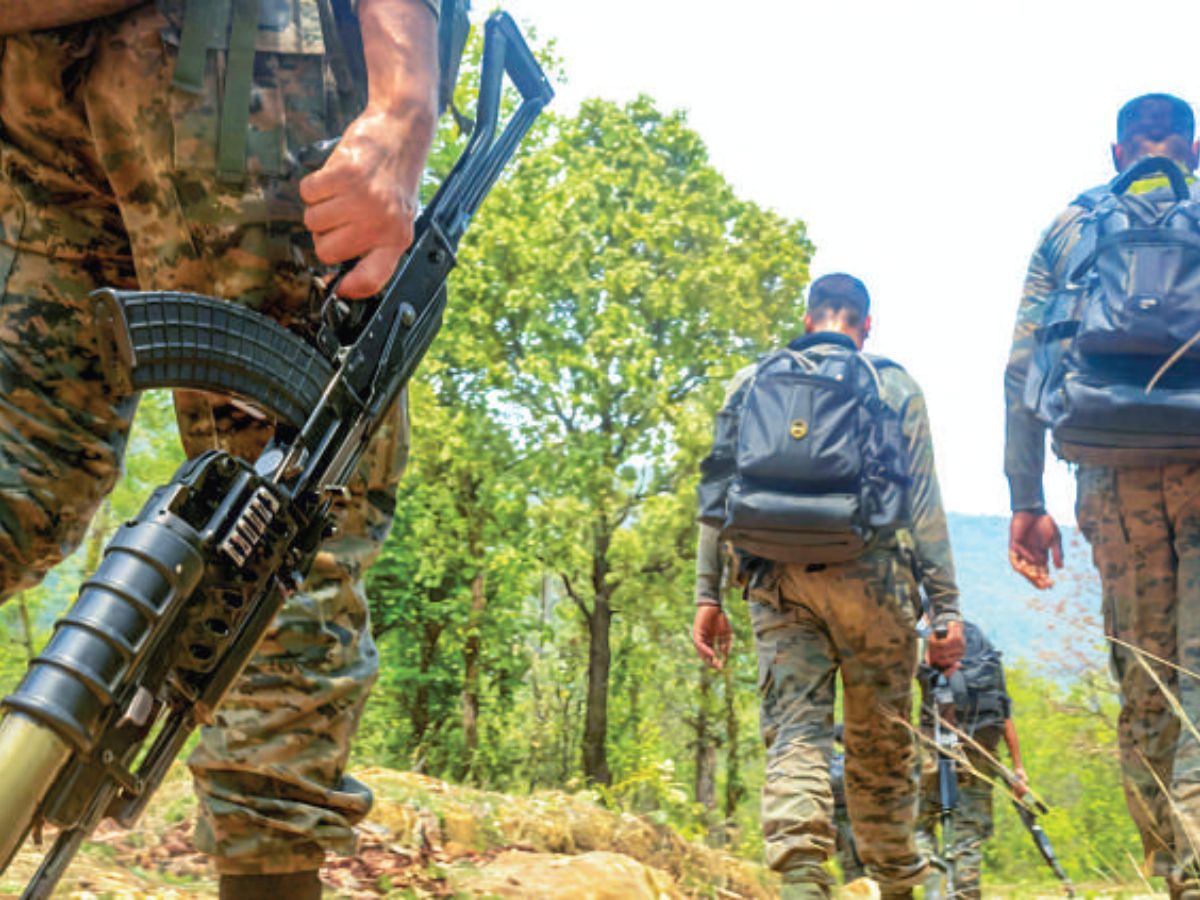
This July 16 photo shows CRPF’s 209 CoBRA unit personnel during an anti-Naxal operation in a forest area of Jharkhand. ANI
New Delhi: Ever since I wrote the biography of Sardar Vallabhbhai Patel (“The Man Who Saved India”, 2017), I have argued that the Indian state must transition from using only Gandhian notions for selfreference to combining the aspiration of universal nonviolence with the practical application of hard security to protect sovereignty in a difficult geography and build a high trust society. The idea that India must use its own cultural history, including its foundational literature, as ideational sources for strategy has been deliberated more vividly in recent times, not least in the public utterances of Prime Minister Narendra Modi, and foreign minister S. Jaishankar (including in his book “The India Way”). The completion of the Ram temple in Ayodhya has also brought about declarations of the start of the recreation of “Ram Rajya”, a golden age of justice which, says the Ramayana, started with the return of the godking Ram to Ayodhya after 14 years in exile.
But beyond the spiritual symbolism, a lot more structural thought is needed into trying to understand if “Ram Rajya” indeed could be a socio-political aspiration of India, and what policy decisions and actions would be required to build it.
Fundamentally, this essay argues that the Ram Rajya is what I call the Patelian state. One of the great failures of the Indian state since Independence is an over-romanticisation of Gandhian idealism while incessantly grappling with intense security, and other structural, challenges for which Gandhian thought had little immediate answers. Therefore, the Indian state had to surreptitiously build and deploy military capability in everything from insurgency to nuclear weapons capability while advocating non-violence. While this, for a time, may have worked as international positioning during the tenure of the first Prime Minister Jawaharlal Nehru, quickly it created deep social cognitive dissonance, not least when India lost a critical war to China in 1962.
My argument therefore is that the Indian state is— and must with even greater vigour—transition to becoming a hard security state while continuing to deepen and widen the scope and nature of its welfare activities. This is critical to change India from a relatively low trust society (though digitization has been changing some aspects of this for the better) to a high trust society with a hard security dimension. Without hard security— especially in a country which has nuclear-armed adversaries on two borders, terror attacks inside, rampant illegal immigration, and insurgencies and seditious activities—a high trust society cannot be built.
It is important to note that Ram Rajya, as defined by the very nature of Maryada Purushottam Prabhu Shri Ram, is, by its very nature, a very high trust society. And by balancing Gandhian imagination with a strong Patelian realist element, the Indian state must reinvent itself to becoming absolutely resilient, and uncompromising about national security and sovereignty, while ensuring that consistent and growing welfare benefits flow to its genuine citizens.
A historical example that is moot here is Sardar Patel’s determined push to ensure that a deal on Jammu and Kashmir was finalized with Pakistan after the first Pakistani attack and war in 1947-48 in Kashmir before paying the Pakistanis 55 crore rupees that was owed to them due to the split of the treasury. Tragically, this wise and strategic decision was rejected due to Lord Mountbatten’s conniving advice to Mahatma Gandhi that this would “violate terms of partition” (as if the attack hadn’t violated them already), and Gandhi’s decision to go on a fast on the issue which forced the Indian government to pay the money without a deal.
The modern political imagination often posits a binary: a state can either be a compassionate provider or a ruthless enforcer. It is rarely asked to be both. Yet, as India accelerates its transformation into one of the world’s largest welfare states—providing free rations to 800 million people, guaranteed rural employment, and massive housing subsidies—it faces a paradox that European social democracies resolved decades ago. To be a generous state, you must be a hard state.
The logic is brutally simple: A welfare state is a closed loop of trust. Citizens consent to high taxation or resource allocation for the vulnerable only if they believe the beneficiaries are legitimate members of the community. If the loop is broken—by porous borders, unchecked insurgency, or the erosion of rule of law— the fiscal and social contract collapses.
Two global examples, Denmark and El Salvador, offer a roadmap. They demonstrate that the “feast” of welfare can only be protected by the “fortress” of hard security.
Denmark is the gold standard of the social welfare model. It offers free education, healthcare, and generous unemployment benefits. But in the last two decades, Denmark has also become one of the most restrictive migration regimes in Europe.
This was not a contradiction; it was a calculation. Danish policymakers, including the centre-left Social Democrats, realised that their high-trust, highcost welfare system could not survive mass migration from non-Western nations. Research indicated that while Western immigrants were often net contributors, non-Western immigrants frequently remained net beneficiaries, straining the public purse.
A “hard security state” is one that prioritizes control over borders, internal order, and coercive capacity, even at the cost of some civil liberty latitude, on the argument that without order there can be neither redistribution nor rights. Denmark’s Social Democratic governments have explicitly framed restrictive migration and “ghetto” legislation as necessary to preserve a generous welfare model, linking access to benefits with residence, labour market participation and strict integration benchmarks. El Salvador’s Bukele administration has argued that only a maximalist crackdown on gangs—suspending due process guarantees and militarizing policing—could make neighbourhoods safe enough for any kind of social or developmental policy to be meaningful.
Over the past decade, Denmark has tightened asylum rules, reduced access to permanent residence and citizenship, restricted family reunification, and signalled that protection is temporary and return is the default once conditions in origin countries improve. Parallel to this, the “ghetto package” and later “parallel society” laws allow the state to classify certain high immigrant, low income areas and then demolish or privatize housing, relocate residents, impose double criminal penalties, and mandate value education programs for children from “non Western” backgrounds. These measures are justified by Danish policymakers as ways to prevent parallel welfare dependent communities forming outside the labour market, thereby defending fiscal sustainability and political legitimacy of the universalist welfare regime.
India is attempting a welfare rollout on a scale Denmark cannot imagine, but without Denmark’s gatekeeping. India shares a 4,096 km border with Bangladesh. Despite fencing, illegal migration remains a massive demographic and economic disruptor, particularly in Assam and West Bengal. Every grain of subsidized rice, every rupee of MGNREGA wages, and every bed in a government hospital consumed by an illegal entrant is a theft from the Indian poor. In 2005, the Supreme Court of India notably described this influx as an “external aggression,” yet the state’s response has often been soft, bogged down by political equivocation. This is why measures like CAA, NRC, and SIR are critical to ensure that the Indian system is not broken and demographics irretrievably altered with malicious purpose.
Just as Denmark realised it could not be the “welfare office for the world,” India must realise it cannot be the employment exchange for South Asia. A hard security state that ruthlessly enforces border sanctity is not anti-humanitarian; it is pro-citizen. You cannot have open borders and a welfare state; you must choose one.
If Denmark teaches the need for external borders, El Salvador teaches the need for internal order. Under President Nayib Bukele, El Salvador transitioned from the murder capital of the world to one of the safest countries in the Americas. His “Mano Dura” (Iron Fist) policy, which involved mass incarceration of gang members and a state of exception, was criticised initially as too stern but the domestic result was the restoration of the most basic welfare provision of all: the freedom to live without fear. The economic revitalization that followed the collapse of gang extortion rackets has allowed the state to invest in public works and social programs. El Salvador’s gang crackdown since March 2022 has been built around rolling “states of exception” that suspend basic rights, permit warrantless arrests, extend pre trial detention and sharply increase sentences for gang membership, including for minors. Under this approach more than 70,000 people have been detained and homicide rates have reportedly fallen to among the lowest in the region, with official estimates of around 1.9 per 100,000 in 2024, albeit amid severe allegations of arbitrary detention, custodial deaths and systemic abuse. Whatever one’s normative assessment, the case reveals the political appeal, in a high violence environment, of trading civil liberty guarantees for rapid restoration of everyday security as a precondition for any social policy or economic normalcy.
India faces internal security threats that actively prevent the delivery of welfare. For decades, Maoist insurgents have operated in India’s mineral-rich but development-poor tribal belts. Their primary strategy is to block roads, destroy mobile towers, and kill contractors. They starve the very poor they claim to represent to keep the state out. A “soft” approach of endless negotiations often prolongs the poverty. A hard security crackdown that eliminates the armed threat is the only way to bring schools and hospitals to Bastar and Gadchiroli. As the Maoist insurgency is about to be wiped out due to strong security decisions, the Maoist terrorists have demanded a nearly 90-day buffer period to surrender. This should never be provided as it will only ensure regrouping and further attacks. Hard decisions to eliminate this scourge must now be taken to protect the Indian state.
As the recent deadly attack on New Delhi proves, from Kashmir to radicalized pockets in the hinterland, Islamist terrorism forces the state to divert billions into security rather than social uplift. Furthermore, the radicalization of youth acts as a distinct barrier to their economic integration, creating pockets of alienation that the welfare state cannot penetrate.
India is currently a “soft state” trying to run a “hard welfare” program. This is unsustainable. The Indian taxpayer is funding a system that is leaking from the bottom (illegal migration) and blocked from the top (insurgency).
A soft or fragmented security posture allows three corrosive processes that ultimately damage a welfare state. Illegal migration on a significant scale changes local demography, strains land and welfare resources, and creates strong incentives for political actors to transform irregular populations into vote banks, thereby locking in impunity and eroding rule of law norms. Islamist and Maoist actors, in different ways, compete with the state for monopoly over violence, intimidate officials, and obstruct delivery of welfare schemes in peripheral regions, forcing the state either to retreat or to buy temporary peace through ad hoc deals and under enforcement. Persistent insecurity raises the fiscal cost of policing and counter insurgency while simultaneously depressing investment and growth, thus shrinking the surplus available to fund health, education, food security, and employment guarantees at scale.
If generous schemes are perceived as easily accessible to illegal entrants or to populations under the de facto control of anti state militants, political support for redistributive policy among core taxpayers can erode, as has been a central worry in the Danish debate.
For a vast, rights based welfare state like India’s, hard security is best understood not as an illiberal deviation but as a form of insurance that protects the fiscal and institutional base of redistribution. A serious policy agenda in this direction would include the following. Technologically reinforced borders and integrated coastal and land border management to reduce illegal crossings, combined with rapid detection and removal mechanisms consistent with basic human rights standards. A single, accurate, and periodically verified population and identity infrastructure so that welfare and voting rights accrue only to those legally entitled, closing the loop between citizenship, residence, and entitlements. Consolidation of counter insurgency gains into permanent presence of civil administration, courts, and welfare delivery, so that no area reverts to Maoist or other armed control. Intelligence driven disruption of Islamist networks, including financial and online radicalization pipelines, while insulating ordinary citizens from collective suspicion through precise, law bound targeting. A clearer legal basis for temporary, spatially bounded “special security regimes” in zones with chronic violence— analogous in logic, but not necessarily in severity, to El Salvador’s state of exception and Denmark’s “harsh penalty zones”—coupled with strict time limits and independent review. Statutory firewalls that prevent illegal migrants from accessing subsidized welfare or electoral rolls, closing the incentive for political protection that currently undermines enforcement.
In such a model, a hard security state is not an end in itself but the precondition for a high trust, fiscally sustainable welfare order in a continental democracy exposed to intense geopolitical, demographic, and ideological pressures. A state that cannot define who its citizens are (Denmark’s concern) and cannot protect them from violence (El Salvador’s concern) cannot ultimately care for them. If India wishes to continue lifting millions out of poverty through state support, it must stop apologizing for the strength required to secure the resources doing the lifting. The velvet glove of the welfare state requires the iron hand of the security state.
Hindol Sengupta is a professor of international relations at O.P. Jindal Global University, and director of the university’s India Institute.
