Will Russia’s Burevestnik end like America’s Project Pluto?
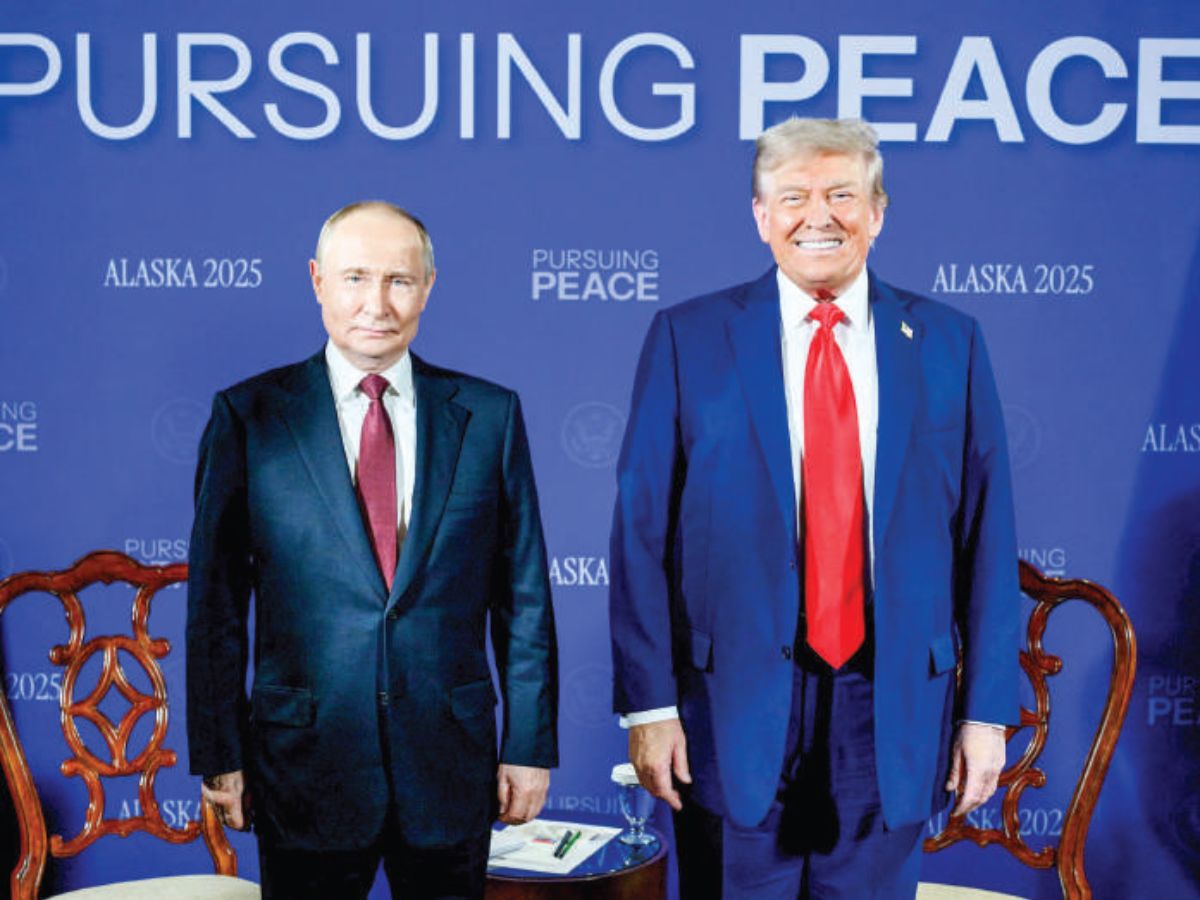
Russian President Vladimir Putin meets United States of America President Donald Trump, in Alaska in August 2025. (ANI)
London: In a week when an irritated Donald Trump announced sanctions against Russia’s two largest oil companies, reportedly because negotiations over a ceasefire deal in Ukraine had stalled, Moscow announced the first successful test of its nuclear-powered cruise missile, the Burevestnik. Coincidence? Possibly, but it was back in 2018 that President Vladimir Putin unveiled a new generation of “invincible” weapons, describing the Burevestnik as a revolutionary missile capable of unlimited range and unpredictable flight paths, perfect for by-passing Western missile defences. It was said at the time that when Putin released the video of how a strike with the Burevestnik might work, showing an animated missile crossing Europe, turning south down the Atlantic, bending around the Cape of Good Hope, then dodging US-missile defence systems to detonate in Florida, President Trump’s orange face went white with fear!
The headline feature of the Burevestnik is its nuclear propulsion system, which allows it to fly for very long distances without the need of conventional fuel. This gives it a strategic reach well beyond conventional cruise missiles, theoretically enabling it to strike from deep inside Russian territory or loiter for extended periods. According to Russia’s top general, Valeri Gerasimov, the missile flew 8,700 miles on its first test, a journey of more than 15 hours. The Burevestnik is also designed to fly at very low altitudes, fifty to a hundred metres above ground, thus reducing radar detection and giving it the ability to evade missile defence systems. Such a terrain-hugging flight combined with the large range, gives it unique “stealth characteristics” by comparison with high-speed ballistic missiles. It’s not surprising, therefore, that in a televised meeting with Vladimir Putin, dressed in military fatigues, a glowing Gerasimov boasted of the development of a weapon of “unlimited range” that could defeat any missile defence system in the world and pack a nuclear punch 20 times that of the bomb dropped on Hiroshima. Even by the Kremlin’s standards, it marked an almighty rattle of a familiar nuclear sabre.
Despite the bold claims, the Burevestnik has faced serious development setbacks over the years and independent analysts remain deeply sceptical. Western intelligence reports suggest that Russia has conducted more than a dozen tests since 2016, with only a handful showing partial success. In one test in August 2019, the 9M730 Burevestnik, codenamed Skyfall by NATO, suffered an explosion at a navy range on the White Sea, killing five nuclear engineers and two service personnel. The blast also resulted in a spike in radioactivity in the area that fuelled fears in the nearby city of Archangel. Even if the Burevestnik really works in due course, experts question whether it’s worth the risk. “It’s a technological stunt more than a military necessity”, says nuclear analyst Pavel Podvig. “Russia already has SSBMs and hypersonic weapons that can do the same job without the need of flying reactors.”
The concept of a nuclear-powered cruise missile is not new. More than sixty years ago, the United States dreamed of a missile that could fly forever. Powered by a tiny nuclear reactor, it would scream across continents at three times the speed of sound, hugging the terrain and dropping hydrogen bombs before crashing itself into oblivion. The idea was terrifying, brilliant - and doomed. That weapon was Project Pluto and it died quietly in late 1964. Russia’s Burevestnik is Moscow’s attempt to bring it back to life.
Project Pluto was born at the height of the Cold War, when American scientists at the Lawrence Livermore Laboratory in California were told to think the unthinkable. The result was the Supersonic Low Altitude Missile, or SLAM - a flying nuclear reactor that could loiter for days, outsmart defences, and deliver catastrophic firepower anywhere on Earth. In ground tests the scientists actually made the concept work, and in early 1964 the Tory II-C engine roared to life in the Nevada desert, heated by the live reactor instead of jet fuel. But success came with a price. Politicians realised that the engine exhaust would have spewed radioactive particles wherever it flew, irradiating the ground below even before the warheads fell, making the programme politically and environmentally unacceptable. Another factor for politicians to consider was that in the early 1960s, ballistic missile technology was maturing rapidly, and intercontinental ballistic missiles (ICBMs) became more reliable, faster to deliver and less diplomatically fraught than a ravenous nuclear-powered cruise missile. As a result, because of the environmental risks, diplomatic cost, and changing strategic calculations, the project was cancelled.
Project Pluto turned out to be a Cold War parable - brilliant hardware, a feasible concept, but a project halted because the price of doing so, radioactive skies and unmanageable escalation, proved too high. The dream of nuclear-powered cruise missiles faded into the archives - until resurrected by Moscow.
Both Pluto and Burevestnik promise limitless power and strategic advantage. Both face the same obstacles: reactor miniaturisation, heat management, radiation control, and sheer cost. The difference lies in context. The United States could afford to walk away from Pluto - it already led the nuclear arms race. Russia, however, sees Burevestnik as a political message as much as a weapon. In an age of sanctions and encirclement, it’s a symbol of technological defiance, proof that Moscow can still shock the world. Whether the missile ever enters full service almost doesn’t matter. As with the space race, spectacle is part of strategy.
Still, physics and engineering have a way of humbling ambition. Nuclear propulsion in a cruise missile remains a nightmare of complexity and contamination. If Russia ever deploys Burevestnik, it will likely be in limited numbers - more a propaganda piece than a practical weapon. In the end, the “unlimited-range” missile may share the same fate as its American ancestor: remembered less as a breakthrough than as a warning. Both Pluto and Burevestnik remind us that there are ideas so dangerous that even superpowers think twice. The line between genius and madness in nuclear weapons design has always been wafer thin. And sometimes, the smartest move is simply not to cross it.
