A substantial portion of digital dissent and social friction we witness daily is being engineered transnationally, orchestrated from across our borders.
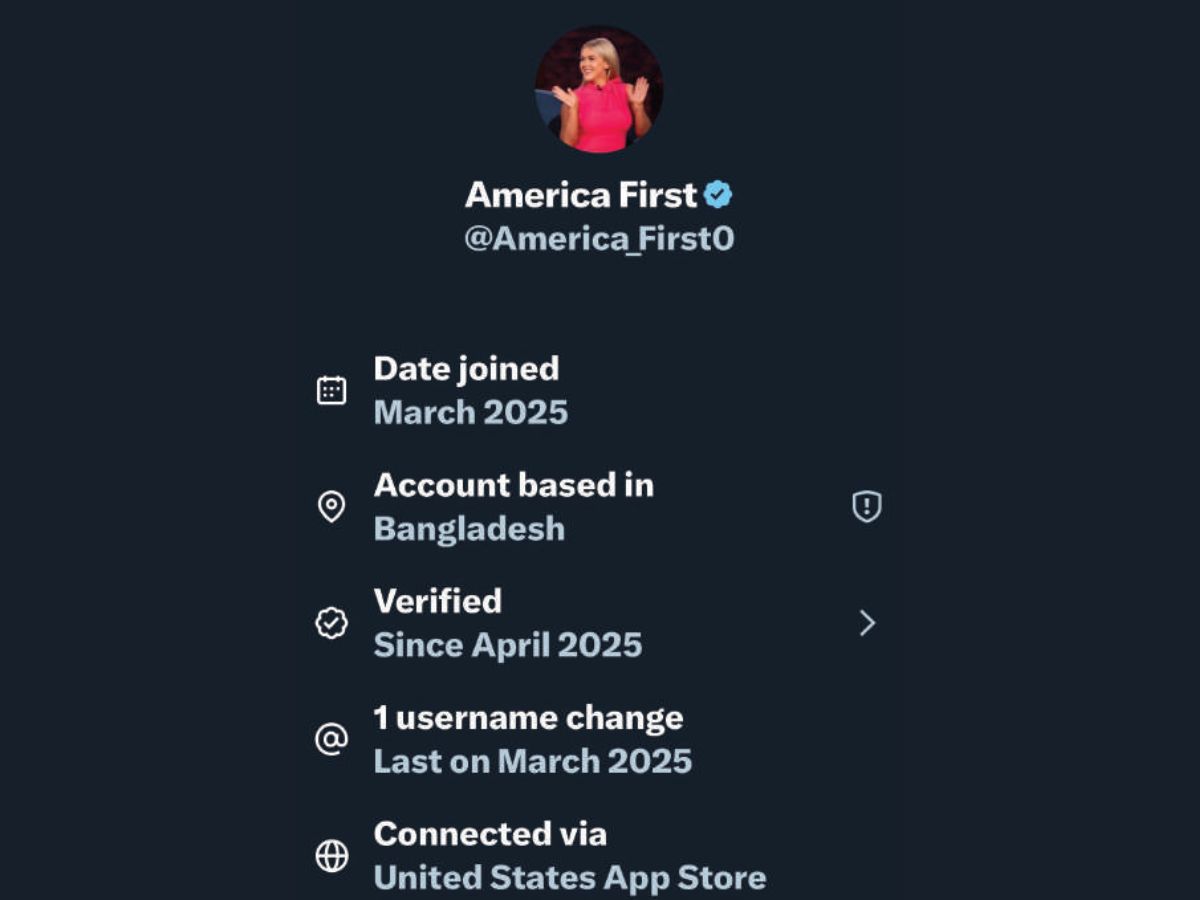
An America First account on X turned out to be Bangladeshi.
THE DIGITAL DECEPTION UNVEILED
Imagine engaging in passionate discourse with a farmer from Ludhiana regarding agricultural policy, only to discover he is tweeting from a suburb in New Zealand. Or nodding along to a concerned Kashmiri activist’s heartfelt plea, unaware that the person behind the screen resides in a government office in Rawalpindi. For years, Indians have harbored suspicions that the cacophony of outrage on social media wasn’t entirely organic. We acknowledged bots existed; we recognized “IT cells” were real entities; yet the scale of foreign interference remained perpetually speculative. That paradigm shifted late last month, when a seemingly innocuous update on X (formerly Twitter) illuminated a dark room—and what materialized before our eyes was both startling and revelatory.
THE REVELATION: A NATION AWAKENED
In late November 2025, X deployed an innovative transparency feature titled “About this account.” The objective remained elegantly simple: to exhibit the primary country or region where an account operates. It was designed specifically to counteract bot proliferation, yet during a brief, chaotic temporal window, it functioned akin to a Geiger counter for deception. The feature transcended mere location display; it systematically shattered meticulously constructed personas. Abruptly, “patriotic” American accounts were unveiled as operations headquartered in Mumbai, while thousands of “Indian” activists, journalists, and concerned citizens were exposed as entities functioning from Pakistan, Bangladesh, and beyond geographical boundaries.
THE ‘SAREE’ BRIGADES OF RAWALPINDI
The revelation manifested itself with impartiality and brutal efficiency. For India specifically, the data painted a particular, troubling canvas: a substantial portion of digital dissent and social friction we witness daily is being engineered transnationally, orchestrated from across our borders. Among the most striking exposures was the deployment of what internet sleuths term the “Saree Network.” These constitute accounts utilizing profile pictures of Indian women, frequently adopting generic Hindu names such as “Diya Sharma” or “Yashita Nagpal.” Their timelines emerge as masterclasses in camouflage—festive greetings for Diwali interspersed with complaints about local traffic, punctuated throughout by sharp, divisive political propaganda. Consider the case of @ChaturvediSwat. To the casual observer, she manifested as Swati, a vocal critic of governmental flood relief initiatives in Punjab. She tweeted over 2,000 times, cultivating a reputation as a “fearless” local voice. When transparency functionality became operational, her location designation failed to indicate Punjab or Delhi; instead it proclaimed Pakistan. She existed in splendid isolation. Dozens of analogous accounts, having invested months or years embedding themselves within Indian conversational matrices, were subsequently unmasked. They transcended mere bots mindlessly retweeting hashtags; these represented sophisticated, human-operated interfaces engineered specifically to emulate the tonal cadence, linguistic slang, and contextual concerns of ordinary Indians.
THE ‘FALSE FLAG’ CASTE WARRIORS
Perhaps the most insidious tactic exposed was the “False Flag” operation meticulously designed to inflame caste tensions. We frequently presume that online hate originates from genuine extremists within our societal fabric. The empirical data suggests otherwise entirely. The transparency update unveiled a constellation of accounts employing upper-caste surnames—Mishra, Tiwari, Sharma—operating from Pakistan and Bangladesh. Their strategic objective? To masquerade as arrogant, hateful upper-caste Hindus systematically abusing Dalits and OBCs across digital platforms. Contemplate the profound implications. An Indian student navigating through X encounters a vile casteist slur and assumes derivation from a fellow citizen. Anger intensifies incrementally; communities drift apart organically; faith in social unity undergoes fracturing processes. In reality, the slur had been typed by an operator stationed in Lahore whose specific job description encompassed manufacturing that precise emotional response. It constitutes identity theft on a national scale, strategically weaponized to systematically dismantle the social fabric.
THE ‘DIASPORA’ DISTORTION
The exposures extended beyond Pakistanian borders entirely. The case of @Tractor2twitr_P presented a sobering examination of how geographical distance systematically distorts discourse. This particular handle emerged as a leading voice during farmer protest movements, claiming representation of “ground reality” specifically within Ludhiana. The location tag, however, directed attention toward Australasia. This phenomenon confirms a long-standing grievance articulated by Indian policymakers: that legitimate local issues are frequently hijacked and amplified exponentially by diaspora groups possessing no substantive stake in consequential outcomes. A tweet inciting unrest imposes negligible economic burden for individuals situated in Melbourne or Toronto; yet the ultimate price is invariably settled by citizens navigating urban landscapes of Delhi.
A GLOBAL GAME OF MIRRORS
To claim this phenomenon occurs exclusively “to” India would constitute intellectual dishonesty. The glitch functioned as an equal-opportunity offender, revealing that Indian operators maintain active participation within this strategic game. “American” accounts such as @AmericanGuyX, which previously posted fervent support for Donald Trump, were subsequently discovered to be operations managed from India. Similarly, accounts presenting themselves as distressed mothers in Gaza specifically soliciting donations were traced back to Indian IP addresses.
THE CRISIS OF TRUST
This transcends mere India-Pakistan geopolitical dynamics; it represents the emerging paradigm of global information warfare. We are collectively entering an epoch where nationality functions increasingly as costume while geography progressively evolves into fiction. What renders this development terrifying extends beyond technological dimensions to encompass fundamental psychological principles. We remain neurologically hardwired to trust “social proof” mechanisms. Upon observing thousands of individuals expressing collective outrage regarding specific issues, we instinctively assume the grievance enjoys widespread legitimacy and organic provenance. We seldom pause to interrogate whether those thousands of individuals actually exist—let alone whether they physically inhabit our national territory. The X transparency event has furnished us with empirical evidence confirming that our digital public square teems with imposters masquerading as authentic voices. The “student” radicalizing youth segments, the “activist” mobilizing protest movements, and the “journalist” curating “exclusive” narrative clips might all represent characters within scripts authored by foreign intelligence agencies or compensated troll farm operations.
MORPHING GEOGRAPHIES
The transparency feature precipitating this meteoric storm has already undergone iterative modifications, with location data now frequently concealed or generalized to broader regional designations such as “South Asia” specifically protecting user privacy. Yet the proverbial cat has demonstratively exited the bag; we now possess irrefutable proof of concept. For the average Indian user demographic, this phenomenon serves as necessary cognitive inoculation against digital deception. The subsequent occasion encountering a handle featuring generic nomenclature accompanied by stock photography imagery making inflammatory claims warrants pause. The outrage might indeed manifest organically; however, the individual marketing this emotional resonance to you potentially constitutes a phantom entity.
WHERE DO WE GO FROM HERE?
The glitch transcended geographical revelation, illuminating our existential positioning upon a digital battlefield where identities undergo systematic weaponization against us. Defence strategies extend beyond robust password protocols alone—they demand cultivation of perpetually sceptical cognitive frameworks. The transparency feature has already undergone iterative modifications, yet the proverbial cat has demonstratively exited the bag; we now possess irrefutable proof of concept. For average Indian users, this phenomenon serves as necessary cognitive inoculation against digital deception. Subsequent encounters with handles featuring generic nomenclature accompanied by stock photography imagery making inflammatory claims warrant pause. The outrage might manifest organically; however, individuals marketing emotional resonance potentially constitute phantom entities operating from distant shores. In essence, we stand at a pivotal moment where technological awareness and critical thinking converge as our primary shields in an era of manufactured consent and strategic misinformation. The path forward requires not merely digital literacy but philosophical vigilance—a conscious recognition that our most fundamental beliefs and social connections are increasingly subject to manipulation by unseen hands across continents.
Brijesh Singh is a senior IPS officer and an author (@brijeshbsingh on X). His latest book on ancient India, “The Cloud Chariot” (Penguin) is out on stands. Views are personal.
