
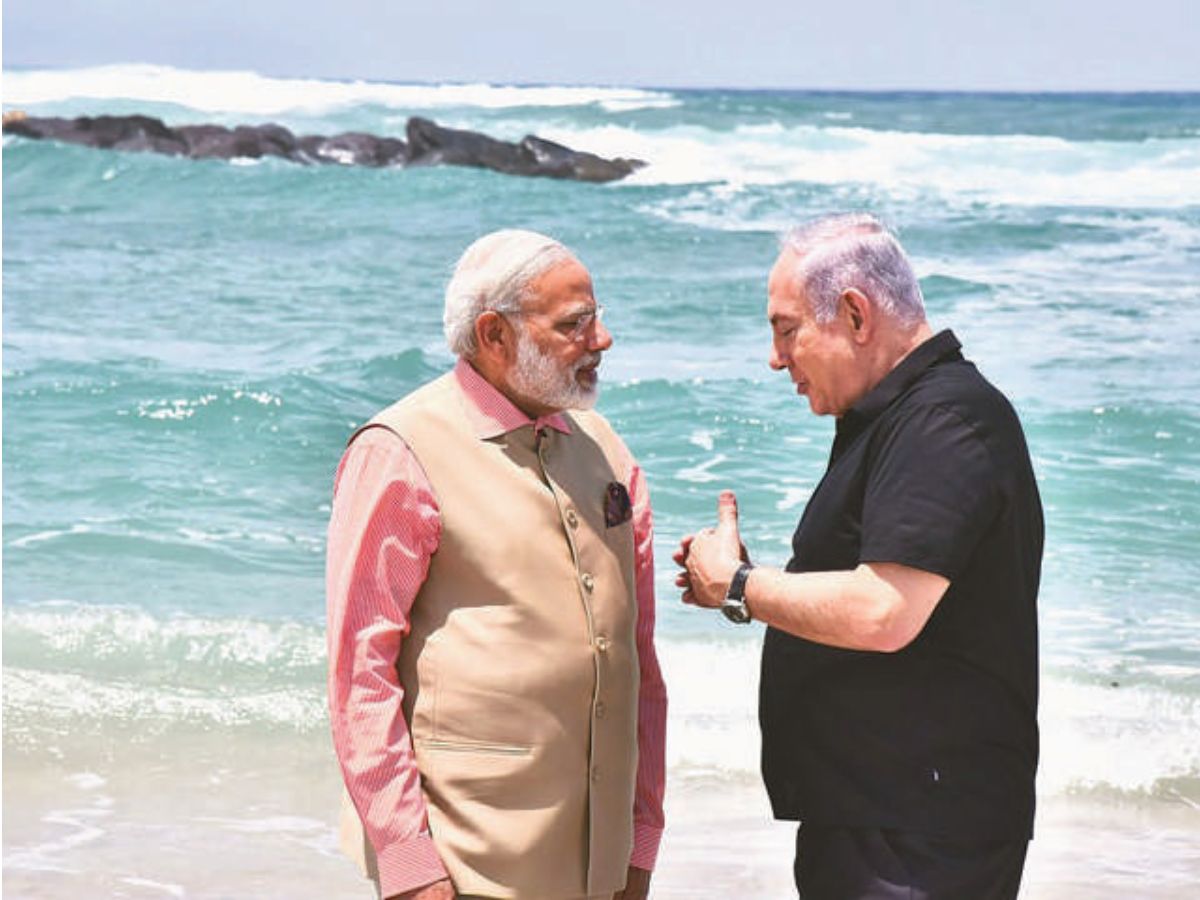
Prime Minister Narendra Modi is to undertake a rather long overdue, two-day visit to Israel this month. This will be his second visit after the historic visit in July 2017. The first historic visit marked the 25th anniversary of the establishment of diplomatic relations between the two countries. Both countries are ancient civilisations and are surrounded by inimical neighbours in a littoral context. India has supported the Gaza Peace Plan but stayed away from the Trump-led “Board of Peace”.
PM Modi is expected to address the Knesset, besides engaging in bilateral talks with Benjamin Netanyahu and the Indian diaspora. India recognised Israel in 1950 and thereafter the diplomatic balancing was essentially counterproductive till as late as the establishment of diplomatic relations in 1992. The bilateral trade between the two countries is 11 billion USD as of last year, which is significant. Post signing the Bilateral Investment Treaty (BIT) in 2025, a fullfledged Free Trade Agreement (FTA) could also be in the works. Ahead of this crucial visit, both countries have signed another industry led MoU to deepen defence ties and strengthen ongoing joint activities on 19 February 2026 in Tel Aviv.
PM’s visit in 2017 was a watershed which formalised several initiatives. India and Israel agreed to establish a strategic partnership in water and agriculture. This included water conservation, water treatment, desalination, water utility reforms, and the cleaning of the rivers using advanced water technologies. Establishment of a Joint Working Group to steer this partnership was also initiated. The two nations agreed that negotiations would be conducted on an agreement for the Protection of Investments to encourage bilateral investments from both sides. MoU for establishing the India-Israel Industrial R&D and Innovation Fund (I4F) by the Department of Science and Technology and National Authority for Technological Innovation, Israel, with a modest contribution of US$20 million from each side was also inked. Another MoU was also signed between the Indian Space Research Organisation (ISRO) and Israel Space Agency (ISA) for cooperation in the GEOLEO optical link and electric propulsion for small satellites.
The world has changed with a huge upheaval in West Asia, especially post the ghastly attacks of 7 October 2023 on Israel and the ensuing conflict in Gaza. The situation between Israel and Gaza remains critical, with the ceasefire in place as large-scale fighting has stopped. A formal ceasefire has been in effect since October 2025, however, the IDF has recently indicated that it is not holding up, as expected due to a stalemate in Hamas’ disarmament. Gaza is nominally under a transitional “Board of Peace”, intended to bypass both Hamas and the current Palestinian Authority. The International Stabilisation Force (ISF), slated for deployment to facilitate the second phase of the peace deal is yet to be deployed, but four nations have finally committed troops. The disarmament of Hamas remains a distant possibility though.
Silicon, Surveillance, Stealth and Spectrum are the four pillars for cutting edge military collaborations for the future. Israel is India’s second largest defence supplier, with a large market for hight technology intensive Israeli arms industry. Indian inventory consists of Rampage missile, Harop and Sky Striker loitering munitions, Crystal Maze 2 missile, Barak-8 MRSAM air defence system developed in collaboration with DRDO and Heron Mk2 UAV. Some of these weapon systems decimated Pakistan’s terror seminaries and assets during Op Sindoor. During the 2019 Balakot airstrike, Indian Air Force aircraft are known to have effectively used SPICE-2000 bombs to strike terror targets.
Israel is also in collaboration with various Indian companies to manufacture in India. Adani Defence formed a joint venture with Israel’s Elbit Systems in 2016 to manufacture Hermes 900 drones domestically by establishing a production facility in Hyderabad. Adani Defence also produces small arms such as the Tavor TAR-21, X-95 Tavor, Negev Light Machine Gun, Galil ACE assault rifle, Galil DMR, and Masada pistols in collaboration with the Israeli Weapons Industries. 16,479 Negev NG-7 LMGs for the Indian Army were contracted in 2020. On 26 January 2026, SURYASTRA has been showcased which is PULS (Precise and Universal Launching System) manufactured by Elbit Systems in collaboration with Nibe Defence Limited.
There could be major defence purchases from Israel in the immediate future. While the probability of procuring weapon platforms remains low, air-to-ground missiles like IAI Rampage, Air LORA ballistic missile, Ice Breaker missile and Rafael SPICE-1000 bombs may be procured or co-produced under joint ventures. Advanced avionics for LCA Tejas and other aerial platforms could also be explored. Several joint technological collaborations are also likely to be signed. Israel is the startup cauldron of the world and has a vibrant defence and critical technologies start up ecosystem. More collaborations in this niche segments can incubate many disruptive technologies and accrue long term results.
The issue of Iran and Gaza is likely to come up during the talks. India-Middle East-Europe Economic Corridor (IMEC), a critical project for economic interests for both nations, and new agreements in the agriculture sector could also be signed between the two countries.
It is a state of uneasy calm, post the 12-day intense war of June 2025 with Israel and the US conducting intensive strikes against Iranian nuclear and military infrastructure. Israel has placed its military on maximum alert following indications of potential large-scale US strikes on Iran, if the current negotiations in Iran-US nuclear talks in Geneva fall apart. The region has been on the edge with hostage negotiations, military brinkmanship, diplomatic trapeze and “tripwire turbulence” in the last two years. As the US moves more aircraft carriers and deploys military assets in the Middle East, albeit to strike Iran and defend Israel from Iranian attacks, it is a rapidly developing politico-military situation.
Vintage in collaborations and international groupings is a pivotal aspect as it gives impetus to mature systems, emphasis on dialogue as well as a greater elbow room for negotiations. Is there a case in point for Israel to move its weapon production lines to India and co-develop critical technologies to include AI, cybersecurity, semiconductors, etc.? Will the Modi-Bibi bonhomie, beyond Yair Lapid’s boycott call, a volatile scenario in West Asia and expanding US footprint in Iran’s backyard defuse tensions and steer expected outcomes to include deeper ties? In a multi aligned world, rise of the tech giants and ever evolving nature of warfare and diplomacy, India-Israel relations have the wherewithal to not only endure the naysayers but silence them with poise.
-
Anurag Awasthi is a veteran, and CEO of Escape Velocity Mediaworks. He is a known policy expert and a columnist who writes extensively on critical technologies, security and geopolitics. Views are personal.




