Balancing sovereignty and innovation becomes the central task. India cannot afford to remain dependent, but it also cannot smother its own technological growth. India’s new AI Governance Framework addresses this balance directly.

Strategic Autarky for the AI Age
For decades, the world has tapped into a single digital backbone. Cloud infrastructure, social platforms, semiconductor supply chains, and cutting edge AI systems are overwhelmingly controlled by the United States. From hyperscale cloud providers to the chipmakers powering modern computation, American companies hold the central levers of the global digital economy. This dominance delivers convenience, but it also concentrates control in ways that can create vulnerabilities for countries plugged into these systems.
India is part of this interconnected world. Our rapid digital rise has been remarkable, yet the infrastructure supporting it often lies outside our borders. The essential silicon for AI compute still comes from firms like Nvidia, Intel, and AMD. The cloud resources running everything from banking to governance are hosted on Amazon Web Services, Google Cloud, and Microsoft Azure. Even the AI models used across industries are built and trained on foreign servers. These dependencies do not weaken India, but they do reveal an external exposure we cannot ignore.
Strategic vulnerability is not hypothetical. In 1999, during the Kargil conflict, India sought precise GPS coordinates from the United States. The request was declined. That moment showed how reliance on a foreign digital layer could shape battlefield realities. India responded by creating NAVIC, our own navigation system. NAVIC is proof that national capability can emerge the moment a country decides to build for itself.
The stakes today are larger. This time the leverage lies in AI compute capacity, cloud availability, chip access, and control over critical data flows. In any future conflict, the opening blow may not involve missiles. It might come through denied access to servers, throttled bandwidth, or sudden authentication failures across digital systems that hold national importance.
This is why AI sovereignty is no longer only a policy aspiration. It is a national necessity. AI sovereignty means a nation has the ability to build, run, and secure its AI stack, including data pipelines, algorithms, and compute infrastructure, without fearing sudden disruption from external actors.
Around the world, other regions are taking firm steps. Europe has tried to reclaim its digital independence through strong regulation. The EU AI Act classifies AI systems by risk, mandates algorithmic transparency, enforces documentation obligations, and demands conformity assessments for high risk models. The region has also invested in local cloud initiatives and data localization strategies to reduce external dependence. These choices strengthen consumer safety and accountability, but they also carry side effects. The cost of compliance is high. Startups must navigate heavy documentation requirements, model audit obligations, and prescriptive technical standards. Innovation can slow. Investment can shift to less restrictive markets. This is the classic risk of overregulation.
This is the lesson India must take seriously. AI is still emerging. Overspecifying rules, enforcing rigid certification pathways, or creating sector wise chokepoints too early can stifle the very innovation we aim to promote. Burdensome compliance layers, mandated algorithmic disclosures, prescriptive model testing protocols, and fragmented approval processes can all create friction. Overregulation can discourage experimentation, elevate the cost of market entry, and drain our fastest growing startups. The risk is simple. Innovation flight. Loss of competitive edge. A domestic ecosystem slowed down before it reaches maturity.
Balancing sovereignty and innovation, therefore, becomes the central task. India cannot afford to remain dependent, but it also cannot smother its own technological growth.
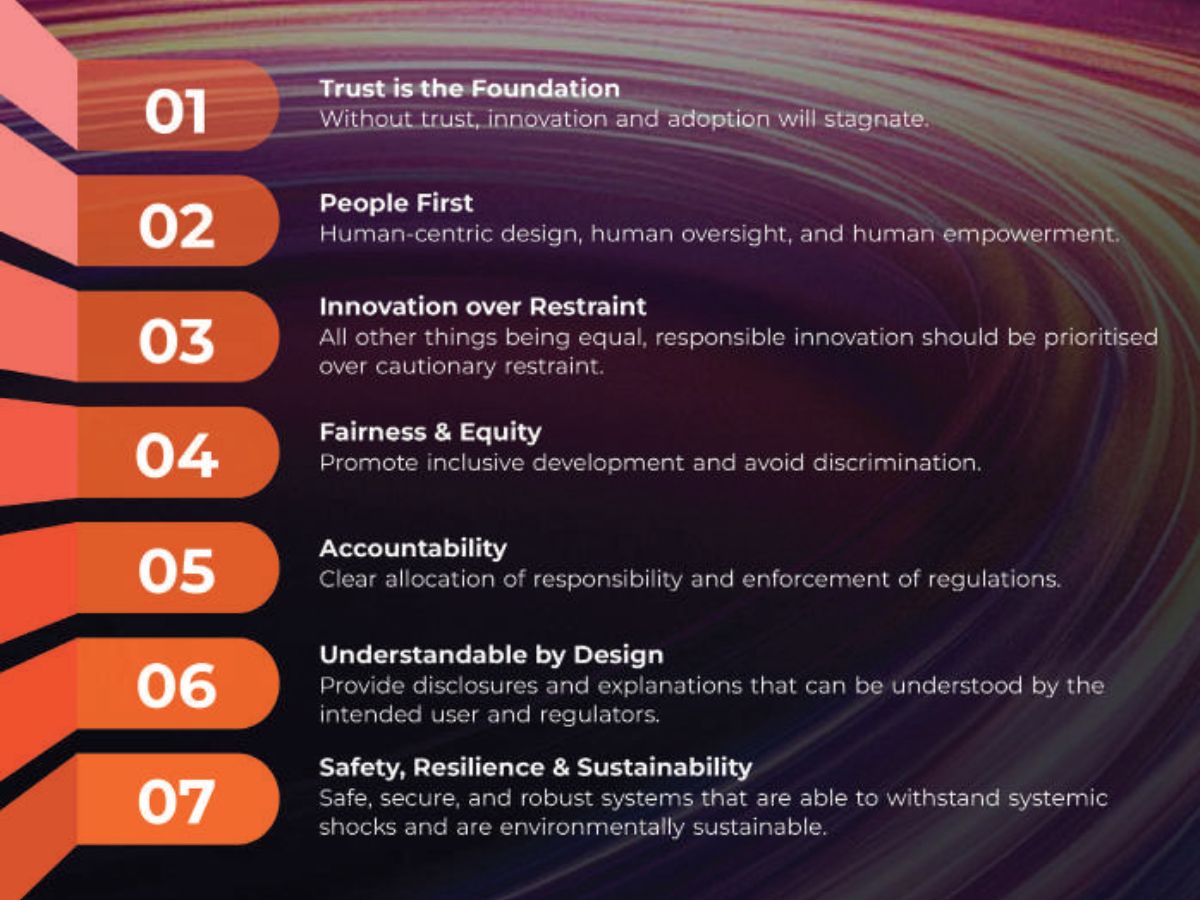
India’s new AI Governance Framework addresses this balance directly. It follows seven guiding principles built around trust, accountability, transparency, privacy, security, human centricity, and collaboration. The standout feature is its “light touch” approach. Instead of imposing rigid controls, the framework sets high level principles that can evolve with technology. It relies on India’s existing legal foundation, including the Digital Personal Data Protection Act and the Information Technology Act, and is supported by institutional structures like the AI Governance Group and the AI Safety Institute.
The framework contains several strong provisions. It encourages voluntary risk assessments rather than mandatory rigid audits for most systems. It promotes developer accountability without creating unnecessary reporting burdens. It strengthens transparency expectations for high impact AI systems but avoids prescriptive algorithmic disclosure. It also supports sandbox environments for sector specific experimentation and allows regulators to adapt guidelines as technologies mature. Crucially, the framework recognises the value of India’s Digital Public Infrastructure. It encourages building AI solutions atop trusted, indigenous digital rails. This positions India not just as a consumer of global AI but as a producer of sovereign AI solutions.
The Digital Personal Data Protection Act and the new DPDP Amendment Rules complement this approach. They provide clear principles for data minimization, purpose limitation, lawful processing, breach reporting, and accountability of data fiduciaries. The Act empowers citizens while mandating strong safeguards for sensitive and high risk data. The new Rules offer clarity on cross border data transfers, retention timelines, grievance redress procedures, and responsibilities of large data fiduciaries. Together they form a strong foundation for digital sovereignty by ensuring that data belonging to Indians is protected through law and cannot be misused or transferred without oversight.
Hardware independence is another pillar of this strategy. The Production Linked Incentive schemes for semiconductors aim to reduce India’s reliance on imported chips. Recent investments in fabrication and assembly units in Gujarat and partnerships with global semiconductor leaders mark real progress. The goal is simple. Build domestic capability in chip manufacturing, packaging, and design. This will help India secure the compute backbone required for its AI ambitions.
These efforts reflect a clear national strategy. Under the leadership of the Prime Minister, India has placed digital sovereignty at the centre of its technological roadmap. The intention is not isolation but controlled independence. Collaboration on fair terms. Openness with safeguards. Innovation driven by Indian talent and built on Indian soil.
The story of NAVIC taught us that self-reliance strengthens a nation. Today, India is applying that lesson to AI, cloud infrastructure, chip manufacturing, and data protection. What was once a vulnerability is becoming a strength. The country is building digital foundations that are secure, resilient, and aligned with long term national interest.
With the right balance between sovereignty and innovation freedom, India can emerge as a global leader in AI and advanced digital technologies. We have the talent, the scale, the policy vision, and the institutional groundwork. The task now is to sustain the momentum. India is moving from dependence to capability. From vulnerability to control. From being plugged into someone else’s system to gradually building our own. And as we strengthen our digital foundations, the nation moves closer to a future where our digital switch is in our hands and our technological destiny is firmly our own.
Kartikeya Sharma is Independent Member of Parliament (Rajya Sabha).
