By recognizing how Washington weaponizes information through these annual publications, India can better protect its narrative sovereignty while selectively leveraging American documentation when interests align.
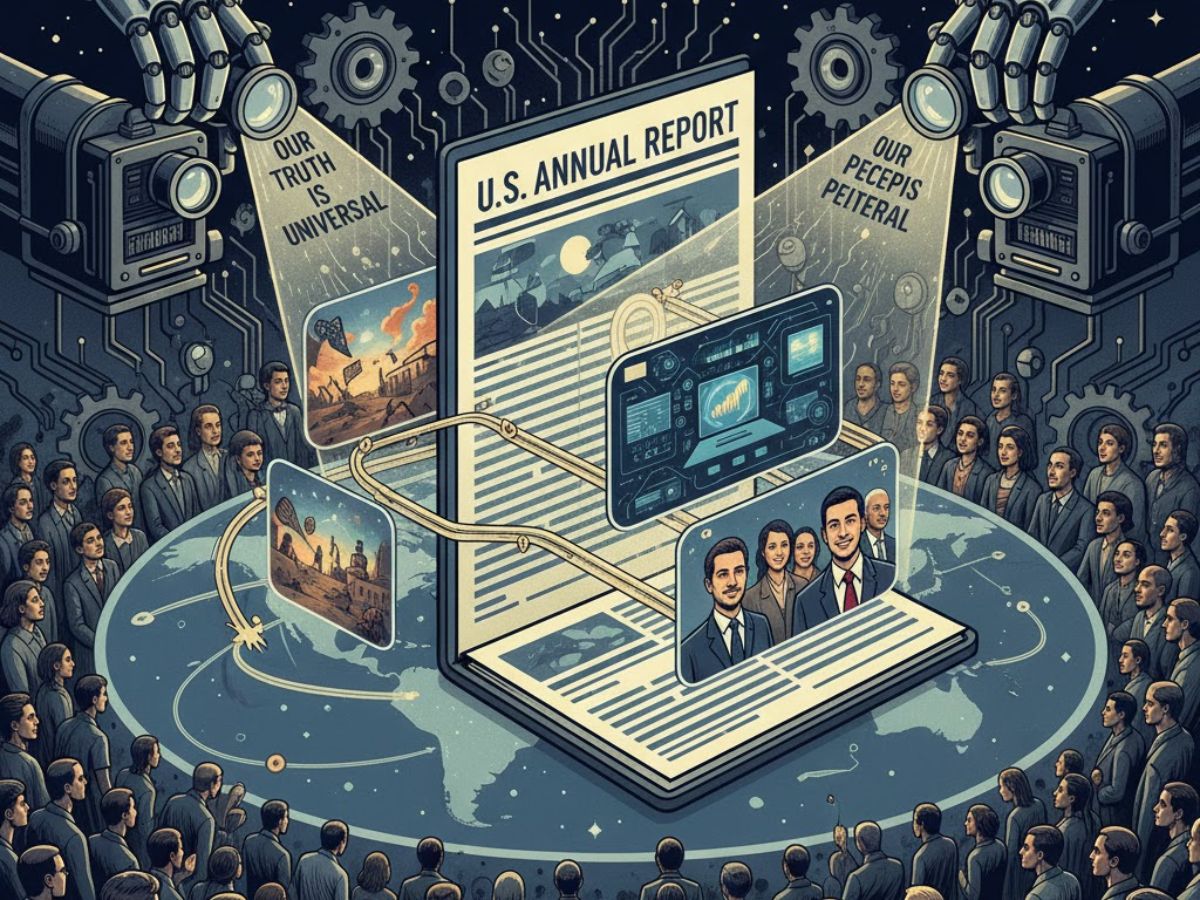
Strategic Storytelling: U.S. Annual Reports are Tools for Global Narrative Control
THE SILENT ARCHITECTS OF POWER
In the shadowy corridors of global power politics, documents often wield more influence than missiles; this truth has been reaffirmed by the recently released “2025 Annual Report to Congress” by the U.S.-China Economic and Security Review Commission. This report—sending ripples through security circles in India—has illuminated not merely explosive claims about China’s role in the May 2025 India-Pakistan clash, but something more profound: America’s sophisticated machinery of strategic communication. Like a master weaver crafting tapestries from invisible threads, Washington transforms bureaucratic documents into instruments of narrative warfare.
BEYOND INTELLIGENCE: THE ART OF ‘PAPER WEAPONS’
For Indian readers navigating an increasingly complex geopolitical landscape, understanding how America crafts and deploys such documents isn’t merely useful—it’s essential. The USCC report joins a constellation of American publications—the State Department’s annual “Country Reports on Human Rights Practices,” the “International Religious Freedom Report,” “Internet Freedom Reports,” and others—that function less as neutral assessments and more as strategic tools designed to shape global perceptions, build coalitions, and pressure adversaries.
These documents represent what scholars call “paper weapons”—non-kinetic instruments of statecraft that often achieve more than military deployments.
OPERATION SINDOOR: NARRATIVE ENGINEERING IN ACTION
Consider the USCC report’s treatment of Operation Sindoor by India, dubbed the four-day May 2025 conflict. By portraying the limited war in terms of “Pakistan’s military success achieved through Chinese weapons,” highlighting Beijing’s opportunistic leveraging of the clash, and noting China’s dominant 82 percent share of Pakistan’s arms imports, the report persuasively constructs a narrative that serves multiple American strategic purposes simultaneously.
Its timing and content aren’t accidental; they reveal Washington’s intention to provide Congress with concrete justification for tightening export controls and sanctions against Chinese defence entities—legislation already making its way through Capitol Hill.
Simultaneously, it offers American diplomats a ready-made evidence package to share with allies, particularly India, reinforcing the narrative of China as a destabilizing force that weaponizes regional conflicts for commercial and strategic gain.
FROM DOCUMENTS TO DISCOURSE: THE AMPLIFICATION EFFECT
But the real power of such reports lies in their media amplification; Washington understands that a congressional document carries more weight than a White House press statement. When the USCC report details how China used Pakistan’s purported “battlefield successes” as “live advertising” for its weapons systems, it provides journalists worldwide with ready-made headlines and compelling narratives.
Major newspapers, television networks, and digital platforms amplify these findings, often without critical examination of their sourcing or political context. The result? America’s strategic framing of adversaries’ behaviour becomes the dominant global narrative, shaping public opinion and policy debates far beyond Washington’s corridors.
THE HUMAN RIGHTS PARADIGM: A LEGACY OF NARRATIVE CONTROL
This isn’t new methodology; for decades, America’s annual human rights reports have functioned similarly. When the State Department publishes its country-by-country assessments, it doesn’t merely document abuses—it strategically selects timing, emphasizes particular violations, and frames findings to advance specific foreign policy objectives.
Countries that cooperate with American interests often receive more nuanced treatment, while adversaries face exhaustive documentation of their failings.
The religious freedom and internet freedom reports follow identical patterns, creating what diplomatic analysts call “narrative asymmetry”—where one nation controls the terms of global discourse about its competitors.
For India, this reality demands sophisticated navigation; when American reports highlight China’s support for Pakistan during the May 2025 clash, they validate Indian security concerns while simultaneously advancing America’s own containment strategy toward Beijing, while advancing the interests of the US military-industrial complex.
This alignment of interests can be beneficial—providing India with international validation for its stance on cross-border terrorism and Chinese military expansion. Yet it also creates dependencies; by relying on American documentation to legitimize our security concerns, India risks having its strategic autonomy subtly compromised, with Washington setting the terms of acceptable discourse about regional stability.
THE DENIABILITY DIVIDEND: POWER WITHOUT BACKLASH
The genius of America’s report-based strategy lies in its deniability; unlike military interventions or economic sanctions, which trigger immediate backlash, these documents operate in the realm of “objective analysis.” Their bureaucratic language and voluminous footnotes create an illusion of neutrality that makes criticism appear defensive or conspiratorial.
When China protests the USCC report’s findings about its weapon exports to Pakistan, its objections are easily dismissed as predictable defensiveness rather than legitimate challenges to American narrative dominance.
Indian policymakers must recognize that these reports aren’t passive reflections of reality but active constructors of it; the USCC’s emphasis on the “proxy war” debate surrounding the May 2025 clash, for instance, isn’t merely analytical—it’s designed to shape how future conflicts are interpreted.
By establishing a framework where Chinese arms transfers automatically trigger proxy war discussions, America creates precedents that can justify intervention in other theatres where Beijing seeks influence.
This strategic communication ecosystem extends far beyond security matters; America’s religious freedom reports, for example, often highlight issues in countries where the U.S. seeks to counter Chinese, Indian or Russian influence, while downplaying similar concerns among strategic partners.
Internet freedom reports similarly map onto geopolitical priorities, with digital rights criticisms intensifying against nations that resist American technological dominance.
For India, where technology partnerships and strategic autonomy are increasingly vital, understanding these patterns is essential for maintaining balanced relationships.
INDIA’S RESPONSE: FROM DEPENDENCE TO NARRATIVE SOVEREIGNTY
The challenge for India isn’t to reject American reports wholesale—they often contain valuable information and analysis—but to develop our own strategic communication capabilities that match this sophistication.
Just as America uses the USCC report to validate India’s concerns about China while advancing its containment agenda, India must learn to craft narratives that serve our interests without becoming dependent on external validation.
This means investing in credible, transparent documentation of security challenges that resonates internationally while maintaining our strategic independence.
When American reports detail China’s 82 percent dominance over Pakistan’s arms imports, they serve India’s interest by exposing Beijing’s military entanglement with Islamabad; yet this same documentation also advances America’s goal of isolating China globally, and selling its own weapons.
Indian strategists must recognize both dimensions—the tactical benefit and the strategic cost—when engaging with these materials.
For ordinary Indian citizens, this understanding matters because these reports shape the international environment in which India operates; when American narratives dominate global discourse about South Asia, they influence foreign investment, tourism perceptions, and diplomatic support on critical issues like Kashmir or border disputes.
By recognizing how Washington weaponizes information through these annual publications, India can better protect its narrative sovereignty while selectively leveraging American documentation when interests align.
THE FUTURE OF INFLUENCE: CRAFTING COMPELLING COUNTER-NARRATIVES
America’s paper weapons won’t disappear—they’re too effective; but India can develop counter-narratives that are equally compelling and credible. This requires moving beyond reactive statements to proactive strategic communication that anticipates how global audiences interpret regional events.
When the next USCC report emerges, or when the State Department releases its human rights assessments, Indian policymakers should ask not just what the documents say, but what strategic work they’re designed to accomplish—and how India can shape that narrative rather than merely responding to it.
In today’s world, where perception often trumps reality in determining geopolitical outcomes, understanding the machinery behind these reports isn’t academic—it’s fundamental to national security.
As India ascends as a global power, mastering this dimension of statecraft becomes as crucial as military capability or economic strength. The documents emerging from Washington aren’t just pages of text; they’re battlefields where the narratives of tomorrow are being written today.
India’s future security depends on understanding this game—and learning to play it with equal sophistication.
Brijesh Singh is a senior IPS officer and an author (@brijeshbsingh on X). His latest book on ancient India, “The Cloud Chariot” (Penguin) is out on stands. Views are personal.
