
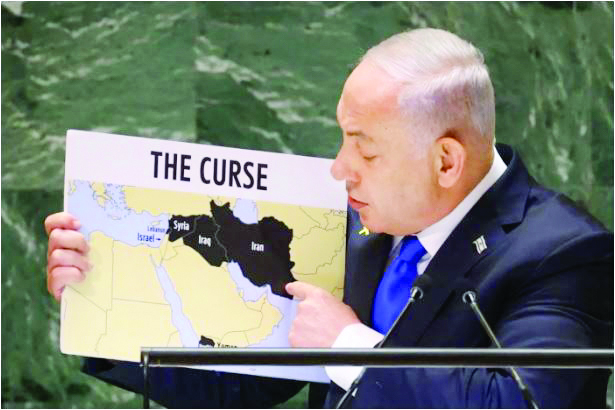
LONDON: Bibi acted like a madman. He bombs everything all the time”, a White House official told the New York Post last Monday. Officials in the West Wing are said to be fuming over Israeli Prime Minister Benjamin Netanyahu’s “madman” trigger happy behaviour to Israel’s neighbours, even while President Trump plays nice with him. Having agreed to stand down on Tuesday the previous week, Netanyahu escalated the situation the next day by ordering the bombing of Syria’s military headquarters and a facility near the presidential palace.
“The bombing in Syria caught the president and the White House by surprise” said the official. “The president doesn’t like to turn on the television and see bombs dropped on a country in which he is seeking to make peace”. White House Press Secretary, Karoline Leavitt, confirmed to reporters on Monday that Trump was “caught off guard by the bombing in Syria”, before glossing over the issue saying that the president “enjoys a good working relationship with Prime Minister Bibi Netanyahu and stays in frequent communication with him”.
Of course he does, say critics, pointing to the sickening scene when Netanyahu in full view of the world polished Trump’s ego while handing him the letter recommending the president for the Nobel Peace prize! So, why did Netanyahu order the airstrikes on key government sites in central Damascus, including the Ministry of Defence headquarters on 16 July? After all, under the current President of the Syrian Arab Republic, Ahmed al-Sharaa, Syria no longer presents a real and present danger to Israel.
Netanyahu’s goal, said his spokesman, was to defend the Druze community in southern Syria who, he claimed, were under attack from the local Bedouin tribes. Recent violence in Syria’s southern Suwayda has brought renewed global attention to the Druze and Bedouin communities, who have a history of coexistence and conflict spanning centuries. The Druze, who make up about 3 percent of Syria’s population, live mainly in the Israeli-occupied Golan Heights. Others live in Israel’s Galilee. Those in the Golan Heights identify as Syrian, while those in Galilee identify as Israeli citizens and are conscripted into the Israeli Defence Force. In many ways, the DruzeBedouin issue encapsulates the problems facing President al-Sharaa.
Syria has one of the oldest continuous histories in the world, stretching back thousands of years when it was the centre of early writing, trade and diplomacy. Following the Persian Empire, Hellenistic and Roman/ Byzantine periods, Syria was an Islamic Caliphate for more than a thousand years, before the Ottomans ruled from 1516 until the end of the First World War. The result is a Syria that is a highly diverse country with many ethnic and religious minority groups. Based on population categories, Sunni Arabs are by far the majority, making up about 75 percent of the population with Shiite Alawites making up about 12 percent. Christians, Kurds and Druze make up the majority of the remainder, together with small numbers of Ismailis, Yazidis, Assyrians, Armenians, Turkmen, Circassians, and Chechens.
There are even some 200 Jews living in Syria. With such a mish-mash of a population, Ahmed alSharaa has an almost impossible task on his hands. However, Martin Stutzman, a US Congressman who visited Syria in April and met with Sharaa, said afterwards that the new president is dead-set on keeping Syria united. “Any effort to divide the country into regional parts or sectarian parts was not acceptable”, he said after the meeting. The following month, US Secretary of State Marco Rubio was less sanguine, telling US lawmakers that Syria may be weeks away from plunging into another civil war or collapsing altogether.
Rubio, who met with top Syrian officials during President Trump’s Middle East trip, said fears for the fledgling Damascus government were the main reason why Trump abruptly opted to implement a 180-day waiver on sanctions following his meeting in Saudi Arabia with Syrian President Ahmed al-Sharaa. “It is our assessment that, frankly, the transitional authority, given the challenges they’re facing, are maybe weeks – not many months – away from potential collapse and full-scale civil war of epic proportions, basically the country splitting up,” Rubio ominously told the Senate Foreign Relations Committee.
Ahmed al-Sharaa is not unfamiliar with revolution, having himself toppled the detested Assad regime last year, ending a dynasty that had ruled the former French colony since 1971. A career militant who fought US troops as a member of Al Qaeda in Iraq in the early 2000s, al-Sharaa founded the terrorist group’s Nusra Front affiliate in Syria in 2012. He broke with al Qaeda’s leadership in 2016 and has sought to rebrand himself as a defender of Syria’s religious diversity. Nevertheless, until Donald Trump made his first international trip of his second term to Saudi Arabia, where he was greeted like royalty with gold-plated pomp, the now-director of US National Intelligence, Tulsi Gabbard, condemned al-Sharaa during her confirmation hearing in January as “an Islamist extremist who danced on the streets to celebrate the 9/11 attack”.
Gabbard is well known for changing her opinion when pragmatism demands. The great fear in the West, however, is that if Syria collapses again it could lead to chaos throughout the Middle East. Marco Rubio emphasised this concern in his evidence to the US Senate, underscoring how after the civil war erupted in March 2011 the country became a “playground, frankly, for jihadists like ISIS and others.” Jihadist activity is causing the greatest concerns among Syria-watchers. The BBC’s Mina al-Lami, who was born and grew-up in Baghdad in the shadow of 2 Gulf Wars when she personally witnessed the rise of Jihadism, described on X this week the intense debate among jihadist circles sparked by al-Sharaa’s meeting with Trump in Saudi Arabia.
Mina currently leads the broadcaster’s Jihadist media monitoring team, where she keeps a close watch on jihadist communications and online networks. Al-Sharaa’s meeting with Trump, she reports, has raised many questions among Jihadists in the media about the Syrian president’s trajectory and whether his actions amount to apostasy. Developments in Syria over the past few weeks have exposed a deepening rift between pragmatic Islamists, who view al-Sharaa’s approach as a strategic victory for the Islamist movement and its attempt to enter mainstream global politics, and hardliners who regard his perceived alignment with “infidel” states as a grave betrayal of Islamic principle.
The greatest concern is that al-Sharaa’s compliance with certain Western demands could risk intra-Islamic conflict that could further destabilise Syria. Mina al-Lami poses the question: “Will Sharaa’s political gains alienate him from the broader Islamist movement, or will his example inspire other groups to abandon global jihad in favour of localised political projects, with the hope of achieving similar success?” Unquestionably, Ahmed al-Sharaa has his work cut out to keep Syria united against the odds, and Benjamin Netanyahu is not helping the situation by his belligerence across the region.
On 16 July he authorised the bombing of a Syrian envoy heading towards Suwayda in southern Syria to address the bloodshed between the armed Bedouin tribesmen and the Druze militia. Syria’s government claimed it was simply trying to stop the violence and restore order, but Netanyahu accused it of helping in the attacks on the Druze. He also accused Syria of crossing a zone inside southern Syria that he had demanded remain demilitarised. Al-Sharaa diplomatically declined to retaliate against Israel and agreed to pull troops back from Syria’s south, but Netanyahu is clearly trying everyone’s patience in the Middle East.
Netanyahu’s belligerence towards al-Sharaa suggests that Israel is seeking to keep Syria weak, fragmented and in disarray. He appears to believe that scepticism towards the new Syrian leadership is warranted, suspecting that al-Sharaa’s apparent pragmatism stems solely from the urgent need for resources such as fuel and wheat. This is wrong. Netanyahu is overlooking how much al-Sharaa has evolved over the past decade, severing his ties with al-Qaeda, engaging in fierce battles with both al-Qaeda and ISIS, and repositioning his party as a strictly Syrian Islamistnationalist group focused on successfully defeating the Assad regime.
While ruling Idlib in north-western Syria, al-Sharaa leant increasingly towards conciliation of minorities, reaching out to Christians and Druze, offering them protection, reopening churches and returning properties that the rebels had confiscated. Somewhat bizarrely, Israeli officials voice concern about both the Syrian governments current weakness and its hypothetical future strength, fuelling perceptions that Israel’s strategy is muddled. Netanyahu’s current approach to Syria is increasing the danger of the country becoming a failed state. He must be stopped. A Middle East in chaos is good for nobody, even if the Israeli leader mistakenly believes that such disorder will benefit Israel’s security. Syria is on the edge and Netanyahu’s belligerence is not helping.
John Dobson is a former British diplomat, who also worked in UK Prime Minister John Major’s office between 1995 and 1998. He is currently a visiting fellow at the University of Plymouth.




