
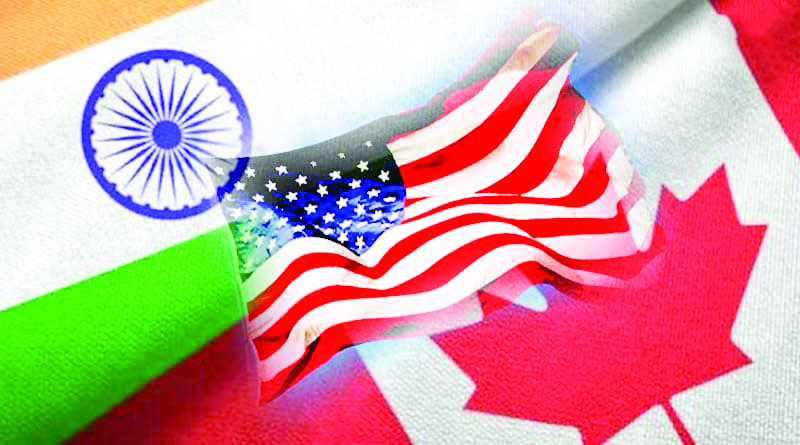
OTTAWA: There are moments in history where leaders mistake force for strategy. Last week was one of those moments.We are at that moment in time and both the statistics, and the market reactions told us all that President Trump’s bravado, along with his trade protectionist and Trump sycophant Peter Navaro,is pushing us all to a place where our collective patience is running thin. Somehow, Americans have decided it’s better to teach a lesson rather than to work in partnership.We all take offence to the cheap shots President Trump has made; and the sheer bombast at times has everyone shaking their head.
These include that Canada has treated and taken advantage of America for a “long, long time”, while throwing in the little American farmer into his diatribe. As a publisher, businessman, and Canadian, who has worked to build relationships across borders from Ottawa to New Delhi to Washington, I watched with great concern as President Trump reimposed a 35% tariff on all imports outside the CUSMA(Canada, US, and Mexico) trade zone.
A move that may, in his mind, signal strength, but in reality, signals something else entirely: economic anxiety wrapped in political bravado. With the August first deadline the Mexican President was able to placate the President enough that they were willing to give Mexico a 90-day reprieve. Canada? No such luck. Instead, we’ve once again found ourselves in the crosshairs of a political narrative that paints allies as freeloaders and tariffs as silver bullets.
Once again citing our lack of a response to illicit drugs and fentanyl production and distribution as a key reason why we can’t get to an agreement. Let me be clear: tariffs are not strategy. They are tactics—blunt ones at that. And while they may bring short-term relief to struggling industries, they do so at a high cost—paid not by adversaries, but by everyday Americans and their closest partners.
A LEGAL SLEIGHT OF HAND, NOT A MANDATE
What makes these new tariffs especially troubling is not just their economic impact—but their questionable legal foundation. Under U.S. law, tariffs must generally align with either congressional trade authority or be justified under specific statutes such as Section 232 of the Trade Expansion Act (for national security) or Section 301 of the Trade Act (for retaliation against unfair trade practices). Yet in this latest round, the Trump administration has offered neither a public investigation nor formal findings to justify 35% duties on CUSMAadjacent goods. Instead, it appears to be repurposing outdated Section 232 arguments—originally used to justify steel and aluminium tariffs—as a catch-all basis for broader, politically motivated trade actions.
This skirts congressional oversight and evades public hearings that were part of the original CUSMA negotiation process. In bypassing procedural safeguards, the administration undermines the very legal architecture of trade policy and invites challenges at the WTO and from domestic industries dependent on transparent, rules-based trade. In oral arguments before the U.S. Court of Appeals for the Federal Circuit on July 31, 2025, judges heavily challenged the legality of Trump’s sweeping tariffs imposed under the International Emergency Economic Powers Act (IEEPA). Judge Jimmie Reyna highlighted a key flaw: “IEEPA doesn’t mention the word tariffs anywhere,” expressing alarm that this strained use could grant the executive unchecked authority over trade law.
Judge Timothy Dyk echoed that concern, noting he found it “hard… to see” Congress intended to permit the President to unilaterally rewrite federal trade statutes based on the Act. But let’s not get hung up on the legal, but rather let’s examine one more part of the illusion. That the tariffs will make us rich and pay of the deficit spending.
TARIFFS: PAIN WITH NO PAYOFF
It’s important to understand the numbers, because numbers don’t lie even when politicians do. Last year, the U.S. ran a $1.6 trillion deficit. Its national debt surpassed $34 trillion. At the very peak of Trump’s first trade war, tariff revenues pulled in less than $90 billion. Even if you get to the administration’s wildly optimistic $300 billion, you’d still only cover about 20% of the federal deficit. Let’s not kid ourselves: this is not about balancing books. It’s about scoring points. Tariffs don’t repair a hollowed-out middle class.
They don’t rebuild trust in government. They simply shift the pain—from decaying industries in the Midwest to price tags in every store aisle. It is where the Trump base resides, but are we focused on the past or the future? And yet, we are told these moves will somehow restore economic order. Worse, we are told that allies—Canada, Mexico, even India—must absorb the cost of America’s economic identity crisis. That’s not diplomacy. That’s desperation.
CANADA: PUNISHED FOR BEING PRINCIPLED
I take particular offence, as a Canadian, when our nation is used as a political punching bag. We’ve stood shoulder to shoulder with the United States for over a century—on the beaches of Normandy, in Afghanistan, and through the quiet daily grind of North American economic life. Our supply chains are integrated. Our values are aligned. Our people, in many ways, indistinguishable. And yet, because our leaders may differ politically—or because our trade practices don’t fit neatly into a protectionist narrative—we’re treated like adversaries. That’s not how alliances work. You don’t tax loyalty. You build on it. We were all led to believe that this renewed tariff push was about China. About taking on an authoritarian empire whose state-run capitalism has undercut fair market competition, stolen intellectual property, and sought to dominate supply chains in critical sectors like semiconductors, rare earths, and pharmaceuticals.
That’s a battle most Canadians and indeed, most democratic nations—are willing to support. Realigning our trade relationships to de-risk from authoritarian dependency is not just economic strategy; it’s democratic survival. The Chinese Communist Party has shown little regard for rule of law, transparency, or international norms. Standing up to that isn’t just acceptable, it’s necessary. But somewhere along the way, the focus blurred. Instead of building a coalition of democracies to responsibly decouple from China, we are now watching Washington lash out at its friends. Canada is being hit with tariffs not for dumping steel or violating trade deals—but for existing independently, for making sovereign decisions, for refusing to bend politically.
That’s not principled policy. It’s petty punishment. We’ve already seen the public in Canada begin to sour. Calls to diversify away from U.S. markets are growing louder. Companies are eyeing Europe, Southeast Asia, and Africa with fresh urgency. Ottawa is re-engaging Commonwealth ties with purpose. And make no mistake: if this continues, Washington risks creating a long-term rift with its most dependable partner—one that won’t be easy to mend. And it’s not just about Canada. It’s about what kind of world we want to build going forward. Do we want a fortress economy, where trust is transactional and alliances are negotiable?
Or do we want an open, democratic trading order where shared values—free enterprise, transparency, rule of law—define our relationships? That’s where India comes in. If we truly want to build an economic bloc capable of withstanding Chinese authoritarianism, India must be at the centre of it.
Yes, India is part of BRICS. Yes, it still trades with Russia and Iran.
But India is also the world’s largest democracy. It’s a nation where over a billion people believe in voting, pluralism, and rising through hard work. But here’s the hard truth: India cannot get there alone. If we want India to be the democratic counterweight to China, we have to treat them like a partner, not a problem. We need to help lift India’s GDP per capita through investment, trade, and technology—not trap them in punitive tariffs or secondary sanctions. That’s where Canada can play a pivotal role. We understand the power of values-based partnerships. We believe in building, not bullying. And if Washington forgets what real allies look like, perhaps it’s up to Canada and India—along with other democracies—to remind them. Because this moment isn’t just about economics. It’s about alignment. It’s about choosing sides not based on power, but on principle. And if we don’t get it right now, we may lose the very coalition we need to preserve the freedoms we all claim to defend.
TRUST IS THE REAL CURRENCY
Here’s what this all comes down to: trust. Not revenue. Not retaliation. Trust. Tariffs are not how you build trust. They’re how you destroy it. You don’t build a coalition to counter China, Russia, or Iran by alienating the very democracies that should be standing with you. You build it by sharing burdens, respecting sovereignty, and remembering that real strength lies in relationships, not slogans. Donald Trump’s notion of sending China a “big, beautiful bill” may resonate with the crowds, but as any lawyer, economist, or diplomat will tell you, it’s unenforceable and reckless. Sovereign nations don’t get invoiced. And the moment you start weaponizing trade not just against adversaries—but against friends—you risk unravelling the very world order that kept us safe and prosperous for 75 years.
THE PATH FORWARD: DEMOCRATIC REALIGNMENT
It’s tempting to respond in kind. To slap tariffs on U.S. goods. To retreat inward. But we must resist that urge. Canada, India, and other like-minded democracies must play the long game. That means deepening trade within the democratic world. Building trusted supply chains. Investing in shared technology, health innovation, energy resilience, and critical minerals. We must stop chasing the mirage of the globalist past—but we cannot replace it with populist isolationism. Instead, we need a principled realism. One that acknowledges the failures of the old order while committing to a future rooted in cooperation—not coercion.
WAIT IT OUT, AND BE READY
This storm will pass. It always does. Political winds shift. Economies self-correct. And the need for partnership always returns. So let us, as Canada and India, as democracies, be patient. Let us hold to our principles. Let us strengthen our ties. And when the shouting stops, when the slogans fade and we have all endured the economic pain, we will be there, ready, to build a future not based on fear, but on shared strength and values. Democratic values.
Dean Baxendale is a Publisher, CEO of the China Democracy Fund and co-author of the upcoming book, Canada Under Siege.




