
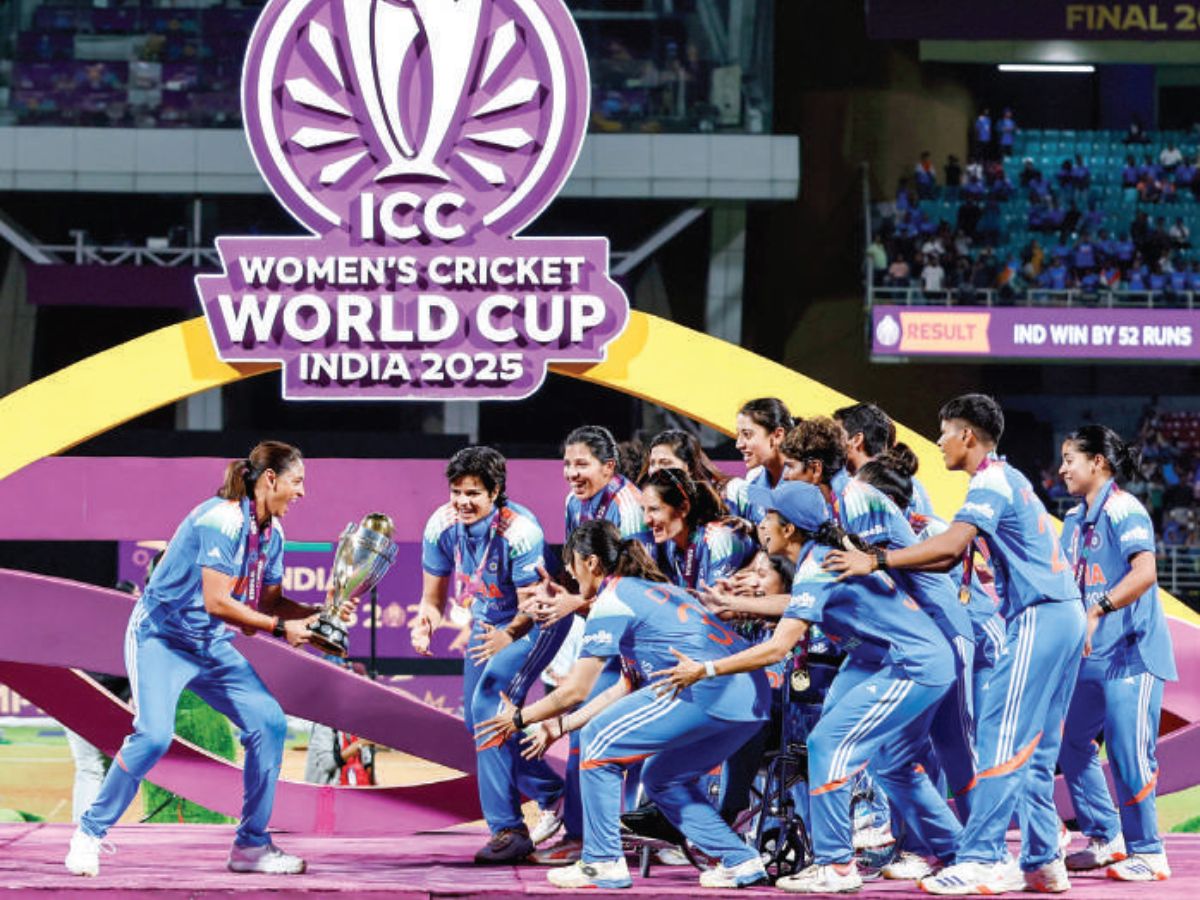
India’s recent sporting triumph—the India women’s cricket team clinching their maiden ICC Women’s World Cup title in a stirring final at Navi Mumbai—was more than a historic moment on the scoreboard; it was a national affirmation of what sustained physical training, collective discipline, and competitive exposure can achieve. The images of Shafali Verma’s blistering innings, Deepti Sharma’s all-round excellence, and Harmanpreet Kaur’s steady leadership will remain vivid symbols of resilience and teamwork. Prime Minister Narendra Modi and the Union Government have rightly celebrated the squad’s achievement as a landmark for Indian sport and society.
This triumph comes at a time when women’s cricket in India is witnessing unprecedented institutional support and recognition. Under the stewardship of Prime Minister Narendra Modi, the government has actively promoted gender equality in sports, while the BCCI, under then Secretary and now ICC Chairman Jay Shah, took the landmark decision to introduce equal match fees for men and women cricketers. This reform not only bridged a historic gap but also ensured that women athletes received the respect and rewards their talent merited. It has elevated the stature of women’s cricket, inspiring young girls across the nation to pursue sports as a serious profession. The World Cup victory is, therefore, not an isolated feat but a reflection of the ecosystem of encouragement, investment, and equal opportunity that India is building—one that must now extend deep into the foundations of our education system.
Sporting excellence is cultivated through years of structured practice, mental conditioning, and institutional support—qualities that take root when sport is treated as an integral part of education. This is not new to Indian thought. The Gurukul tradition recognised learning as holistic: physical training in wrestling, archery, yoga, and martial disciplines was not peripheral but intrinsic to shaping disciplined and capable citizens. This ancient synthesis of body, mind, and spirit anticipated modern research showing that physical activity enhances cognition, emotional balance, and social competence. Reclaiming that insight today means applying time-tested wisdom through contemporary policy.
States that have begun integrating sports into school curricula are acting where the impact will be most transformative. Assam’s decision to introduce football as an elective subject is a welcome example: by embedding sports into assessment frameworks, it signals a decisive shift from viewing play as optional to recognising it as foundational to learning and citizenship. The benefits of embedding sport in schooling are extensive. Regular, structured physical activity improves cardiovascular and musculoskeletal health, reduces the risk of lifestyle diseases, and instils habits of movement that persist into adulthood. Sports participation also supports cognitive development—attention, working memory, and executive function all improve measurably—and correlates with stronger academic performance. Beyond individuals, sports build social capital: teamwork, leadership, emotional resilience, and conflict-resolution skills learned on the field translate into better classroom and workplace outcomes. In a young nation, leveraging these gains is key to turning demographic advantage into sustained national progress.
It is encouraging that India’s policy framework now explicitly connects education and sport. The National Education Policy (NEP) 2020 recognises physical education, sports, and yoga as integral to holistic development, mandating their inclusion in curricula and urging states to build lasting capacity. NEP’s focus on experiential, multidisciplinary learning creates a logic for integrating sport with science, mathematics, and language pedagogy so that movement itself becomes a learning tool.
Building on this, the Union Government’s National Sports Policy 2025 (Khelo Bharat Niti) positions integration with education as a central pillar of India’s sports ecosystem. NSP 2025 proposes certified PE teachers, school-college talent pathways, institutional fitness indices, and technology-enabled monitoring. The Modi government has also made sports more inclusive in both design and intent. Initiatives promoting women athletes and developing infrastructure for para-sports illustrate this commitment. The remarkable story of Sheetal Devi, India’s armless para-archer, who not only won medals internationally but also earned a place in India’s able-bodied archery team for the Asia Cup, epitomises this inclusivity. Her success reflects a system that now seeks out and nurtures talent across gender, region, and ability.
By aligning NEP 2020 and NSP 2025 and encouraging state-level innovation, the Union Government has built both the mandate and machinery to mainstream sports in education. These are not symbolic reforms; they are structural changes that must be implemented with urgency and discipline at the ground level. For state governments, practical action must now follow policy intent. Educational authorities should make physical education compulsory, design age-appropriate sports curricula, and ensure assessments reward physical literacy and teamwork alongside academic achievement. Gone are the days when children were told, “Padhoge likhoge banoge nawab, kheloge koodoge banoge kharab.” That mindset belongs to another era. In today’s India, sports can no longer remain an optional pastime or an elective subject—it must be recognised as a core and practical component of education, deserving the same seriousness and institutional attention as mathematics or science.
Making sports compulsory at the school level would not only promote physical fitness but also instil discipline, teamwork, and resilience—qualities that are as essential to nation-building as academic achievement itself. Investment in safe, multipurpose infrastructure—from basic playgrounds to adaptable indoor facilities—must be matched by targeted budgets and public-private partnerships. Crucially, this infrastructure must also serve children with disabilities, with barrier-free access, adaptive equipment, and trained support staff. The recent achievements of Indian para-athletes at global events show the extraordinary potential of differently abled communities—potential that must be nurtured early through inclusive school-level programmes.
Equally, sports programmes must guarantee inclusion—offering equal opportunities for girls, children from disadvantaged backgrounds, and those with disabilities. Traditional and indigenous games should also be preserved alongside mainstream disciplines to deepen participation and cultural identity.
The India Women’s World Cup win is therefore both a celebration and a signal. It proves that disciplined training, institutional support, and national pride can converge to produce world-class results. More importantly, it shows how sport can embody the values—teamwork, perseverance, and strategic thinking—that underpin modern nation-building. Under Prime Minister Narendra Modi’s leadership, the integration of sport and education reflects a deep understanding that building a great nation is not only about economic growth but also about cultivating healthy, confident, and resilient citizens.
Across the world, much smaller nations are consistently winning a remarkable number of medals on global sporting stages. India can not only match but surpass them if it builds robust training infrastructure at the grassroots—beginning with schools and colleges—to nurture talent systematically. Developing this foundation is central to making India a true sporting nation, capable of translating its demographic strength into global sporting excellence. Reintegrating the lessons of the Gurukuls—physical discipline alongside intellectual formation—into a modern, evidence-based curriculum is not nostalgia; it is a necessity. The task now is to translate national victories into lasting systems that ensure every child, regardless of background, grows fitter, sharper, and more capable of shaping the India of tomorrow.
-
Kartikeya Sharma is an Independent Member of Parliament (Rajya Sabha).




