
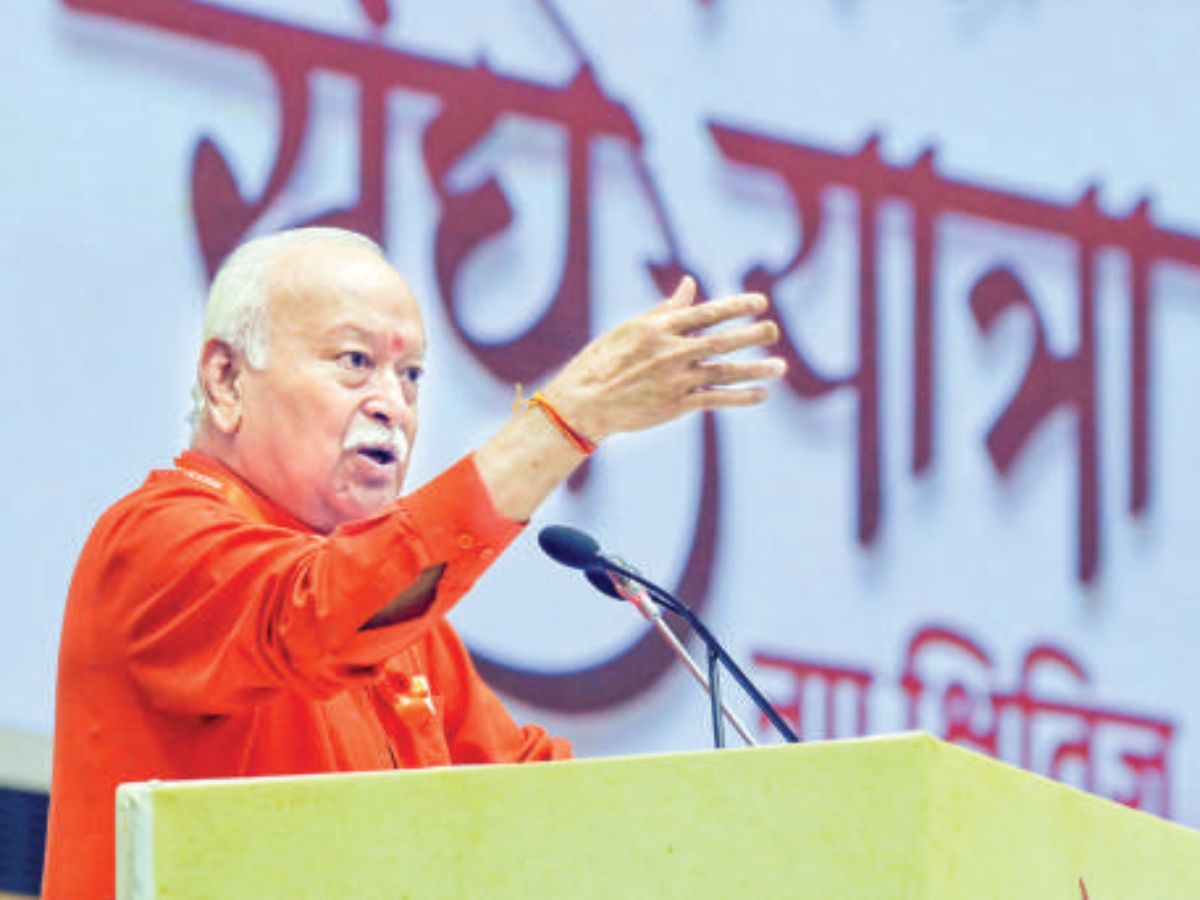
New Delhi: I am among the people invited to listen to Mohan Bhagwat, the head of the Rashtriya Swayamsevak Sangh (RSS), across three days to mark the centenary of the organisation, which is the ideological parent of India’s ruling party, the Bharatiya Janata Party (BJP). Much has been written about the history of the RSS and the fact that its dedicated, and lifelong, followers run the Indian government, including Prime Minister Narendra Modi and many of his top cabinet ministers.
I had the opportunity to consider this history at length in my book on the history of political Hinduism, Soul and Sword. But there is one critical thing that has rarely been considered at length, and this is the nature of its core ideology. This is often simply stated as the recrafting of India as a Hindu Rashtra in line with the core belief of Hindutva, which is best described as a cultural distillate of the lived experience of being Hindu in a sociopolitical context.
In such a baseline understanding, the RSS, a voluntary organisation of around 5–6 million members and more than 70,000 branches, hopes to transform Indian society towards its beliefs, and leverage this transformation to ensure that its political arm, the BJP, stays in power. But since the BJP has not been in power for most of India’s independent history since 1947, this is, at the very least, a limiting framework.
A much better question to ask is — what is the RSS mainly concerned with? The usual answer is power (not merely political power, but the power of societal influence). This, in my opinion, of having studied the organisation for more than a decade now, is the wrong answer.
What the RSS is most concerned about is, in fact, balance. Through its history since 1925, and through the readings of Indian philosophical texts, the RSS leadership has repeatedly come to the conclusion that a sense of balance is the most vital nurturing and enabling force of Indian nationhood.
This essay argues that, contrary to the prevailing belief, the most treasured value and ultimate aim of the RSS, as articulated by its current leadership, is not power (shakti) but balance (samanvay). This ideal, far from being a modern rhetorical flourish, is deeply interwoven with the core civilizational philosophy of India, which has historically valued equilibrium, harmony, and the middle path above all else. By framing its mission in these terms, the RSS seeks to position itself not merely as a political force, but as the custodian of a timeless national ethos.
The foundation of this re-evaluation rests on Mohan Bhagwat’s explicit definition of Dharma. In a centenary lecture in New Delhi, he stated:
“Balance in society and individual life is Dharma, which avoids all forms of extremisms. Bharatiya tradition calls it the middle path and this is the biggest need of the world right now.”
This statement is profound in its departure from the common conflation of Dharma with religion. Here, Dharma is presented as an ecological and societal principle — a state of equilibrium that eschews radicalism and fosters harmony. It is the active process of maintaining balance within oneself, within society, and with the natural world. This interpretation moves the RSS’s ideological goalposts from political and social objectives to philosophical ones.
Power, in this framework, is not the end goal but a potential byproduct, and a dangerous one at that if it leads to imbalance. Bhagwat expressed deep concern over a world grappling with “religious extremism, conflict, and unrest,” driven by a consumerist and materialistic worldview that has diminished human values. He invoked Mahatma Gandhi’s seven social sins — including “politics without principles” and “science without humanity” — as examples of the imbalance that modern societies suffer from.
To translate this philosophical ideal into actionable social change, Bhagwat outlined the “Panch Parivartan” or five-fold transformations that the RSS is currently focused on: social harmony (samajik samrasta), family awakening (kutumb prabodhan), environmental awareness (paryavaran sanrakshan), selfhood (swatva) rooted in cultural pride and self-reliance, and civic duties (nagrik kartavya). Each of these pillars is an exercise in restoring balance. Social harmony aims to balance the rights and duties of different castes and communities, moving beyond historical fissures. Family awakening seeks to balance individual aspirations with familial responsibilities. Environmental awareness is a direct call to restore the balance between human development and nature.
The emphasis on swatva and swadeshi (self-reliance) is presented as a strategy for economic balance. Bhagwat clarified that self-reliance “does not mean stopping imports,” but rather ensuring that international trade is a voluntary engagement between equals, not a relationship of dependency or coercion. This is a call to balance national economic interests with global interdependence. Finally, the focus on civic duties is about balancing individual rights with collective responsibilities, a crucial element for a functional and harmonious society. This five-pronged approach demonstrates a holistic vision where balance is not a passive state but an active, multi-dimensional pursuit.
Balance, by the way, was important to Keshav Baliram Hegdewar, the man who created the RSS, too. In his words:
“For peace and order to prevail in the world, balance is needed. A place where weak and strong come together, peace and order is ruined. Two tigers don’t trouble each other. But it needn’t even be mentioned as to what happens where a tiger and a sheep come together. Peace and harmony can dwell only between those with equal strength.”
These words have particularly potent resonance in a world. This emphasis on balance is not an ideological invention of the RSS but a direct inheritance from the deepest currents of Indian philosophy. The concept of the “middle path” (Madhyamapratipad), which Bhagwat explicitly invoked, is central to Buddhist thought, advocating a balanced approach to life that avoids the extremes of self-indulgence and self-mortification.
The Hindu framework of the four Purusharthas — the legitimate goals of human life — is itself a grand exercise in balance. It validates the pursuit of material wellbeing (Artha) and pleasure (Kama), but contextualizes them within the ethical framework of Dharma, with the ultimate aim of spiritual liberation (Moksha). Life is not about renouncing the world or indulging in it excessively, but about navigating its demands in a balanced, righteous manner.
The Bhagavad Gita, a foundational Hindu text beloved of Gandhi, Vivekananda and Aurobindo, among others, champions nishkama karma, or selfless action, which is the epitome of psychological balance — acting with full commitment without being attached to the fruits of the action. Furthermore, the concept of loksangraha (the welfare and holding-together of the world) from the Gita posits that the ideal action is one that maintains social and cosmic order. This ancient wisdom, which sees the universe as an interconnected whole where every entity has a role in maintaining the overall equilibrium, forms the philosophical bedrock of the vision Bhagwat articulates.
The RSS, in this light, sees itself as working to restore this traditional Indian understanding of a balanced life, which it believes has been eroded by centuries of foreign rule and the subsequent adoption of “incomplete” Western ideologies like capitalism and communism.
If all this sounds too esoteric, let’s consider some of the things Bhagwat said during the two days of lectures, and a third when he answered questions. He said India’s goal is to rise to the very top of the international order but without being disruptive, and without pushing an agenda that is iconoclastic. He emphasised that India’s purpose is to deliver spirituality to the world, highlighting that the ancient wisdom of India was never defined in a sectarian manner. Instead, Bhagwat emphasised that this philosophical wisdom was, at its core, universalist — and never promoted one aspect of life above the other.
This echoes another RSS stalwart, Deen Dayal Upadhyaya, who said:
“The fundamental characteristic of Bhartiya culture is that it looks upon life as an integrated whole… There is diversity and plurality in life but we have always attempted to discover the unity behind them.”
He also said that the gulf between the extremely rich and the poor is a roadblock to India’s ascension, and even though the RSS participated in the Ram Mandir movement, it would not do so in other similar movements like in Mathura and Kashi. However, it was not opposed to its swayamsewaks or dedicated members from taking part.
As far as the RSS was concerned, said Bhagwat, Ayodhya, Kashi and Mathura had always been key as preeminent Hindu holy sites adversely impacted by Islamist invasions in the medieval period, and beyond these, “there was no need to go looking for a Shiv linga beneath every mosque.” He added that if he, as the head of the RSS, could openly say that his organisation would not support any further movements related to religious sites beyond these three, then Muslim communities should perhaps find the heart to accommodate the three longstanding demands. This would provide a middle-path, a balance to curbing any future strife.
Bhagwat also reiterated that while RSS is most intrinsically connected to the BJP, the party that emerged from its ideological base, it is not averse to helping anyone or any organisation that is conceptually on the same page. The RSS is not opposed to reservations as affirmative action but underlines that real brotherhood among different sections of society requires more than just government action; it needs real social amity, which the state cannot engineer. Bhagwat warned again about the excesses of both communism and capitalism, in line with RSS thinkers like Dattopant Thengadi who even propagated “non-alignment” with either and wrote a monograph about a middle-path choice called Third Way (1998).
Woke propaganda and cancel culture are things that the RSS sees as harmful propaganda, but Bhagwat warned repeatedly that without ecological consciousness — considered in the Western Right as a Left cause — disaster looms large. While suggesting that the RSS does not interfere with the inner workings of the BJP, he also quipped that if it had been the RSS’ decision, the choice of a new party chief of the BJP would not take as long.
It would be easy to describe this as an RSS “coming out party” for an organisation that has historically preferred to remain in the background, but that again would be a hasty reading. The RSS has always forcefully argued — as Bhagwat did in the three talks too — that its work is indistinguishable from the causes of broader Indian society.
It today perhaps feels that many of its arguments have deeper resonance in an India, and world, fatigued by superficial progress, and with a growing yearning for traditional values which also embrace gradual change. Therefore, the RSS is more willing to deliver its message to what it believes is a samaj (society) more ready than ever to listen.
Hindol Sengupta is a multiple award-winning historian and author of 13 books, including Soul and Sword, a definitive history of political Hinduism.




