
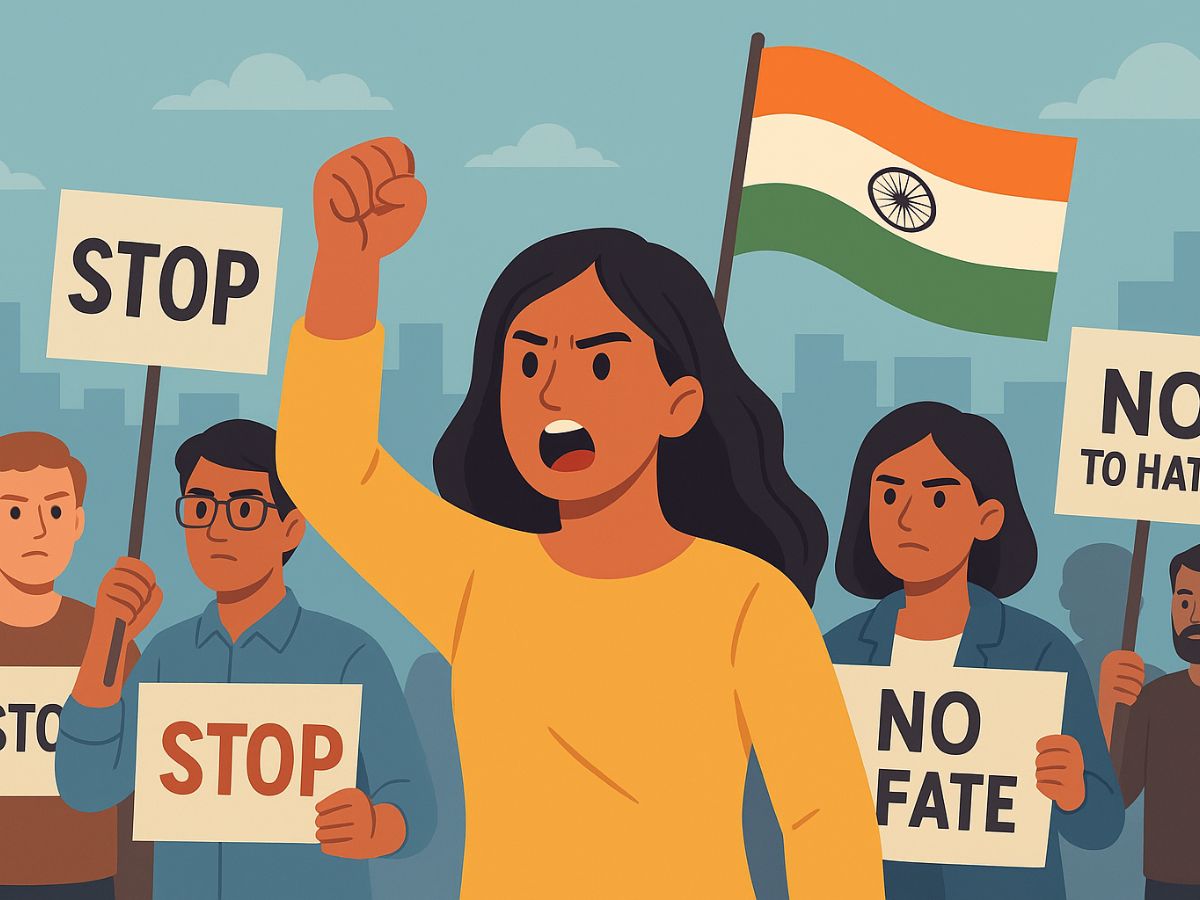
New Delhi: Since December 2024, on these pages, I have warned that a moment of reckoning is coming for the Indian diaspora, one of the great success stories of the country. Long feted as the model minority around the world, it now faces perplexing and unprecedented attacks, including mass protests (in Australia and Ireland), with calls for curbing immigration from India.
In America, this has been fuelled, in part, by comments of President Donald Trump and some members of his team on the trade tariffs issue which have been taken as a dog whistle by large parts of the so-called MAGA base. But it would be unwise to dismiss this merely as a “far right” uproar or conspiracy theory.
Since the early 19th century, when Indians first started to migrate to America, this backlash represents one of the most vicious emerging challenges for a community that, from world over, sends back more than $100 billion a year to the mothership. This must be taken seriously and addressed at the very roots before it destroys the unique and over-achieving story of Indian immigration.
In an era when a dark cloud hovers over the unprecedented global mobility and interconnectedness of past decades, the narrative of the Indian diaspora, particularly in Western nations such as the United States, Ireland, and Australia, which has long been one of remarkable success, is souring dramatically. Long lauded as the model minority, a community characterized by its high levels of education, professional achievement, and economic prosperity, a darker, more troubling counter-narrative is now emerging.
A rising tide of protests, physical attacks, and vitriolic online abuse suggests a significant and alarming shift in perception. This essay will explore the complex and multifaceted reasons behind this backlash, arguing that the very success of the Indian diaspora, coupled with a confluence of economic anxieties, cultural shifts, and geopolitical transformations, has ironically made it a target of resentment and hostility.
For decades, the story of Indian immigrants in the West has been presented as a testament to the power of hard work and determination. Arriving in often unfamiliar and challenging environments, they have not only integrated but have also excelled, becoming one of the most economically successful communities in these nations. Their presence is strongly felt in the fields of medicine, engineering, information technology, and finance.
This success is not merely anecdotal; it is backed by stark economic data. In the United States, for instance, Indian Americans have the highest median household income of any ethnic group. This economic prowess is increasingly translating into leadership positions, with a growing number of Indian-origin individuals ascending to C-suite roles in major multinational corporations. The likes of Satya Nadella at Microsoft, Sundar Pichai at Alphabet, and a host of other Indian-origin CEOs have become global symbols of this incredible success story.
However, this very visibility and success have, in a cruel twist of fate, sown the seeds of a backlash. In a climate of growing economic inequality and social anxiety in many Western nations, the conspicuous success of a minority group can easily become a focal point for resentment. The narrative of the “model minority,” once a badge of honour, is now being weaponized. It is used to create a damaging and simplistic dichotomy, pitting successful Indian immigrants against other minority groups and even the white working class, feeding a populist narrative of “us versus them.” The talent and economic success of Indians, once celebrated as a contribution to their adopted homelands, are now being reframed as a threat, a sentiment that is amplified by populist politicians and media outlets.
This resentment is not abstract; it is manifesting in tangible and dangerous ways. In Australia, anti-immigration protests have seen Indians specifically targeted. In Ireland, a country historically known for its warmth and hospitality, a spate of violent and unprovoked attacks against members of the Indian community has instilled a palpable sense of fear. In the United States, while the violence may be less overt, the hostility is palpable in the political discourse and in the digital realm. Online forums and social media platforms have become breeding grounds for anti-Indian sentiment, with discussions often revolving around the trope of Indians “stealing” jobs.
The issue of the H1-B visa program in the United States serves as a lightning rod for much of this animosity. While the program is designed to allow American companies to hire highly skilled foreign workers to fill specific gaps in the workforce, it has been plagued by accusations of misuse. Some employers have been accused of using the program to replace American workers with cheaper foreign labour, and a minority of Indian employees have been complicit in a system that can be seen to undercut local wages and opportunities. While the vast majority of H1-B visa holders are highly skilled professionals who contribute significantly to the American economy, the actions of a few have been used to tarnish the reputation of the entire community.
The abuse of the H1-B visa system has provided a convenient and potent narrative for those who wish to portray Indian immigrants not as assets, but as economic mercenaries. This confluence of economic success and the perception of being a threat has led to a deeply unsettling parallel being drawn between the contemporary experience of Indians in some parts of the world and the historical experience of Jewish people. Some argue that in many ways Indians are becoming “Jew adjacent,” resented for their success, their adaptability, and their perceived clannishness. Just as Jewish people were historically resented for their economic success and their ability to thrive in diverse and often hostile environments, Indians are now facing a similar brand of envy-fuelled animosity.
The “model minority” tag, much like the stereotypes that have been used against Jewish people, creates a caricature of a community that is seen as being both hyper-successful and insular, further isolating them from the broader population.
This troubling trend is further compounded by India’s rising stature on the global stage. As India’s economy continues to grow and its geopolitical influence expands, its citizens can no longer be viewed through the patronizing lens of the “third world.” India is increasingly seen as a competitor, a rising power that is challenging the established global order. This shift in perception has a direct impact on how Indian immigrants are viewed in the West. They are no longer seen as grateful newcomers in need of a helping hand, but as representatives of a powerful and assertive nation. This geopolitical subtext adds another layer to the resentment, transforming economic anxiety into a form of quasi-nationalistic animosity.
THE WAY FORWARD
Faced with this growing hostility, what is the way forward? The solution, paradoxically, may not be less immigration, but more. The current wave of anti-Indian sentiment is fuelled, in large part, by ignorance and caricature. The most effective way to combat these negative stereotypes is through greater cultural exchange and understanding. More, not less, immigration from India, particularly of a diverse cross-section of society, can help to humanize the Indian diaspora in the eyes of the host population.
When immigrants are not just seen as doctors, engineers, and tech workers, but as artists, writers, musicians, and entrepreneurs, it becomes more difficult to reduce them to a monolithic and threatening stereotype. These new waves of immigrants can become cultural ambassadors, telling the story of a modern, pluralistic, and dynamic India that is often absent from the headlines. They can engage with local communities, share their culture, and build the bridges of understanding that are so desperately needed. By fostering a more nuanced and multifaceted understanding of India and its people, they can dispel the myths and prejudices that are at the root of the current backlash.
This is not to suggest that immigration is a panacea for all the complex issues at play. Host nations must also address the underlying economic and social anxieties that make their populations susceptible to xenophobic rhetoric. However, in the long run, the most potent antidote to hate is understanding, and the most effective way to foster that understanding is through human connection.
Indians must also become more politically active in their adopted countries than ever. It is clear that the old model of “keeping your head down, and working hard” is past its sell-by date. Unless they become an integral part of the politics of their adopted country, they will not be able to push back against the negative storm that is set to increase. It is not enough to pay large donations to key political parties. It is time to fund members of the community who will fight elections at every level and aim to represent the community at every level of government—the success that Indian immigrants have had in business and in rising to C-suite jobs must now be replicated in politics, and with strong political ambition to rise to top policy and administration roles.
In July, in these pages, I recommended strategic widening of Indian immigration to countries like Japan, Russia, Israel, Scandinavia and parts of Europe which are yet unaffected by the kind of negativity that is being spread in America, for instance. It is time to also consider the creation of institutions like the American Jewish Committee in America to give choice to Indians who feel imperilled or discriminated against.
It is vital to remember that in recent years, through a sustained campaign, Indians have been equated with racism with the theory that blames the age-old Indian caste system for all the evils of slavery and racial discrimination in America and Europe. This propaganda has spread and has extremely dire social consequences, making it socially acceptable to attack a community that, for instance, makes up only 1% in America but pays 6% of all taxes collected.
Therefore, the Indian diaspora in the West finds itself at crossroads. The success that was once a source of pride has now made it a target of resentment. The model minority label has been transformed into a double-edged sword, and the rising power of India has added a new dimension to the challenges they face. The comparison to the historical experience of Jewish people is a sobering reminder of the dangers of allowing prejudice to go unchecked.
The path forward is not to retreat into insularity, but to double down on cultural exchange and engagement. By telling their own stories and by showcasing the richness and diversity of their heritage, Indian immigrants can challenge the caricatures and build a future where they are not just tolerated for their economic contributions, but are truly valued as integral members of the societies they have chosen to call home.
Hindol Sengupta is professor of international relations at O.P. Jindal Global University.




