The killing of Khamenei and the war in Iran represent the worst fears about nuclear weapons and their proliferation coming true.
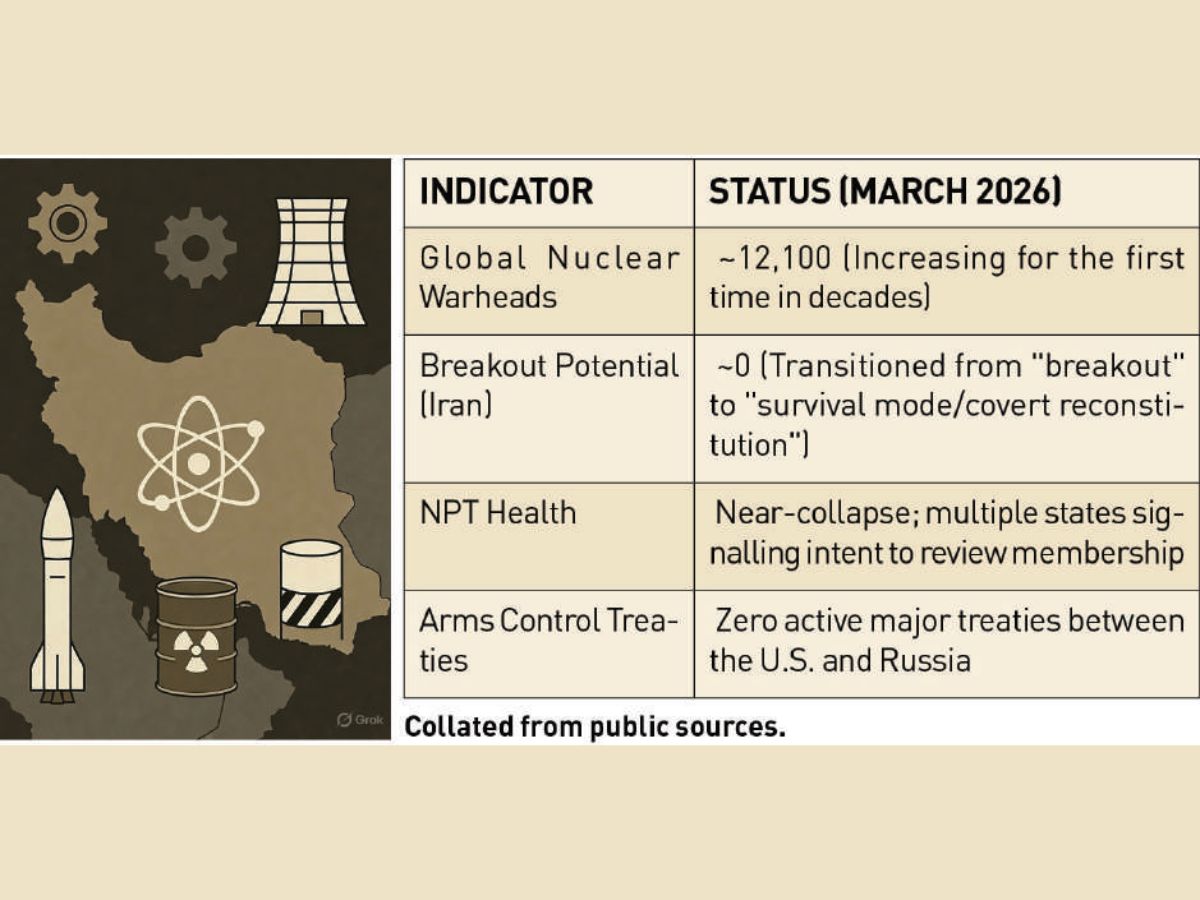
The nuclear taboo is crumbling
The joint United States-Israeli attack on Iran’s nuclear and military infrastructure in early 2026 has pushed the global system closer to the actual use—and subsequent spread—of nuclear weapons than at any time since the end of the Cold War. While Washington and Tel Aviv justify the campaign as necessary to prevent Iran from acquiring the bomb, the strikes are already reinforcing a powerful lesson for other states: in a world of regimechange threats and preventive wars, not having nuclear weapons can be more dangerous than having them.
On 27 February 2026, following new International Atomic Energy Agency (IAEA) disclosures about hidden Iranian highly enriched uranium, Israel and the United States escalated to large scale strikes on Iranian territory. Their stated objectives include destroying Iran’s nuclear capability, degrading its missile forces and dismantling the regime’s security apparatus. Key nuclear related sites at Natanz and other facilities have been hit in successive waves of air and missile attacks, while Iran has retaliated with missile strikes against Israel and regional US partners and has temporarily closed the Strait of Hormuz.
This escalatory ladder brings several nuclear dangers closer. First, Iran’s leadership has little incentive to maintain past self restraint on weaponization pathways when nuclear latency did not prevent devastating conventional strikes. Second, any miscalculation that draws in other nuclear powers—Russia via Syria, or even Pakistan through Gulf entanglements—raises possibilities of inadvertent nuclear signalling or alert measures, even if actual use remains unlikely. Third, the precedent of preventive attacks on nuclear infrastructure deepens the sense in many capitals that only an actual nuclear deterrent can immunize a regime from such treatment.
What we are seeing is the crumbling of the “nuclear taboo”. As explained by the nuclear scholar Nina Tannenwald, the nuclear taboo is “a widespread inhibition on using nuclear weapons” and “a de facto prohibition against the first use of nuclear weapons,” rooted not only in calculations of deterrence but in a powerful moral and normative stigma that makes nuclear use appear illegitimate and almost unthinkable in global politics. In other words, the nuclear taboo is a collectively held norm that treats nuclear weapons as qualitatively different from other armaments, associating them with moral opprobrium and fears of catastrophic, uncontrollable consequences, so that leaders feel constrained from even considering them as normal military options despite having them in their arsenals.
Historically, Iran’s nuclear trajectory diverged markedly from North Korea’s, even though both confronted US pressure and sanctions. Iran remained within the Nuclear Non Proliferation Treaty (NPT), accepting intrusive IAEA safeguards in exchange for a recognized right to civilian nuclear technology. The 2015 Joint Comprehensive Plan of Action (JCPOA) imposed strict caps on enrichment levels, stockpile size, and centrifuge types, lengthening Iran’s breakout time to more than a year in return for sanctions relief. Although the United States exited the JCPOA in 2018, Iran’s response until the early 2020s consisted mainly of incremental expansions of enrichment and research, coupled with continued declarations that it did not seek nuclear weapons, rather than a dash to a bomb or NPT withdrawal.
By contrast, North Korea used its civil nuclear program as a pathway to weapons. After signing denuclearization declarations in 1991 and the Agreed Framework in 1994, Pyongyang was found to be developing a clandestine highly enriched uranium program, withdrew from the NPT in 2003, restarted its plutonium facilities, and eventually declared itself a nuclear armed state. Estimates in 2021 suggested that North Korea had produced enough fissile material for around 50 nuclear weapons, and subsequent production has likely increased that number. Despite severe sanctions, the regime remains in power and has used its arsenal as both a shield against invasion and a bargaining chip for economic concessions.
The 2026 strikes on Iran effectively send a stark message: Tehran, which stayed in the NPT and stopped short of overt weaponization, was attacked twice within a year—first in the US “Operation Midnight Hammer” in 2025 targeting Fordow, Natanz, and Isfahan, and then in the joint 2026 campaign. Pyongyang, which built and tested nuclear devices and openly defied nonproliferation norms, has escaped comparable preventive bombardment of its nuclear core. For many in North Korea’s elite, this contrast will be seen as vindication of their decision to “go nuclear” early and decisively, reinforcing the belief that nuclear weapons are the ultimate insurance against regime change.
The Iran strikes unfold against a broader backdrop of eroding confidence in the existing nuclear order. In Northeast Asia, North Korea’s expanding arsenal and aggressive strike doctrine have already generated powerful incentives for neighbours to revisit the nuclear option. South Korea is a classic latent nuclear state: it possesses advanced civilian nuclear technology and the industrial capability to weaponize relatively quickly. Public opinion polls in recent years consistently show around 70 percent support for South Korea acquiring its own nuclear weapons, driven by fears that the US extended deterrent might fail under extreme stress. Analytical work on South Korea’s potential nuclear path highlights three drivers: the territorial threat posed by North Korea, concerns about prestige and reputation, and domestic political economic dynamics— all of which gain force as crises like the Iran conflict deepen scepticism about security guarantees.
Japan, which maintains a large stockpile of separated plutonium and advanced fuel cycle capabilities, faces similar pressures, even if elite and public discourse remains more constrained. Persistent concern about North Korea’s missiles and China’s military rise has already nudged Tokyo to expand debate around the country’s traditional “Three Non Nuclear Principles” and its taboo against hosting US nuclear weapons. Analysts warn that a perceived weakening of US commitments, combined with evidence that non nuclear states can be attacked to prevent hypothetical future threats—as in Iran—could gradually erode the domestic consensus against even latent weaponization in Japan.
The shockwaves extend beyond East Asia. In Europe’s north, Russia’s war in Ukraine and increasingly explicit nuclear signalling have already catalysed strategic rethinking. Recent commentary in Nordic policy circles points to serious voices in Sweden and neighbouring states arguing that it is time to discuss a “Nordic nuclear” option, either through deeper integration with NATO’s nuclear planning or, in more radical scenarios, some form of shared deterrent under European or regional control. Mainstream politicians and media in Sweden are now reopening what had long been a closed file on nuclear deterrence, reflecting the perception that the global taboo against proliferation looks weaker than ever. Meanwhile, in France, President Emmanuel Macron has declared, speaking from the Île Longue nuclear submarine base in Brittany, that not only will France expand its nuclear arsenal, for the first time in decades, it will also no longer specify how many nuclear warheads it possesses, thus heightening nuclear ambiguity, a key component of nuclear taboo.
The 2026 attacks on Iran will likely accelerate this mood shift. If preventive strikes against nuclear infrastructure become normalized tools of statecraft, elites in vulnerable democracies will ask whether the only way to avoid being treated like Iran is to move, deliberately or quietly, toward a North Korean style fait accompli—or at least a robust latency that can be converted rapidly.
These trends underscore a core paradox: actions justified as non-proliferation— destroying Iran’s nuclear facilities—can, in the aggregate, undermine the very non-proliferation regime they claim to protect. Iran’s continued membership in the NPT and its years long acceptance of IAEA monitoring did not shield it from massive conventional punishment; instead, its partially developed nuclear infrastructure has been twice devastated from the air in less than twelve months. By contrast, North Korea’s open withdrawal from the NPT, construction of an arsenal, and repeated missile and nuclear tests have made direct military options far more dangerous and therefore less likely.
For leaders in Seoul, Tokyo, Stockholm, and elsewhere, the lesson is not lost: if they rely solely on treaties and external guarantees, they may be exposed to coercion or attack before they can build deterrent capabilities; if they cross the nuclear threshold early, they might, like Pyongyang, become too risky to strike. As one regional proliferation study concludes, the unresolved North Korean problem already risks a “nuclear domino effect” in Northeast Asia, with both Japan and South Korea possessing the materials and technologies to arm quickly if political decisions change. The 2026 Iran conflict adds a vivid example of the costs of restraint.
At the global level, repeated uses of force against states with advanced but non weaponized nuclear programs erode the incentive structure built into the NPT: that states which forgo weapons will gain security and prosperity advantages over those that defect. When those states instead face sanctions, sabotage, and air strikes, while nuclear armed outliers retain their arsenals and their regimes, more governments will weigh whether joining or remaining in good standing with the NPT actually enhances their security.
If the 1960s Cuban Missile Crisis symbolized the danger of nuclear superpower confrontation, the 2026 Iran crisis symbolizes a different, more diffuse risk: a world of multiple potential nuclear breakouts, fuelled not only by regional rivalries but by the perception that only nuclear weapons can prevent the fate Iran is now suffering. In that sense, even as Washington and Jerusalem insist, they are bombing to prevent one state from acquiring the bomb, they may be paving the way for a more fractured, unstable, and heavily nuclear armed international system.
The strikes on Iran may or may not achieve their immediate military objectives. Iran’s known nuclear infrastructure has been severely damaged across two rounds of attacks. But the broader strategic consequences are already materialising. The NPT is under its most serious strain since North Korea’s withdrawal in 2003. The Doomsday Clock stands at its most dangerous setting in history. New START has expired without replacement. A nuclear-armed India and Pakistan have already traded blows. China is on track to match U.S. and Russian ICBM numbers by decade’s end. And from the Nordic countries debating collective European deterrence to South Korea demanding its own arsenal and Saudi Arabia watching Iran burn, the question of who should have the bomb— once a taboo in polite strategic discourse—is now a mainstream political debate across four continents.
In Pyongyang, the calculus is simpler than anywhere else. Kim Jong-un watched Iran—a country with sophisticated air defences, regional proxy networks, and decades of nuclear investment—receive two rounds of devastating strikes because it lacked the one thing that guarantees immunity: a deliverable nuclear warhead. Every analyst, every intelligence service, every foreign ministry that draws the same conclusion and acts on it brings the world closer to the threshold that Operation Epic Fury was meant to prevent. The supreme paradox of the age of nuclear coercion is this: the more aggressively powerful states use force to stop proliferation, the more desperately necessary proliferation appears to every nation that is not already protected. The strikes on Iran did not close that circle. They widened it.
Hindol Sengupta is professor of international relations, and director of the India institute, at O.P. Jindal Global University.
