
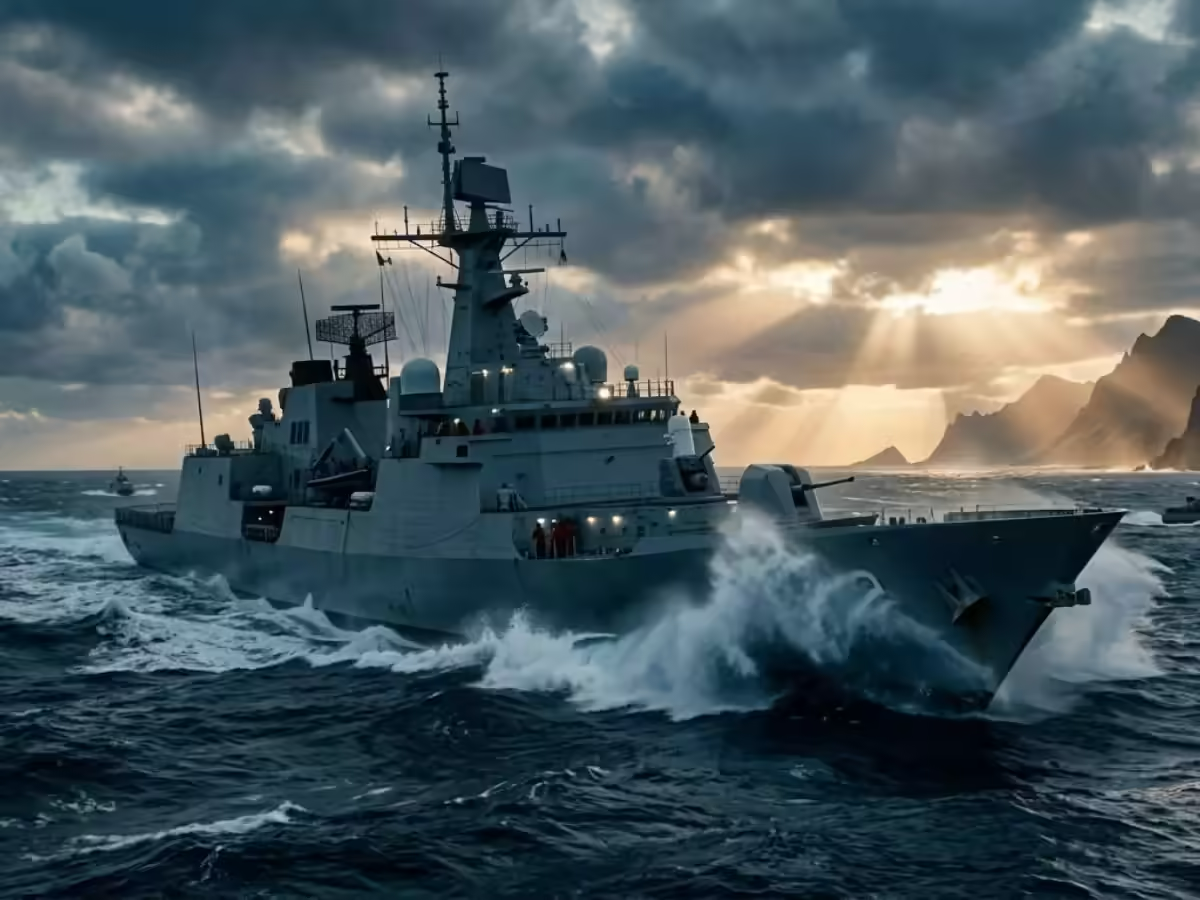
NEW DELHI: The sinking of the Islamic Republic of Iran Ship (IRIS) Dena by a United States Navy submarine off the coast of Sri Lanka on March 4 has created headlines in the Indian media for several reasons. Much of the discussion about this event is focused on whether this attack has caused “strategic embarrassment” to India or whether the US naval operations “near Indian waters” risked the war being brought into its vicinity, thereby “entangling India in a conflict not of its making”. Some foreign media portray the incident as a setback for India, reflecting a misunderstanding of the Law of Armed Conflict (LOAC), also known as the International Humanitarian Law (IHL), which governs the actions during an armed conflict (jus in bello), but does not regulate the recourse to armed force (jus ad bellum), which is enshrined in the UN Charter.
This article endeavors to analyse the sinking of the Dena in light of the provisions of the LOAC. It attempts to answer two basic questions—first, did the LOAC apply in this situation, and second, whether the belligerents adhered to the principles and specific provisions of the LOAC? The application of the LOAC is to be found in Article 2 of the second Geneva Convention (Geneva Convention II), which states, “In addition to the provisions which shall be implemented in peacetime, the present Convention shall apply to all cases of declared war or of any other armed conflict which may arise between two or more of the High Contracting Parties, even if the state of war is not recognised by one of them.” With both Iran and the United States, which have been engaged in an armed conflict since 28 February 2026, being parties to the Geneva Conventions, there is no doubt that the LOAC is, indeed, applicable in this situation. Another fairly authoritative document, though not possessing the weight and binding authority of a treaty, is the San Remo Manual (SRM), which states, “The parties to an armed conflict at sea are bound by the principles and rules of international humanitarian law from the moment armed force is used.”
Once again, both Iran and the United States, being parties to an armed conflict at sea, are bound by the provisions of LOAC. With the applicability of LOAC in the attack on IRIS Dena having been established, the specific provisions applicable in this context must now be examined.
Geneva Convention II, whose primary focus is on the amelioration of the condition of the wounded, sick, and shipwrecked, as also the protection of civilians and the treatment of POWs, is by no means an exhaustive reference for international law applicable to armed conflict at sea. Since the law of armed conflict applicable to naval warfare has evolved over a period of time, it is the San Remo Manual that serves as a more useful guide for naval practitioners. The actions of the United States, in attacking IRIS Dena, must be judged against specific criteria that are set out in the vast body of law that constitutes LOAC. The first criterion is the “net” satisfying the fundamental principles of IHL, namely, the principle of distinction (between civilians and combatants, civilian objects and military objectives), the principle of necessity, and the prohibition on causing unnecessary suffering (such as the use of weapons that do not kill an opponent but maim him while causing him to suffer unnecessary pain). The US submarine adhered to these fundamental principles by selecting a military target and using an accepted weapon to destroy that target.
The second criterion through a legal lens is the area of operations. While LOAC forbids hostile actions by belligerent forces within the internal waters, territorial sea, and, where applicable, the archipelagic waters of neutral states, it explicitly permits operations in areas where neutral states enjoy sovereign rights, jurisdiction, or other rights under general international law, provided the belligerents have due regard for the legitimate rights of those neutral states. The Dena was attacked approximately 40 nautical miles South of Galle, a position that lay within the Exclusive Economic Zone (EEZ) of Sri Lanka. During the attack on the Dena, no violation of Sri Lanka’s rights in its EEZ was reported. Thus, the US Navy was legally justified in carrying out the engagement where it occurred.
Reports indicate that a second Iranian naval vessel, IRIS Bushehr, has entered Trincomalee port in Sri Lanka, where the Sri Lankan Navy evacuated 208 personnel and brought them ashore. According to the Sri Lankan government, the vessel will be placed under state custody. From a legal standpoint, this action aligns with the Hague Convention (XIII) of 1907, which governs the rights and duties of neutral powers in naval war. The convention allows a neutral state to detain a belligerent vessel, render it incapable of sailing during the war, and hold its crew. Officers may be granted limited liberty upon giving their word not to leave neutral territory without permission.
Viewed through the legal framework of the San Remo Manual, international law provides that belligerent forces may not use neutral waters as a sanctuary. At the same time, a neutral state may permit the passage of belligerent warships through its territorial sea and allow limited replenishment of food, water and fuel sufficient for the vessel to reach its own port. Repairs may also be permitted if required to make a ship seaworthy, provided they do not restore or increase its combat capability. A belligerent warship may not remain in neutral waters for more than 24 hours, except when unavoidable due to damage or severe weather.
If a belligerent violates this regime, the neutral state is obliged to take measures to end the violation. Should it fail to do so, the opposing belligerent must first notify the neutral state and allow reasonable time for corrective action. If the violation constitutes a serious and immediate threat and remains unresolved, the opposing belligerent may, in the absence of feasible alternatives, use force strictly necessary to address that threat. Much will therefore depend on how the United States interprets and responds to the situation. This does not automatically imply that Sri Lanka is siding with Iran in the ongoing armed conflict. As a neutral state, Sri Lanka is bound to apply identical conditions and restrictions to both Iran and the United States regarding access to its ports, roadsteads and territorial waters.
Another relevant provision arises from Article 18 of the Geneva Convention II, which requires parties to a conflict to search for and collect the shipwrecked, wounded and sick after engagements at sea. In submarine warfare, however, this obligation is widely recognised as impractical because surfacing to rescue survivors would expose the submarine to enemy attack. The logistical difficulty of accommodating and caring for survivors further complicates compliance. Consequently, it is not surprising that this requirement was not fulfilled in the two known submarine engagements involving warships since the Second World War.
In legal terms, therefore, the sinking of IRIS Dena by the United States Navy constitutes an act carried out by a belligerent in an armed conflict exercising its rights under the Law of Armed Conflict (LOAC). Claims that the incident represents a “strategic embarrassment” for India are matters of opinion rather than conclusions grounded in international law. Likewise, fears that the conflict could automatically spread across the wider Indian Ocean overlook a key principle of naval warfare: belligerents are legally permitted to conduct operations anywhere on the high seas that do not fall within the territorial or internal waters of a neutral state. Naval warfare has always been geographically fluid. Unlike armies fighting across fixed land frontiers, navies engage wherever enemy forces or commerce may be found. Even in earlier eras with far more limited mobility, major naval battles—such as the battle of the Nile, River Plate, Java Sea, and Coronel—took place thousands of miles from the belligerents’ coasts and often near neutral waters.
The reach of naval conflict has therefore always depended on the objectives of the belligerents and the endurance of their fleets. Concerns that India could be drawn into a conflict not of its making are similarly overstated. India’s leadership retains a clear understanding of national priorities and the capacity to steer the country accordingly.
* Vice Admiral Pradeep Chauhan (Retd) is an alumnus of the National Defence Academy, the Defence Services Staff College, the Naval War College, and the National Defence College. He is currently the Director-General of the National Maritime Foundation.




