
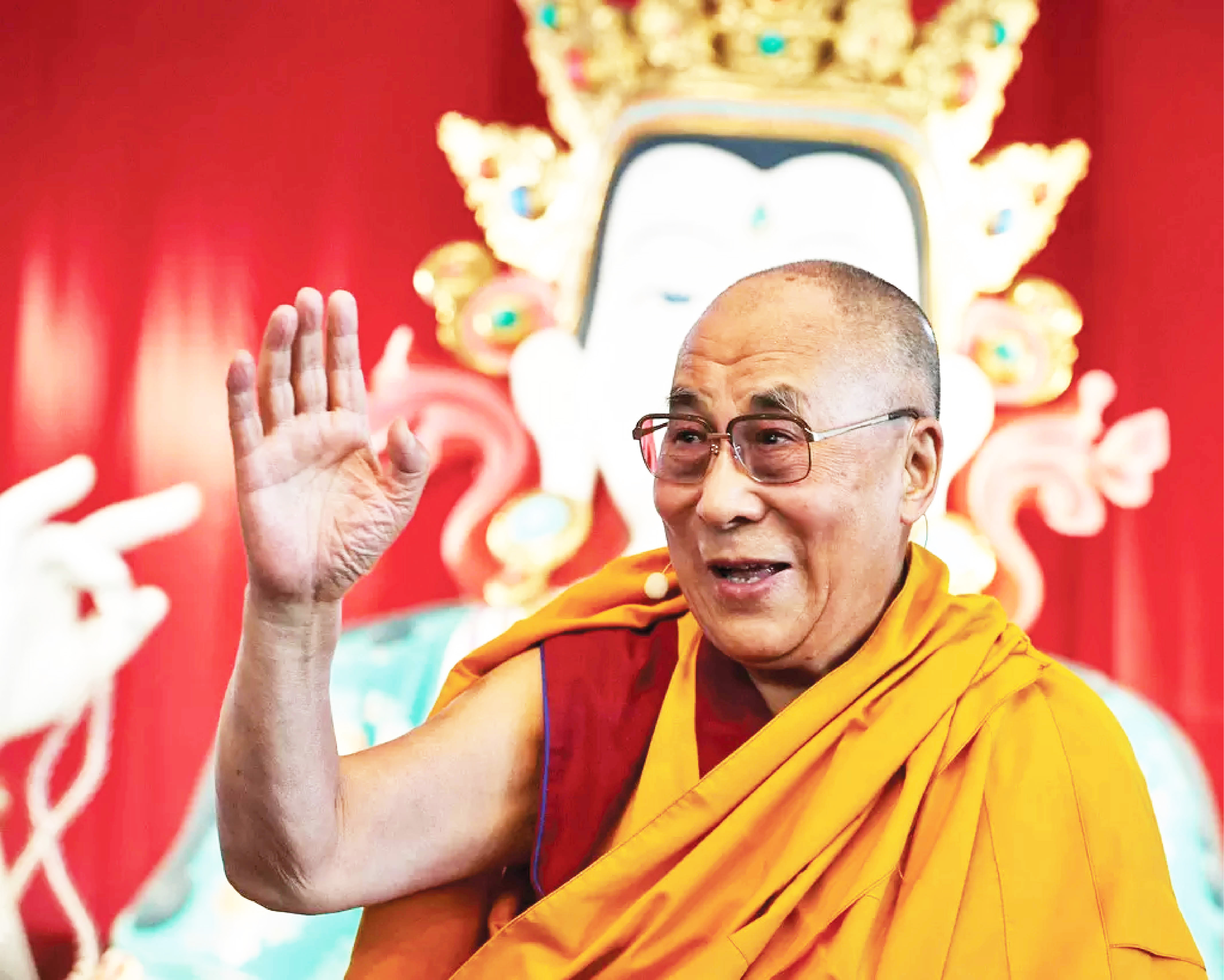
When the Chinese Embassy in New Delhi recently declared that the Dalai Lama’s succession is a “thorn” in India-China relations, it was not merely a diplomatic jab—it was a revealing admission. The thorn, however, was not planted by India. It was sown in 1950, when China invaded Tibet, dismantled its sovereignty, and forced its spiritual leader into exile.
The Dalai Lama’s presence in India is not the cause of tension—it is the consequence of China’s own actions. In 1950, the People’s Liberation Army marched into Tibet under the guise of “liberation.” By 1951, the Seventeen-Point Agreement had formalized China’s control, though Tibetans never accepted it as legitimate. The Dalai Lama fled to India in 1959 following a failed uprising, and India granted him asylum. Since then, he has lived in Dharamshala, becoming both a spiritual beacon and a symbol of Tibetan resistance.
China’s occupation of Tibet was not just territorial— it was cultural, spiritual, and psychological. Monasteries were razed, religious practices suppressed, and Tibetan identity systematically eroded. The Dalai Lama’s continued existence outside China is a reminder of that unfinished story. For India, the Dalai Lama is not a geopolitical pawn but a guest, a spiritual leader, and a Nobel laureate. His presence gives India a measure of moral leverage—a “Tibet card,” as some analysts call it. But India has played it cautiously.
In 2003, New Delhi formally recognized Tibet as part of China, hoping to stabilize relations. Yet China’s aggression along the Line of Actual Control and its refusal to respect India’s sovereignty in Arunachal Pradesh have made that gesture seem increasingly one-sided. Now, as the Dalai Lama turns 90 and asserts that his reincarnation will be chosen by his own office— not by Beijing—China is rattled. The Chinese ambassador’s statement that the Dalai Lama’s succession is an “internal affair of China” and a “burden” for India is not just inaccurate—it’s ironic.
The burden was created by China’s own refusal to respect Tibetan autonomy. Beijing’s insistence on calling Tibet “Xizang” and framing the Dalai Lama’s succession as a separatist issue is part of a broader strategy to Sinicize Tibetan Buddhism. By promoting its own Panchen Lama and threatening to install a state-approved Dalai Lama, China seeks to control not just territory, but reincarnation itself. India, meanwhile, has maintained a careful stance.
The Ministry of External Affairs reiterated that it does not comment on matters of faith. But Indian ministers, including Kiren Rijiju, have voiced support for the Dalai Lama’s right to choose his successor. This subtle divergence between official policy and public sentiment reflects India’s internal balancing act. The Dalai Lama’s succession will be a defining moment—not just for Tibetans, but for Asia. If China installs its own Dalai Lama, it risks deepening the legitimacy crisis it already faces in Tibet.
If India supports the Dalai Lama’s chosen successor, it may provoke Beijing. But silence is no longer neutral. As China sharpens its rhetoric, India must decide whether moral clarity can coexist with strategic pragmatism. The thorn in India-China relations is not the Dalai Lama—it is the wound of Tibet’s occupation. And until that wound is acknowledged, no amount of diplomatic dressing will heal it.
Nephew of the Dalai Lama, Khedroob Thondup is a geopolitical analyst.




