The records are from July 2021 to June 2022 and give a view of how the externally funded initiative operated.
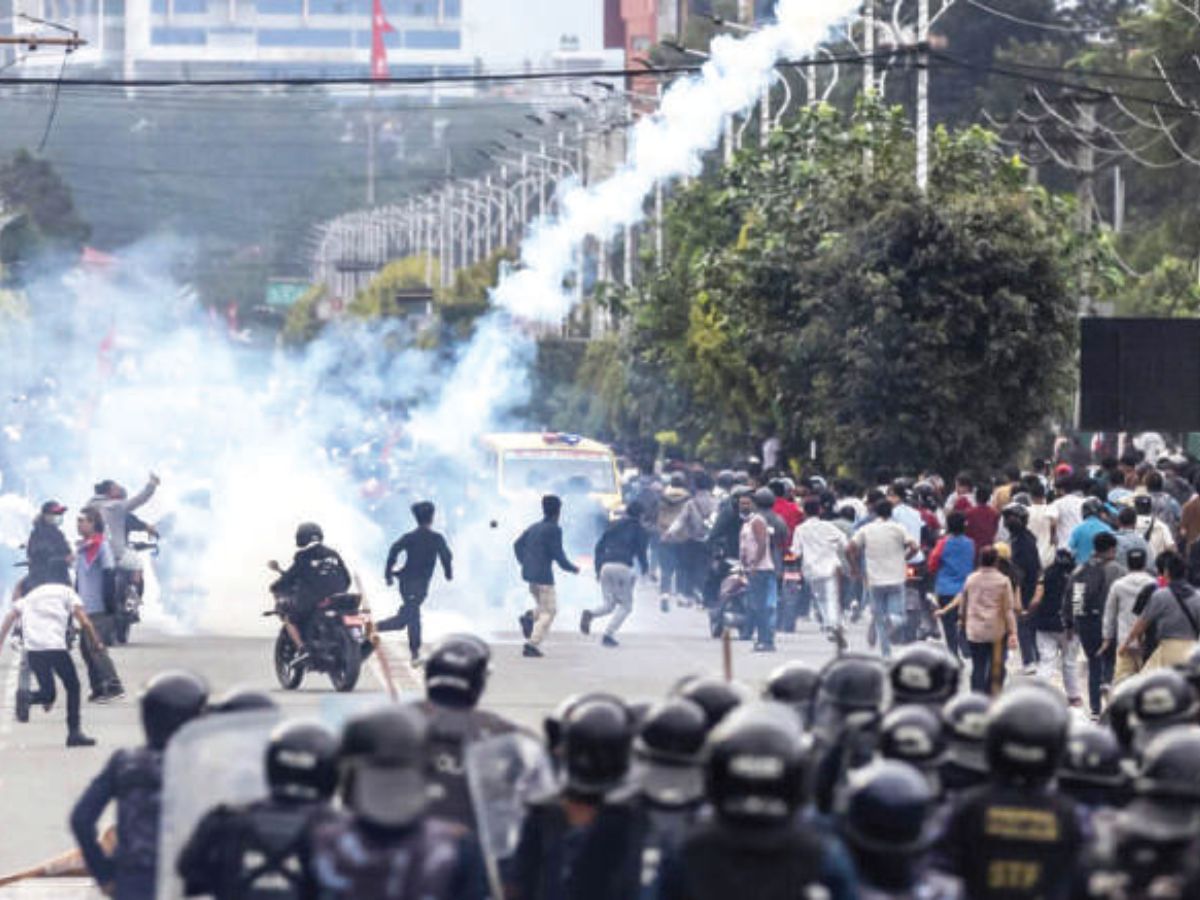
New Delhi: Newly obtained internal records reveal how Washington quietly funded and directed a youth mobilisation programme in Nepal—blending political training, protest strategy, and geopolitical messaging to counter India and China’s influence.
Internal documents from the International Republican Institute (IRI), a U.S. organisation funded by the National Endowment for Democracy (NED), reveal the structure of a $350,000 political programme in Nepal that trained and mobilised young Nepalis to advocate against the influence of India and China in national policymaking and to push for governance reforms aligned with U.S. priorities.
The records—contracts, budgets, proposals, research reports, funder updates and training briefs—cover the period July 2021 to June 2022 and give a granular view of how the externally funded initiative operated.
On 16 February 2022, IRI signed a $9,135 fixed-price contract with Kathmandu-based Solutions Consultant Pvt. Ltd. to conduct a nationwide qualitative study on youth political participation. From the IRI side, the documents were signed by Matthew Carter, then IRI’s Asia Division Associate Director. Carter, who is now Deputy Director in the organisation, had visited Dhaka two months ago to meet Jamaat leaders with his team. Emails sent to both these entities seeking their versions did not elicit a response till the set deadline.
Interestingly, the landing page of IRI’s website makes clear the reason for its existence: “Around the world, dictators are working together against American interests. They are invested in America’s failure – but they will not prevail. For more than 40 years, the International Republican Institute (IRI) has helped to make America safer, stronger, and more prosperous by equipping partners with the tools they need to build successful democratic societies.”
The Nepali firm was tasked with seven focus group discussions across Nepal’s provinces and at least eight key informant interviews with politicians and civil society figures. IRI provided screening tools, required transcripts in English, and reserved ownership of all data. Payment was staged: $1,065 for discussion guides, $4,365 for participant recruitment, and $3,705 for the final report. The contract applied U.S. federal cost principles and record-keeping rules, requiring the Nepali contractor to retain documentation for seven years for potential audit. It also included “covered telecommunications” restrictions under the U.S. National Defense Authorization Act, barring the use of equipment or services from Chinese companies like Huawei, ZTE, Hytera, Hikvision, and Dahua. While this is standard language in U.S. government-linked contracts, it is highly unusual in a local political research deal.
The programme, called “Yuva Netritwa: Paradarshi Niti” (Youth Leadership: Transparent Policy), explicitly described its goal as strengthening youth political participation to “put pressure on Nepali political decision-makers to become more transparent, accountable, citizen-centred and responsive to youth concerns,” while training them to advocate on “political turmoil, government corruption and national policymaking manipulated by countries like China and India.” The plan was to create networks of young activists who would act as advocates for democratic reforms promoted by the U.S., using advocacy campaigns and protests to press party leaders and government officials.
The first step was the barrier analysis. Solutions Consultant ran the focus groups and interviews in April 2022. Participants were aged 18–35, drawn from political party youth wings, civic organisations, and unaffiliated youth, including minorities. The resulting May 2022 report detailed how nepotism, gerontocracy, family political backgrounds, and urban–rural divides shape youth engagement.
IRI reported to NED that these findings were being used to shape its Emerging Leaders Academy (ELA) and Youth Empowerment Skills (YES) workshops. The training content brief instructs facilitators to produce three modules: ‘Changemaking Powers’ – Nepal’s political context and youth roles; ‘Leadership Dialogues’ – leadership qualities, political engagement, protest strategies; and ‘Raising Your Voice’ – digital advocacy, use of low-bandwidth tools, messaging, and “strategies and skills in organising protests and demonstrations: resource mobilisation, organisational structure, communication, and advocacy.” The content development budget was NPR 400,000. Thirty per cent was payable on draft submission and the remainder on final delivery within 30 days.
The programme proposal places Nepal within a broader pattern of IRI’s regional youth mobilisation efforts. It draws repeated comparisons with its Emerging Leaders Academy (ELA) initiatives in Sri Lanka and Indonesia, presenting them as models of how youth networks can be trained to engage elected representatives, run targeted advocacy campaigns, and eventually enter political leadership positions. The text notes that IRI’s ELA “has seen success in providing young civic leaders and activists with the skills and knowledge needed to effectively engage with elected representatives, advocate for democratic change, and position themselves to assume leadership positions within their communities and parties.” Nepal’s programme was described as an adaptation of these models to local political and social conditions, using recent youth protest movements as the entry point.
It also references the use of digital advocacy techniques tested by IRI’s Venezuela team, specifically citing how WhatsApp has been deployed to communicate with “vulnerable communities with low internet penetration rates.” This shows the programme wasn’t designed in isolation—it borrowed from a tested playbook in other politically sensitive contexts, with Nepal as the next application.
The significance of these operations becomes sharper when placed alongside a separate forensic investigation into Nepal’s political protests. Importantly, a recently released report by Tel Aviv–based cyber intelligence firm Cyabra has found that the recent protest in Nepal that led to the overthrow of the government was heavily supported by online manipulations.
Cyabra’s investigation found that what initially appeared to be an organic civic mobilisation driven by frustration with corruption and elite dominance in Nepali politics was not just a grassroots uprising—it was also a digitally manipulated movement, with 34% of protest-related discourse on social media platforms like X (formerly Twitter) generated by fake, inauthentic profiles.
These fake accounts were not crude bots but highly sophisticated digital personas, many of which used AI-generated visuals of protesters and mimicked authentic Nepali voices by using identical hashtags such as #GenZProtest, #WakeUpNepal, and #SocialMediaBan. Cyabra’s forensic analysis shows that these profiles strategically amplified violent and extreme narratives, often embedding themselves in otherwise genuine conversations and engaging with real users to avoid detection. The disinformation campaign reached an estimated 326 million potential views, with over 164,000 interactions between fake and real profiles—a disproportionate influence on Nepal’s political discourse.
The programme budget, submitted to NED, shows $266,553 in direct costs, $18,000 in subgrants, and $65,447 in indirect costs. A large portion covered Washington-based personnel—programme managers, technical specialists, support staff—and repeated international flights between D.C. and Kathmandu. Domestic travel funds covered workshops in eastern and western Nepal. Field office salaries, rent, utilities, and equipment were also included. Invoices had to be submitted by 30 September each year or within 90 days of project end, underscoring the tight financial oversight.
Of the $350,000 total budget, $266,553 was direct costs, $18,000 subgrants, and $65,447 indirect. A significant proportion of direct costs were allocated to Washington D.C.–based personnel, including Technical Area Specialists, Program Managers, Program Officers, Program Associates, and support staff. Their daily rates ranged from $134 to $387, with allocations of dozens of staff days for each role. The travel section reveals multiple Washington–Kathmandu trips for senior managers and technical staff, including per diems, visas, and airport transfers, consuming tens of thousands of dollars. By contrast, the entire local subcontract for research—the core field component—was $9,135, less than the combined travel costs for two Washington trips. The budget also details strict invoicing deadlines (30 September each year or within 90 days of project end), reflecting U.S. federal grant compliance. Nearly every cost category references U.S. federal cost principles or acquisition regulations, effectively binding the Nepali subcontractor into the same compliance regime as a U.S. federal vendor.
The semi-annual narrative report to the National Endowment for Democracy (NED) offers a revealing window into how the programme’s progress and objectives were communicated to U.S. funders. The documents have framed Nepal’s political scene as “centralised, factionalised, and vulnerable to manipulation by India and China.” It casts youth networks supported by the U.S. as strategic actors who can counter these dynamics. The budget document shows how Washington remained the gravitational centre of the programme, despite it being operationally based in Nepal.
The documents clearly show that what was executed in Nepal was a U.S.-funded political programme: Washington-led planning and oversight, local research under U.S. contracting rules, youth network formation, protest and advocacy training, and explicit geopolitical framing around India and China. While the project operated openly through IRI and NED, its internal paperwork shows the extent to which foreign strategic objectives and domestic youth mobilisation were interwoven in Nepal between 2021 and 2022.
