
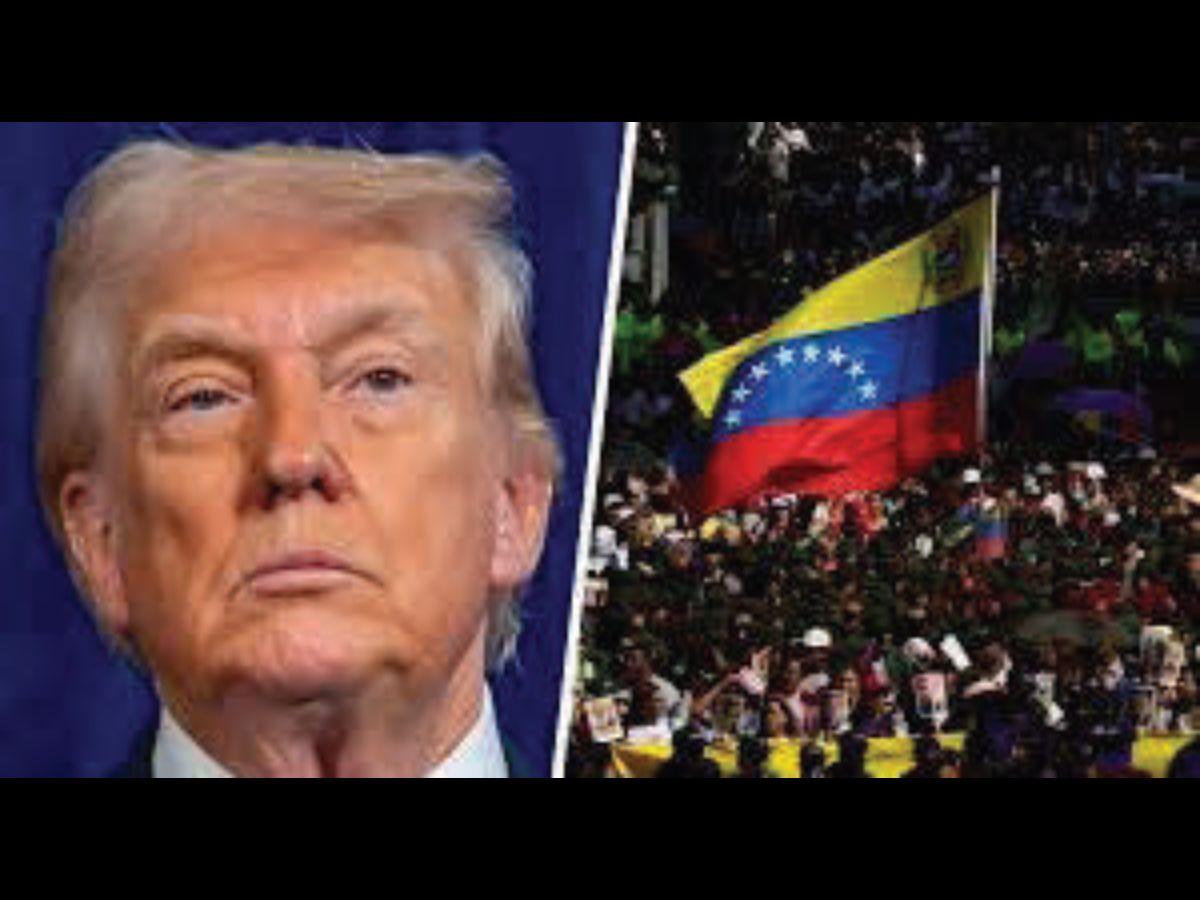
Pune: Changing regimes in a foreign country is nothing new to the USA. They have been doing it for decades now and have removed 35 leaders in the past 100 years. In 1983, President Reagan ordered the invasion of Granada after a supposed Marxist coup; in 1989 Manuel Noriega of Panama was arrested under US drug trafficking indictments, when the actual aim was control of the Panama Canal. And how can we forget the ill-fated invasion of Iraq in 2003 on the false premise of ‘Weapons of Mass Destruction,’ which led to Saddam Hussain’s capture and subsequent hanging. Libya was attacked in 2011 to kill Gaddafi which sent the nation spiralling into civil war. And now, in Venezuela we have the absolutely unedifying spectacle of the President being kidnapped from the sovereign soil of his own country, got back in handcuffs to the USA, to face trial on Trumped up charges (pun unintended) of drug trafficking and narcoterrorism.
The trigger to this was in January 2024 when Nicolas Maduro, a former bus driver, was re-elected in an election considered as fraudulent by the US (compared to the free and fair elections held in Pakistan). Maduro has been in the US crosshairs ever since he first came into power in 2013 and carries a bounty of $50 million on his head. The USA accused Maduro of smuggling cocaine and fentanyl under a drug cartel mysteriously named “The Cartel of the Suns” – allegedly headed by Maduro himself. In response, Venezuelan drug cartels were designated as terrorist organisations, over six lakh Venezuelans deported from the USA, and its exports curbed by 25% tariffs on countries buying its oil.
Things escalated around August when the US deployed destroyers and fighters around its waters, and targeted drug carrying vessels. Over twenty US attacks took place on boats suspected of ferrying drugs, which usually killed all on board under the express directions of the US Department of War. The USA aircraft carrier USS GERALD FORD also sailed into the Caribbean along with over 12,000 troops. Venezuela oil tankers carrying crude were seized and an oil blockade imposed. The undeclared war reached Venezuelan shores when a port was attacked, striking boats supposedly loading up on drugs. OP ABSOLUTE RESOLVE was in the offing for months but eventually launched on 03 January.
Troops of the elite Delta force had been rehearsing around a replica of Maduro’s safe house, practising how to spirit him away from the fortified residence, with Intelligence operatives on ground provided his pin point location. The operation was delayed for days because of bad weather, but on the night of 3rd January over 150 aircraft—including F-35s and F-22s, B1 Bombers, drones and EW aircraft attacked targets around Caracas, crippling its Air Defence Systems. At around 2 a.m. the electrical supply in the city switched off abruptly due to a US cyber-attack. This forced the Air Defence systems to turn to generators for electrical power, providing a crucial 5-7 minutes lag, in which a fleet of AH-24 Apache and AH-64 Chinook helicopters flew at low altitude over Caracas, reached Maduro’s residence and whisked away the President and his wife Cilia Flores to USS IWO JIMA in an operation lasting just around 30 minutes.
Images of a handcuffed President Maduro were flashed on social media, along with chortling self-congratulatory messages by Trump. He also claimed that the USA would oversee the running of the country and takeover its oil resources. “They stole our oil. We built the industry and they took it over. Now we are going to make a lot of money….”
This is the underlying cause of the action. Venezuela’s oil. Venezuela holds around 300 billion barrels of proven oil reserves—over a fifth of the world’s known reserves, more than Saudi, and even more than the USA and Russia put together. Yet, in spite of its vast reserves, Venezuela produces just around 1 million barrels a day—less than 1 percent of the global output—largely due to inefficiency and corruption. Much of the reserves are in the form of sour heavy oil, which is difficult to extract and refine and needs specialised equipment and technology. The contract for that will invariably go to the US firm Chevron which has a presence there.
The governance of Venezuela will be overseen by a team headed by Hegseth and Rubio, in coordination with Maduro’s Vice President Delcy Rodriquez- who has been propped up as the premier with a mixture of coercion, threats and promises. The US has claimed that it will oversee the country “for as long as it takes”—which basically means till its own companies establish a stranglehold on its oil resources.
Who is next? Iran is definitely on the cards. The mass demonstrations and protests in Iran have given Trump an opening and he has warned that excessive action against protestors could draw in US response. They could use it as an opportunity to engineer regime change and remove the Ayatollahs—a longstanding US goal in the region. The socialist regimes of Nicaragua, Columbia and Cuba too are in the crosshairs. We have also seen the unedifying images of Greenland draped in a US flag, with the caption “NEXT.” Canada too is repeatedly referred to as “The 51st State of the USA.”
This show of US hegemony is a dramatic escalation of the Monroe Doctrine—established way back in 1823, which asserted the Americas as the ‘US zone of influence.’ The ‘Donroe Doctrine’ which the Nobel Peace Prize coveting president has unleashed, seems to carry that even further—not only into the Americas, but even other friendly nations like Canada and Greenland, and beyond.
The world response so far has been muted. But condemnation has crept in from Russia and China, and even from US allies. The US has also upped the ante against Russia by impounding Russian tankers and threatened a whopping 500 percent tariffs on countries purchasing Russian oil—largely targeting India, China and Brazil. The rules-based order that had held the world together for over 70 years seems to be fraying dangerously. Will it also encourage China to try its own hand at “the reunification of Taiwan, by military force if required?” Will we see the spectacle of the Taiwanese president similarly abducted? That is a contingency that could be on the cards now.
The upending of regimes not amicable to US interests is disturbing and has implications for India. The student uprising in Bangladesh and the ouster of Sheikh Hasina has the indicators of a US hand. Pakistan has got into Trump’s good books by kowtowing to it, in spite of its military dictatorship, the imprisonment of its former Prime Minister and human rights abuse. The instability of the nations on our flanks can be used to weaken India as well—whose concept of strategic autonomy is not liked by the US administration. India’s internal issues too can be raised; human rights and treatment of minorities raked up, all aided by pliant ‘leaders’ who are willing to raise unsubstantiated claims of election fraud overseas. India needs to keep its guard up. US actions are dangerous and are getting increasingly interventionist. We should not ignore the signs that could erupt, fast and expectedly later.
-
Ajay Singh is an internationally award-winning writer, who has authored 8 books and over 250 published articles. He is a regular contributor to The Sunday Guardian.




