
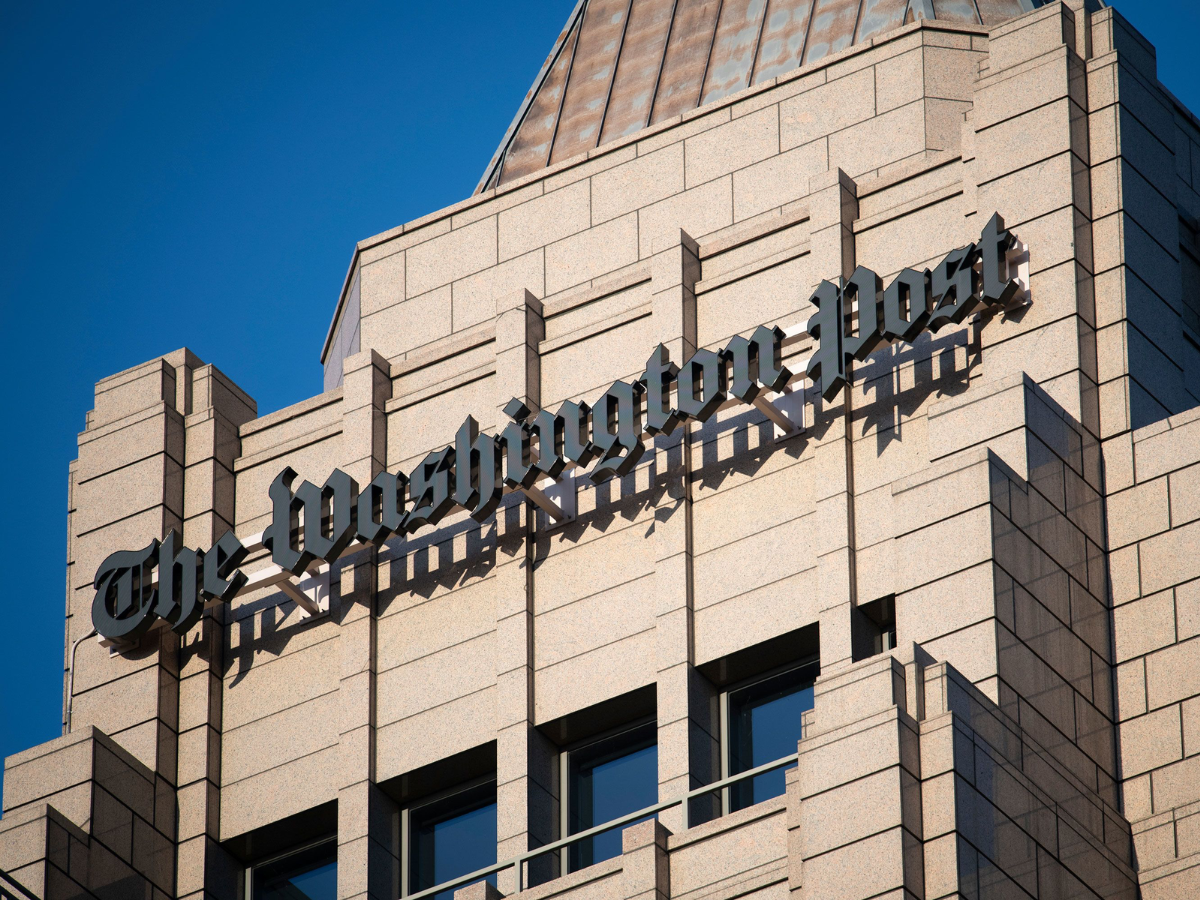
NEW DELHI: The Washington Post is preparing for a significant round of staff reductions that could eliminate between 100 and 300 jobs, more than ten percent of its newsroom, with the cuts expected as early as February 2026. The reductions are widely expected to fall hardest on foreign bureaus and the sports desk, underscoring the sustained financial pressure confronting the Jeff Bezos-owned newspaper despite its global reputation and digital reach.
News of the impending layoffs triggered an unusually public revolt inside the newsroom. Washington Post journalists have launched the #SaveThePost campaign on X, directly appealing to Jeff Bezos to reconsider the scale and direction of the cuts.
Dozens of reporters, particularly those based outside the United States, posted messages warning that shrinking foreign bureaus would cripple the paper’s ability to do original, on-the-ground reporting from politically sensitive regions. Within days, more than a hundred such posts had appeared, framing international coverage not as a dispensable cost center but as central to the Post’s journalistic mission.
Interventions and detailed appeals were also made by members of paper’s New Delhi bureau.
The team members, in their appeal, argued that India’s media ecosystem leaves little room for sustained accountability reporting without fear of government censure, and that this reality makes the Washington Post’s presence in the country especially important. They cited bureau’s recent investigations into preferential treatment for Indian billionaires, the alleged role of Indian conglomerates in fueling Russia’s war in Ukraine, deportations of Muslims to Bangladesh described as draconian, and the diplomatic breakdown between Washington and New Delhi.
These public defence, however, also sharpened a long-standing critique of the Washington Post’s India coverage and is being seen as an unusually candid acknowledgment of the editorial posture that has defined the paper’s reporting on India over the past several years.
The list of achievements closely mirrored a broader pattern in which the Post has repeatedly foregrounded stories portraying India under Prime Minister Narendra Modi and the BJP as a case study in democratic backsliding, communal polarization, censorship, surveillance, and the abuse of state power.
Since roughly 2020, the paper has published a dense stream of investigations, features, and opinion pieces that cast India in a consistently adversarial light. One of the most cited examples is the 2024 Pulitzer finalist series “Rising India, Toxic Tech,” produced by a Washington Post team which argued that Modi and his Hindu nationalist allies methodically undermined democratic norms through coordinated social media manipulation, pressure on U.S. technology companies, and the spread of propaganda and hate.
Other major reports examined what the paper described as vast digital campaigns by Hindu nationalists to inflame communal tensions, alleged government pressure on Meta and Twitter to shape content moderation outcomes, Secretive Section 69A meetings portrayed as a model for global online censorship, and covert influence operations aimed at discrediting Modi’s critics in the United States.
The Post’s coverage has also repeatedly focused on press freedom, minority rights, and surveillance. It has published stories and opinion columns on alleged harassment of journalists, raids on independent media outlets, digital monitoring framed as alarming for democracies, and policies affecting Muslims, including citizenship laws and deportation drives.
Diplomatic reporting has emphasized tensions between India and its neighbors and partners, often using language that critics describe as loaded or accusatory. Environmental and public health reporting has highlighted extreme air pollution and its human impact, at times employing stark comparisons that drew criticism for sensationalism.
In at least one prominent case, a June 2025 report on misinformation in Indian television news during India-Pakistan tensions, the Washington Post issued formal corrections after backlash over mischaracterizations and mistranslations of Hindi language broadcasts. While corrections are a routine part of journalism, critics argued that this episode weakened the paper’s moral authority, since a story accusing Indian media of spreading falsehoods was itself found to contain factual errors that were acknowledged only after sustained public challenge.
Indian officials and pro-government commentators have for years described this body of work as agenda-driven and selectively framed.
The Ministry of External Affairs has accused the Post of comparative hostility, while senior figures including External Affairs Minister S. Jaishankar and BJP representatives have publicly dismissed its reporting as biased and lacking credibility. Right-leaning outlets and commentators have gone further, arguing that negative coverage of India has become institutional habit, a charge that gained renewed traction after the recent tweets by its Indian team was interpreted as presenting adversarial reporting as the bureau’s core justification for survival.
Critics said that the dispute is not about a single contested article but about volume, emphasis, and framing over time. The Washington Post continues to defend its India coverage as independent accountability journalism in the public interest, and has undeniably produced investigations that resonate with global audiences and awards committees. Yet the sheer concentration of critical reporting on governance failures, minority rights abuses, communal tensions, surveillance, and censorship, combined with comparatively limited coverage of India’s economic growth, diplomatic leverage, or policy successes, has entrenched the perception of a sustained anti-India slant.
According to observers, the #SaveThePost campaign has therefore done more than highlight the financial strain facing one of America’s most influential newspapers. It has exposed how closely the Post’s international bureaus, particularly in India, now define their relevance and value through a specific editorial lens.




