
New Delhi: President Donald Trump has waged a tariff war against India, questioning the basic tenets of the India-US strategic partnership constructed painstakingly through tough negotiations for about two and a half decades.
While congratulating himself for promoting seven ceasefires between warring parties in about seven months of his second administration and saving precious lives, he seems oblivious of the negative impact of his tariff policy on hundreds of thousands of labourers who will lose jobs. He also seems to care less about the economic cost of his tariff on American consumers and companies.
Besides the social impact of his 50% tariff on Indian exports, his threats of tariff on products made in India by US companies, such as Apple Inc., his merciless handling of issues related to undocumented immigrants, his unthoughtful H1B visa policy, and his attack on the US education system that would deprive thousands of Indian students of an opportunity to study in the US will affect the lives of innocent people.
President Trump has launched a tariff war against practically every country in the world, including India. This is perfectly understandable. But the secondary tariff that he has imposed on India for buying Russian oil is illogical, illegal and amounts to an undeclared economic war against India. This threatens India’s energy security and obstructs economic growth, while serving no purpose. It can neither force Russia to declare a ceasefire and end the Ukraine War, nor can it benefit the US except by satisfying the American President’s ego that he could bulldoze India into following his diktat.
The secondary tariff is illogical because President Trump has imposed no tariff on Russia, which refuses to end the war in Ukraine on American terms. It is illegal because it is not based on any domestic US legislation or constitutional authority. It is also unjustified because other countries that buy more energy resources from Russia than India are exempted from Trump’s so-called secondary tariff. But it is a classic case of economic coercion that would surely affect Indian economic growth.
Thus, it raises the question as to why President Donald Trump is hell-bent on punishing India, a close strategic partner. This Trumpian penalty is despite India’s efforts from the early weeks of the inauguration of the second Trump Administration.
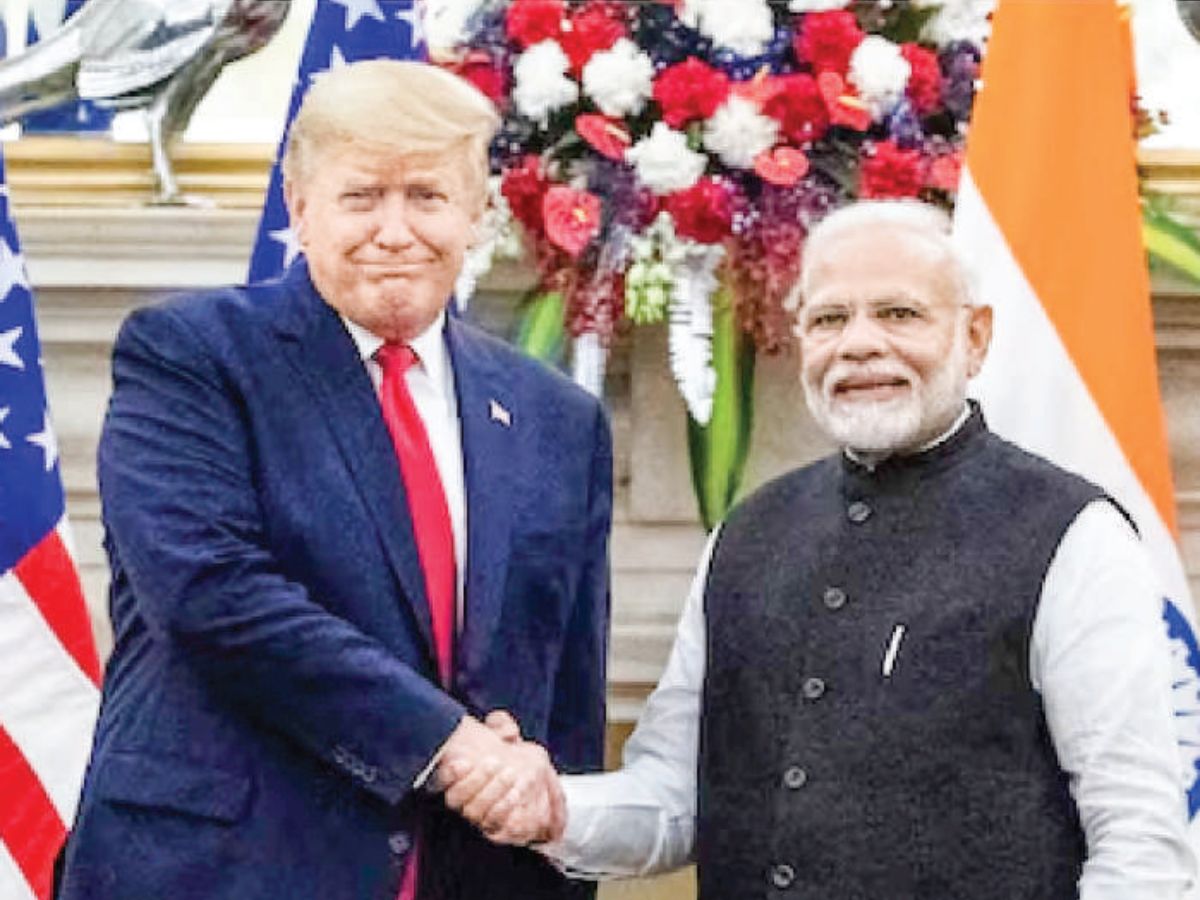
Prime Minister Narendra Modi was one of the first few world leaders to hold a summit meeting with President Trump in February 2025. He offered to cooperate to make India-US trade a $500 billion worth of business in a few years. India, moreover, was one of the first countries to start negotiating a trade agreement. Like many other countries, India also agreed to compromise on several sectors of trade and considerably reduce tariff rates. At no point did the Indian Prime Minister make any adverse remarks on the United States or comment on Trump’s policies.
While President Trump repeatedly called India a tariff king and complained about the US trade deficit with India, the Indian government did not bring up the issue that trade consists of both tangible goods and services and that in the overall trade balance the US enjoys a trade surplus above $30 billion vis-à-vis India.
The reasons behind the Trumpian approach toward India lie elsewhere. First of all, while the Indian government and strategic community displayed quiet confidence in navigating the Trump 2.0 administration after the November 2024 US presidential election, unlike the leadership in many other countries, there were adequate indications that the second Trump Administration would be qualitatively different from that of the first administration.
It was not realized that Trump, an injured political leader since his defeat in the 2020 presidential election, would emerge as a vindictive and revengeful administrator after winning the 2024 presidential election. A barrage of his Executive Orders issued from the very moment of his inauguration, invocation of Emergency Powers to execute his agenda, harsh treatment of immigrants, ending the Diversity, Equity and Inclusion (DEI) schemes across programs, ending numerous foreign assistance programs, showing interest in grabbing foreign territories in North America, Europe, West Asia and Latin America and on-and-off tariff declarations appear, in hindsight, that President Trump desires to be a global emperor—an emperor who would have no mercy on anyone, Americans or foreigners, and a ruler who would not take a “No” from anyone.
In addition, no one should behave like an equal with the emperor. Any leader who would visit him in the White House would not be treated like a head of state or government, but a junior partner country of the United States. If anyone does minimal psychoanalysis of the current American president, it would be known that President Trump would always like to be on the top.
When the Indian Prime Minister, a proud leader of a resilient civilization, would respond to Trump’s oft-repeated assertion of “America First” by saying that he too has an “India First” policy, a mercurial personality like Trump would perhaps not be able to digest it. Secondly, when an Indian Prime Minister would counter the American President’s claim that the latter played a mediatory role in the India-Pakistan ceasefire of May 2025, it would be harder for him to swallow that. Interestingly, Trump has repeated more than 40 times that the ceasefire between India and Pakistan was because of his weaponization of tariff.
Third, the reported refusal of Prime Minister Modi to visit him in Washington on his way back to India from Canada after the G7 meeting perhaps angered Trump a great deal.
There is no doubt that the US President is the most powerful individual in the world. It is understood that the US leadership role in world affairs is crucial for order and stability. But it is also true that global governance cannot be run by one superpower in a fast-emerging multipolar world.
While the India-US strategic partnership is facing a big challenge because of President Trump’s transactional strategies, unless there is a change of course, it will not serve US interests in the long run. What is needed is good advice given to President Trump by his advisers—that a colonial and imperial mindset will not work in the 21st century.
President Trump’s “Make America Great Again” slogan inherently suggests that America has lost its greatness in relative terms. If that greatness has to be restored, the Trump Administration has to adopt a foreign policy that is not coercive, that is deeply cooperative, that is based on mutual respect, and that is trustworthy.
The strategic partnership between India and the US may be halted during the Trump 2.0 Administration, but it will not collapse. The silver lining, interestingly, is indicated in President Trump’s flexibility in approach. As a deal maker, he bargains hard but also makes compromises. The official level 2+2 dialogue held two days before the 50% US tariff against Indian exports kicked in reported willingness of both sides to keep communication open and holds promise of resolution of trade and other tensions between India and the US.
The hard lesson for India, nonetheless, is to de-risk and diversify economic and defence engagements with other countries. Multi-alignment is the appropriate mantra that can serve Indian national interests.
Chintamani Mahapatra is Founder Chairperson, KIIPS and Editor, India Quarterly.




