A landmark musical movement celebrates twenty-five years of global influence and innovation.
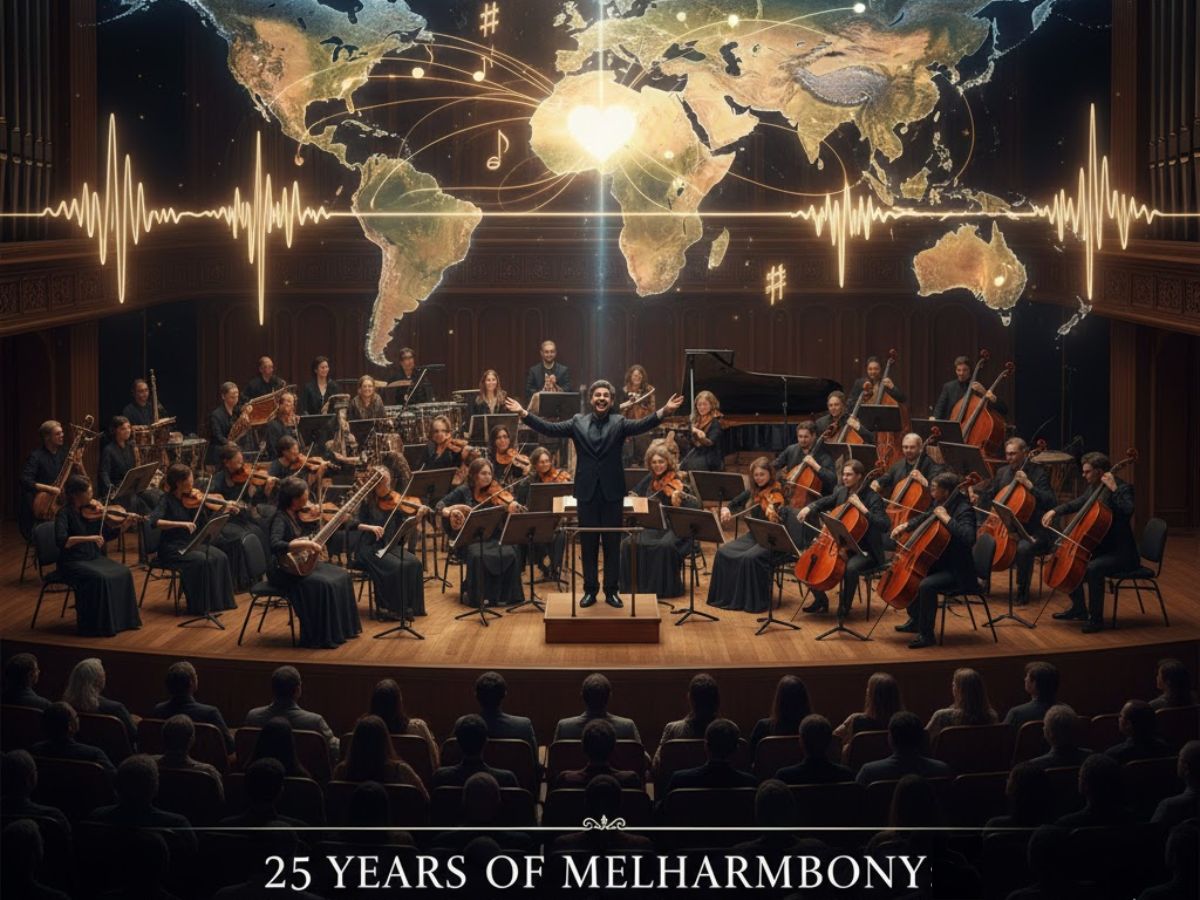
25 years of Melharmony: India’s musical gift to global consciousness
Global impact
The proclamation of Oct 11, 2025 as Melharmony Silver Jubilee Day by the Mayor of Madison, WI, USA, highlights the global impact of this pathbreaking music genre amalgamating Indian Melodic approach and West’s Harmony-centric style. Melharmony has indeed arrived on the world stage as a significant postmillennial contribution of India to world culture. It has enriched Western Symphony Orchestras and World Music ensembles with more than 100 Indian raagas through repertoires of Indian classical master composers, and is emerging as a vehicle to introduce Indian compositions to American school orchestras. Melharmony’s continued growth has the potential to expose every student of Western music to the rich aesthetics and subtle nuances of Indian classical music.
Melharmony has proliferated globally via yearly twin-composer festivals featuring eminent Indian artists collaborating with Western Classical, Jazz and Rock counterparts to audiences as large as 45,000-50,000. Renditions of melody-based Indian and harmony-based Western pieces are followed by Melharmony presentations with orchestral harmonies crafted within the scale logic and phraseology of raagas both familiar (e.g., Shankarabharanam, Keeravani, Shanmukhapriya, Reetigowla and Nattai) and exotic (e.g., Jingla and Umabharanam). Hundreds of such collaborations have led to a rapidly expanding repertoire of orchestral suites, ensemble and chamber creations embedded with Indian microtonal nuances, evocative ornamentation and dazzling rhythmic arithmetics.
Critical acclaim
Melharmony has captured the imagination of connoisseurs, composers and educators, and enchanted multicultural audiences across India, Europe, and America. The inclusive theoretical basis and artistic balance of Melharmony have been lauded as “a new grammar for global music” and “India’s 21st-century contribution to the world’s musical language.” Percussion icon Trichy Sankaran hails Melharmony as an “exciting concept that has added much color to world music.” Four-time Grammy winning drummer Glen Velez said, “My wife Loire Cotler (singer and vocal percussionist) and I have always felt deeply honored to be part of this illustrious concept”. Maestro Andrew Sewell, conductor of Wisconsin Chamber Orchestra acknowledges Melharmony to be an “extraordinary concept brings together Indian and Western music cultures”.
Serendipitous discovery
Musical genius Chitravina Ravikiran serendipitously stumbled upon the Melharmony idea during his collaboration with handpicked members of the BBC Philharmonic Orchestra for the Global Echoes concert series in the UK Millennium Festival in 2000. He quickly articulated his discovery to his collaborators and to Kalasangam‘s Dr. Geetha Upadhyaya, the organizer. The Oct 2000 Melharmony concerts were accorded rousing receptions. They were recognized among the top five events of the year-long festival, invited for an encore in London’s Tate Modern Gallery, and featured as the BBC Magazine’s cover story “BBC Melharmonic!” echoing Ravikiran’s phrase before the Manchester concert.
Melharmony’s theoretical framework from a Western standpoint was subsequently developed by renowned scholar-composer Prof. Robert Morris of Eastman School Music, University of Rochester, USA. Vigorous engagement of performing artists, musicologists, and students have led to Melharmony summer courses and lectures, e.g., Eastman School, University of Wisconsin, Rensselaer Polytechnic Institute, University of Georgia and Ljubljana University in Slovenia, to name a few.
Fusion and Melharmony
East-West fusion music can be traced to Western-style Sanskrit and Telugu compositions of Tyagaraja (1767-1847) and Muttuswami Deekshitar (1776-1835), and the embedding of Indian themes and raagas in symphonic pieces by Claude Debussy (1862-1918) and Gustav Holst (1874-1934). The 1960s birthed fusion performances sparked by Indian classical music showcased by Pandit Ravishankar and Ustad Alla Rakha to western audiences that led to collaborations with Beatles star George Harrison and John McLaughlin. Numerous Indian stars built on this foundation, e.g., Vikku Vinayakaram, Ustad Zakir Hussain, L. Subramaniam, L. Shankar, Umayalpuram Sivaraman, Ravikiran himself and Mandolin Srinivas.
Melharmony is a new fusion music genre that requires multi-note harmonies to be anchored by melodic phrases and sequences informed by raaga aesthetics, unlike generic fusion. Such structured inclusion honors the core values and expands the scope of both parent systems, and can be potentially adapted to unearth alloy variants based on other melodic systems (e.g., from China, Persia, and Africa). Thus, Melharmony demands a higher degree of awareness of nuances in both parent genres than for performing generic fusion. To compose Melhamony pieces, Chitravina Ravikiran taught himself the Western music idiom to convey sophisticated Indian gamakaas (oscillations) to Melharmony orchestras. Such passion to nurture and propagate a new genre with Indian musical values by a top-of-the-field artist is reminiscent of Pandit Ravishankar’s zest to popularize Indian music to the world.
Annual festivals
Melharmony’s inexorable growth has been fueled by multi-event festivals organized by passionate music enthusiasts inspired by the Melharmony founder, with support from private patrons, local businesses, and Government. The annual Madison Melharmony festival curated by performer, art-educator and impresario Vanitha Suresh since 2013 is a trend setter. Each year, top-Indian artists and collaborate with local orchestras to juxtapose creations of a chosen Indian-Western classical master duo (e.g., Oottukkaadu Venkata Kavi and Bach, Tyagaraaja and Mozart, Deekshitar and Beethoven, Shyaama Shaastri and Schubert, and Swaati Tirunal and Mendelssohn).
These two-day festivals also offer a platform for collaborations between Indian dancers, theatre groups, student artists and school orchestras. Indian classical students perform Melharmony pieces with Western symphonic ensembles, while the latter expand their repertoire and versatility by performing Indian classical pieces. Similar festivals have been held in Seattle, Chicago, Toronto, Bradford, Zurich, Goettingen, New Delhi, Bangalore, Mumbai, and Chennai.
Art Diplomacy, global harmony and well-being
Melharmony is a powerful means for cultural diplomacy to tackle global challenges through inclusivity and mutual respect. Recognizing this, Indian missions in US, UK and Europe have supported Melharmony festivals to facilitate constructive dialogues to address global challenges.
Examples include the 2019 epic 72-raaga Climatrix Symphony and the 2023 Tyagaraja-Mozart festival featuring 300 artists from 30 countries. With increasing global presence of Indian classical music, Melharmony could set the tone for multicultural interactions for music innovation and education, performance, and human well-being. The Melharmony Foundation recently embraced Musopathy—a vision to unearth, understand and apply universal musical principles for transcultural therapeutics and human well-being. This is in harmony with the recently launched MS and PhD degrees programs in Music and Musopathy by the Indian Knowledge System for Mental Health Applications (IKSMHA) center in IIT Mandi, Himachal Pradesh, India.
Melharmony is a rapidly growing Indian-inspired cross-cultural global music genre with exciting possibilities that can inclusively inspire, expand, enrich and fulfill hearts in a world seeking connection without cultural erasure. While questions such as “can the raaga spirit be retained amidst structured harmony”, or “can orchestral complexity express every type of raaga or gamaka” need exploration and inquiry, one only needs to listen to Melharmony pieces online to see if the music strikes a chord.
*Ganpati Ramanath is John Tod Horton Professor of Materials Science and Engineering at Rensselaer Polytechnic Institute, Troy, NY, USA (https://faculty.rpi.edu/ganpati-ramanath), WISE Guest Professor of Chemistry, Uppsala University, Sweden, and Adjunct Professor of Indian Knowledge Systems at IIT Mandi. He is a passionate performer and connoisseur of Indian classical music, and teaches spoken Sanskrit. He is currently the Executive Director of Melharmony Foundation.
