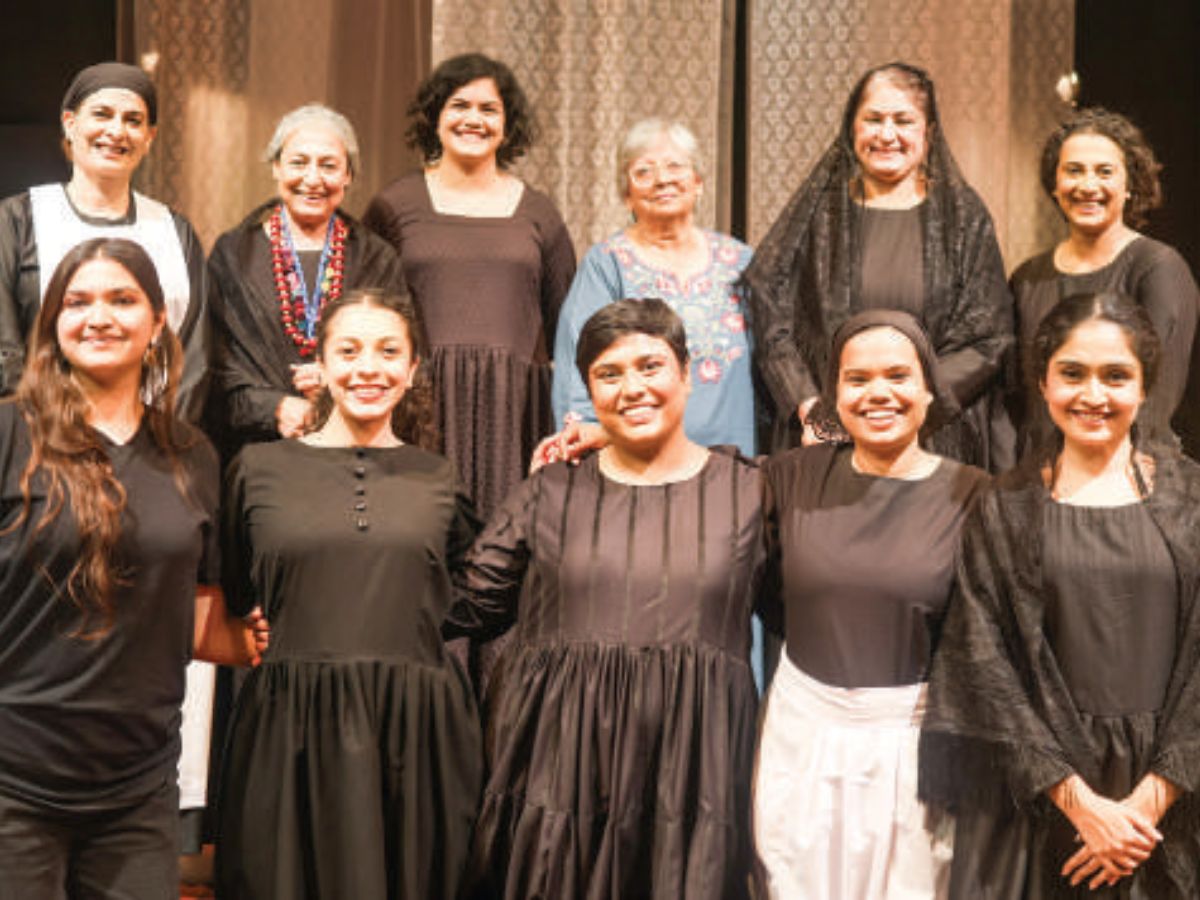
On a recent Saturday afternoon, I drove to Jagriti Theatre, 15 km away in Whitefield, to what used to be the outskirts of Bengaluru. Frankly, when Arundhati Raja, one of the leading lights of English theatre in India, invited me to see her latest production, Federico García Lorca’s The House of Bernarda Alba, I wondered how many people other than loyal fans of the Rajas would be drawn to see it.
I was wrong to doubt. The denizens of my city are sensitive to the repression that women continue to experience. A feminist play written by a rebellious gay Spanish playwright saw a packed auditorium. Lorca wrote it in 1936, a couple of months before he was assassinated by Nationalist forces during the Spanish Civil War. The play originally depicted women’s lives in rural Spain, but this production showed that “the more things change, the more they stand still.”
The play is about the formidable Bernarda Alba, who declares an eight-year mourning period after her second husband’s death. The household is steeped in silence and shadows. She has five unmarried daughters who are forced to follow strict rules and are barred from going outside or having any relationships with men during the mourning period. The play explores how repression has consequences and the dangerous results of desire, jealousy, and defiance.
Arundhati had once planned to play Bernarda herself, but the script sat on her shelf for years. When she revisited it, she felt it was an opportunity to work with an all-female cast and explore themes that resonate powerfully in today’s India. “I just felt it’d be good to work with an all-female cast,” she told me, emphasising how Lorca’s vision deliberately excludes any male presence on stage, even the much-discussed young man Pepe el Romano, who drives the plot but is never seen.
This absence is a powerful statement about women forced to live in the shadows of male influence while men themselves remain tantalisingly out of reach. Arundhati was particular about preserving this dynamic, unlike other productions that featured male characters physically on stage. “If you bring the male into it physically, then I just feel the point of what Lorca was trying to say has gone,” she explains. Lorca, poet, playwright and theatre director, could empathise with repression. He was an openly queer artist, and he lived a life of resistance “against fascism, censorship, and the suffocating codes of gender and sexuality.”
Arundhati’s stagecraft deftly projected it through the backdrop, the set, the music and the cast. What emerged was the deep void when nine women endured something intolerably bleak in common. They were of different ages and different social levels, but none of them was free. Be it the all-powerful Bernarda (Munira Sen), her mother (Padmavathy Rao), the maids, or the daughters from two marriages (Mayura Baweja, Priyanka Chandrasekhar, Kalyani Kumar, Yamuna Kali, Samragni Dasgupta, Urvashi HV and Garima Mishra)—one with money, the rest not so rich—they are all prisoners of societal pressures.
For Arundhati, the common thread binding all of Lorca’s female characters isn’t their desire for Pepe, but their profound lack of agency. “It was, to me, a loss of freedom. They had no choice about doing anything. They had no choice to do things in the house and certainly had no choice to go out and do anything.” The universality of this theme became startlingly clear during rehearsals with the young cast. Arundhati told me she didn’t need to explain the contemporary relevance—her actors immediately connected with the material through their own experiences and those of their friends. Stories poured out about parental pressure to marry, questions about why daughters weren’t “settled” yet, and the constant policing of how women dress and behave.
The parallels between 1930s rural Spain and modern urban India proved inescapable. After the play, I spoke to a few teenage girls in the audience who echoed these views. A telling, if deplorable, commentary.
I asked Arundhati how she dealt with humanising Bernarda Alba. She appeared to me as a complex character and could easily have been reduced to a shrewish despot. Rather than presenting her as a simple tyrant, Arundhati sought to reveal the tragic cycle of oppression. “She’s just repeating what has happened to her.” Bernarda’s restrictive control stems from genuine fear for her daughters’ safety in a world hostile to unprotected women. It’s a nuanced portrayal that underlined how survivors of systemic oppression sometimes become its enforcers.
The production’s visual elements reinforced these themes. Roy Sinai’s projections created what Lorca himself called “a photographic documentation of women”—overlaying contemporary images with period aesthetics to blur the lines between past and present. The decision to open and close with family portraits, removing an errant daughter from the final image, created a visual metaphor for how women disappear when they transgress social boundaries.
Each act built up to a climax before retreating into silence, much like the cycles of repression and explosion that characterise life under patriarchal control. The working songs performed by The Bangalore Men as authentic harvest music rather than operatic interludes added a touch of reality.
Arundhati reflected on the casting process, which posed contemporary challenges, with actors juggling acting with paying jobs, and travelling across Bengaluru’s notorious traffic to rehearse. It was well worth the effort, leading to cross-generational dialogue where veteran actors and newcomers informed each other’s understanding of the material.
Like me, Arundhati was struck by the audience’s response, especially the younger people. Many had read the play beforehand and saw the production with curiosity and engagement. The sight of teenagers sitting transfixed through a 90-year-old Spanish tragedy speaks to the enduring power of stories about power and freedom.
What the Female Gaze says: Through her production of Lorca’s timeless play, Arundhati showed that good feminist theatre does more than just reflect women’s experiences—it shines light on the systems that constrain us, it forces audiences to confront uncomfortable truths about complicity, survival, and the price of freedom. The fight for women’s autonomy is far from over, and speaking about it is a powerful rebellion.
Sandhya Mendonca, author, biographer, and publisher at Raintree Media, offers a distinct female gaze of the world in this column.
