At Kamakhya Temple, Sandhya Mendonca finds a spiritual reconnection with the divine feminine and with her own evolving womanhood.
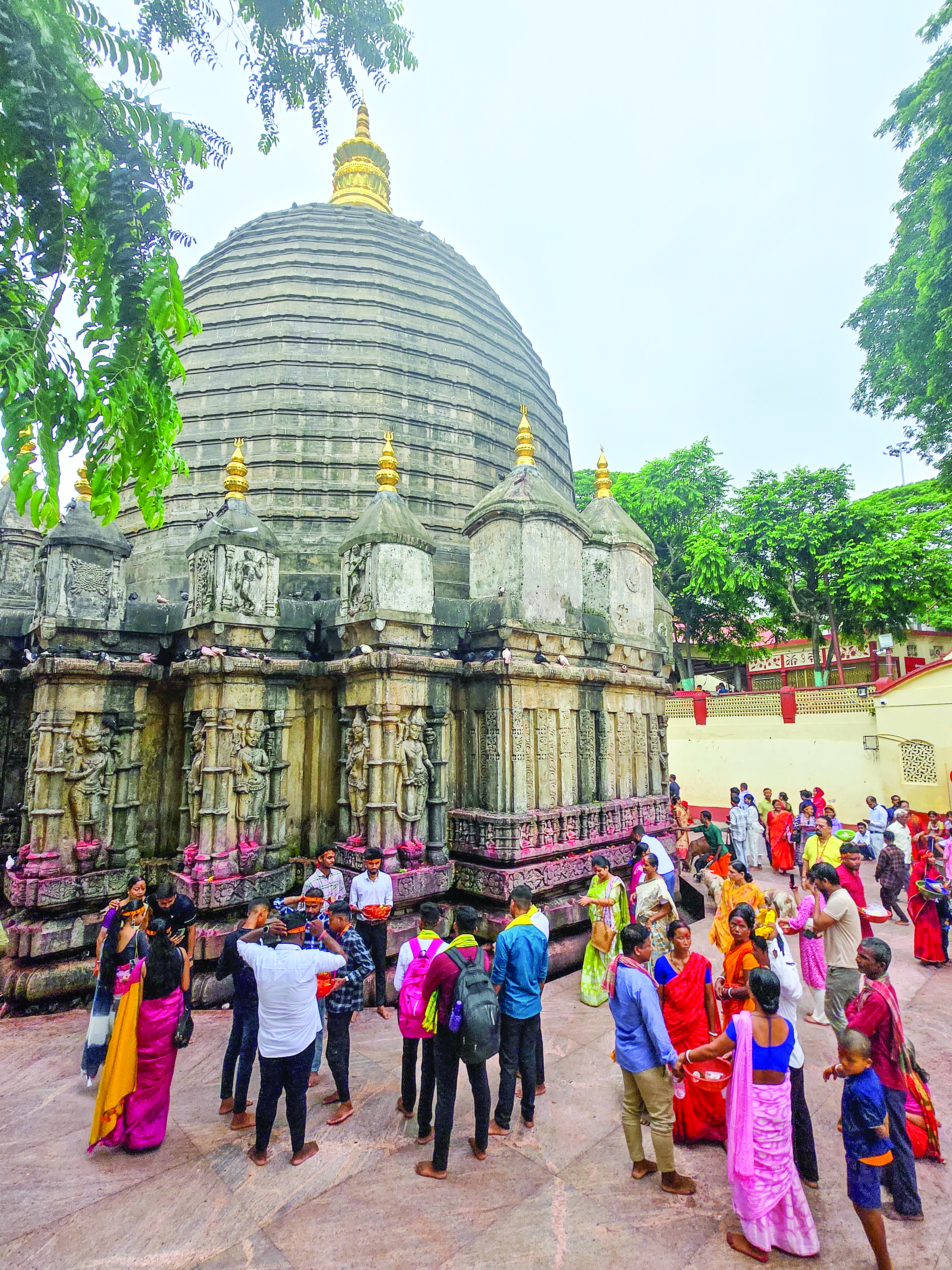
One recent morning, after my daily prayers, it struck me that I hadn’t visited the seat of a female deity in years. I mentioned it to a friend that evening, and she said, “I’m going to the Kamakhya Temple at the end of the month. Would you like to join me?” And just like that, a longheld wish became a reality. It was just a few days after the annual Ambubachi Mela when I arrived in Guwahati. It had been a while since I’d seen a short film about a festival that celebrates the menstruating goddess, and I had made a mental note to visit. Two previous plans to travel to Guwahati had fallen through — by which time, that mental note had almost faded.
So, it felt fitting that this visit would be solely to experience the energy of the divine feminine atop the Nilachal Hills. My friend, an experienced and well-connected pilgrim, ensured that from the moment we arrived at the temple gates, we were guided through all the significant spots and into the sanctum sanctorum. We stepped down into the darkness of a cave where, instead of an idol, there was a stone cleft kept moist by an underground spring — symbolising the goddess’s menstrual cycle and fertility. We offered garlands of red and blue flowers, prostrated ourselves, and dipped our fingers in the spring water. It’s a tight squeeze getting in and out of the cave, but helpful hands guide pilgrims, each carrying fervent prayers.
Amidst the crush of bodies — as many men as women — I didn’t feel the instinct to cross my arms over my chest, a protective tactic many of us learn as teenagers. I sensed that the men seeking blessings from Ma Kamakhya wouldn’t dare test her wrath by touching women inappropriately. Or so I hope. While my friend continued with the more elaborate pujas, I wandered through the temple complex, absorbing the sights and sounds. Apart from locals, the temple seemed most popular with devotees from Andhra Pradesh and Bengal. Professional photographers did brisk business among the selfie-takers, offering instant prints. I befriended a group of transgender devotees who seemed completely at peace. I remembered noticing a few trans persons earlier too, working nearby and appearing fully integrated into the local society.
The contrast between urban and rural mindsets came up again. Though Guwahati is a bustling city, the hilltop temple retains a distinctly rural ethos. While urban India still grapples with accepting gender diversity, here, in a supposedly more traditional space, there appeared to be greater acceptance. The Kamakhya Temple is one of the rare places in India — and the world — where the female body is not just accepted, but revered. As a Shakti Peeth, it is believed to mark the site where the goddess Sati’s yoni (womb) fell after her body was dismembered. Each year, the temple closes for three days to mark the goddess’s menstruation.
This event, the Ambubachi Mela, coincides with the onset of the monsoon and the rise in water levels. Just as the earth becomes fertile with the rains, the menstrual cycle symbolises a woman’s fertility. While most religious spaces deny entry to menstruating women, here, menstruation is divine — not defiling. It’s a powerful counterpoint to temples like Sabarimala, where menstruating women were long barred from entering. I thought of my father, who always insisted we could visit temples even while menstruating. He never stood on a soapbox about it. He’d just say, “It doesn’t matter. Come along.” I wondered whether the Kamakhya Temple — or its authorities — have done anything to truly challenge menstrual taboos. Do the people who flock here do anything about menstrual health access, period poverty, or the stigma that continues to affect millions? I stand conflicted. Even as I embrace my spiritual and physical connection to Indian and Hindu culture, the paradoxes are too stark to ignore. While the temple celebrates a menstruating goddess, it mirrors many patriarchal structures it should transcend.
The temple’s message is feminist, but men dominate its priesthood. I learned that female tantriks are allowed during the Ambubachi Mela, but I didn’t see a single woman priest during my visit. I suspect that women are still excluded from core decisionmaking roles in temple rituals. On a personal level, the trip was made more meaningful by the woman who catalysed it: Prathibha Prahlad, my dear friend, is a strong and independent woman, a renowned Bharatanatyam dancer and a doyenne of culture and creativity.
On our last night, we had dinner with the acclaimed Assamese Sattriya dancer Sharodi Saikia at a charming little cookhouse run by her young friend, Riddhi Barua. I was impressed by her passion for her work and later found out she’s an Instagram favourite with delightful reels. This trip was more than a pilgrimage. It was a return to source. As women, we grow up with the message that our femininity is tied to youth and fertility.
With menopause, there’s an unspoken sense of fading — as though our connection to feminine energy begins to dull. I’ve felt it too, a quiet, internal erosion that creeps in with time. This trip, however, felt like a recharge. A recalibration. Kamakhya reminded me that feminine power isn’t bound to a biological cycle — it’s deeper, cyclical in its own way, and always present if we choose to reconnect with it. It was a reminder that the divine feminine isn’t something we lose with time. It lives in our bodies, our bonds, our rituals, and our resilience. I am deeply grateful that Goddess Kamakhya helped me reclaim a part of myself.
Sandhya Mendonca, author, biographer, and publisher at Raintree Media, offers a distinct female gaze of the world in this column.
