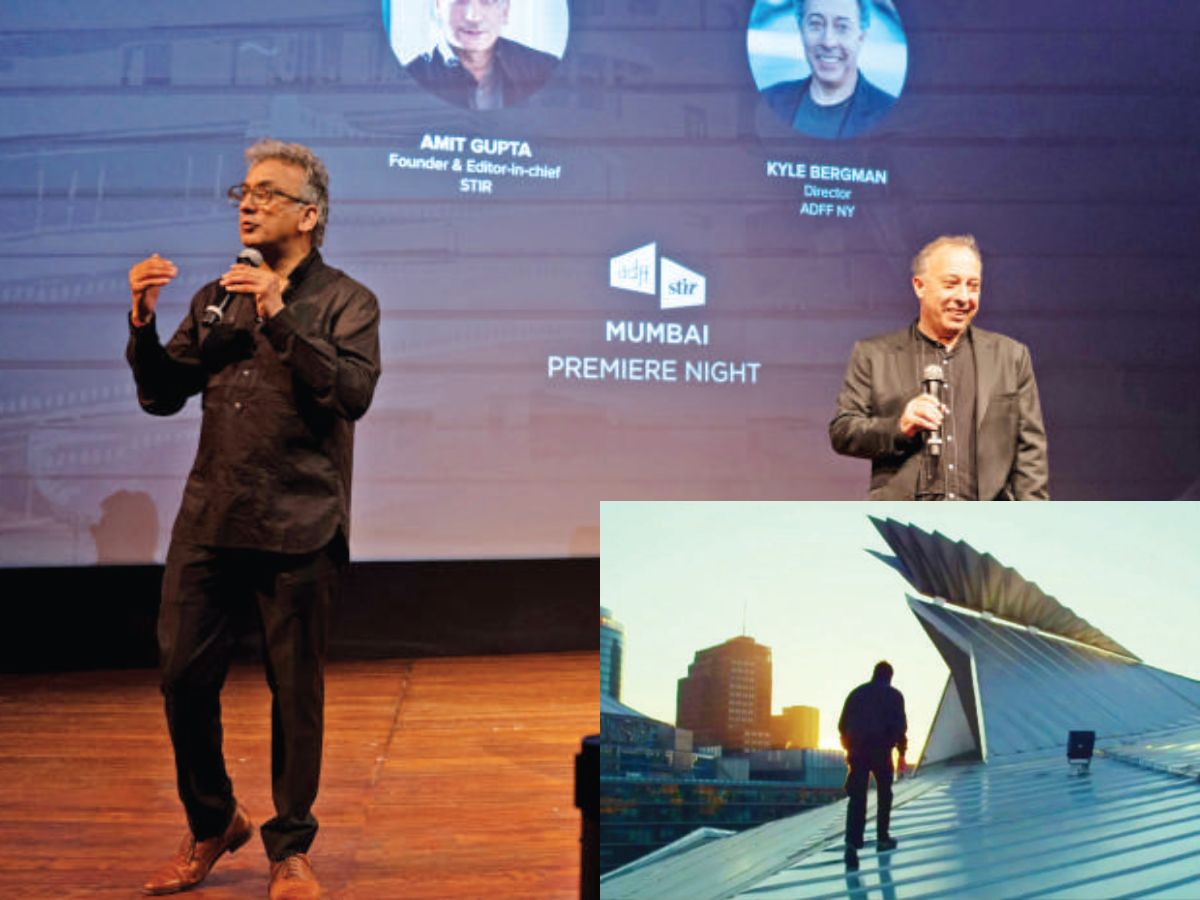
Amit Gupta and Kyle Bergman at the inauguration of ADFF 2026 | A still from Wim Wenders’ Cathedrals of Culture
When the Dean in Ayn Rand’s literary masterwork ‘The Fountainhead’ tries to dissuade the young student architect Howard Roark from thinking out of the box, “My dear fellow, who will let you?” it was really meant to be a rhetorical question, but when to his great shock Roark replies asserting, “That’s not the point. The point is, who will stop me?” it becomes a moment that more or less defines the madness and the urge behind creating something truly formidable. Such are the moments when architecture stops being a noun and becomes a feeling. When walls begin to listen, staircases remember footsteps, and cities reveal themselves not as maps but as montages. Cinema, in such moments, does not merely document architecture—it releases it. It allows buildings to breathe, to hesitate, to speak in silences and shadows. This is the quiet but radical promise that the ‘Architecture & Design Film Festival: STIR Mumbai’ returned with a belief that architecture is not just constructed, but narrated; not only inhabited, but felt. In an age addicted to speed—of renders, reels, and ruthless efficiency—this festival insists on slowness. On looking again. On the idea that architecture, like cinema, is ultimately about time: how we move through it, how it moves through us.
“At its heart, ADFF:STIR is about building a plural platform,” says Amit Gupta, Festival Director and Founder of STIR. “A space where film, architecture, design, the arts, their makers and their audiences can meet—much like what we strive for at STIR. Cinema allows us to engage with the built environment not just critically, but emotionally. It lets us experience the city as something both intimate and immense.”
That emotional register is crucial. Architecture, when filtered through cinema, sheds its professional armour. It becomes democratic. It invites not just architects, but pedestrians; not just critics, but passers-by. A street becomes a frame. A window becomes an edit. A city becomes a screenplay written collectively, often unconsciously, by millions. Nowhere is this truer than in Mumbai—a city that edits itself in real time. Its rhythms are percussive, its transitions abrupt, its juxtapositions startling. Old mills lean into glass towers. Art Deco curves flirt with brutalist severity. The city is never still long enough to be captured in a single shot—which is precisely why cinema is its most faithful medium.
The festival’s films understood this. They did not fetishise form. They interrogate systems, power, ecology, and memory. From portraits of iconic architects to grassroots stories of spatial justice, the selections insisted that architecture is never neutral. It shapes behaviour. It encodes ideology. It decides who belongs and who doesn’t.
Italy was represented at the ADFF this year with two films: Architecton (2025) by Victor Kossakovsky and We the Others (2025) by Maria Cristina and Francesca Molteni. The director of the Italian Embassy Cultural Centre, Andrea Anastasio, conducted the epilogue for both films. The festival opened with Wim Wenders’ 3D short film, ‘Cathedrals of Culture,’ based on The Berlin Philharmonic, exploring its revolutionary architecture by Hans Scharoun, its role as a symbol of a reunified Berlin, and the people within it, from the conductor to the musicians, all shot with sweeping views and unusual perspectives.
“Architecture brings fiction and reality together,” reflects Aric Chen, Curator of the Pavilion Park and Director of the Zaha Hadid Foundation. “You are able to shape experiences and narratives through the spaces that you create. With these pavilions, we hope visitors become actors, protagonists and audiences in their own storylines.” That idea—that we are all performers within architectural scripts—feels especially resonant today. Cities are increasingly choreographed, surveilled, and optimised. Cinema, however, restores unpredictability. It reveals the moments architecture cannot control: a pause, a protest, a child running across a plaza never meant for play.
Cinema also grants architecture a moral dimension. A building on screen is never just a building; it is a witness. It watches human ambition unfold, hubris rise and fall, and communities assemble and fracture. In films about Louis Kahn, the Campana Brothers, or Frank Gehry, we are not merely seeing celebrated careers—we are seeing questions of authorship, labour, legacy.
For Kyle Bergman, Founder and Director of ADFF, this is precisely why the festival exists. “The response to the first edition in Mumbai was extraordinary,” he says. “The audience here is deeply engaged and curious about how films can influence the world of architecture and design. Our aim has always been to draw people in—not just professionals, but anyone who has ever felt moved by a space.” Moved by a space. The phrase feels deceptively simple, yet it contains multitudes. Who hasn’t been altered by a school corridor, a cinema hall, a place of worship, a public square? Architecture shapes our emotional vocabulary long before we learn to name it. Cinema simply returns that vocabulary to us, enriched and reframed.
Beyond the screen, the festival’s conversations extended this thinking into the public realm. The ~log(ue) programme—deliberately playful in name, rigorously serious in intent—treated dialogue as architecture itself: something constructed, negotiated, inhabited. “At ~log(ue), we explored the energy that arises when people and perspectives meet,” explains Samta Nadeem, Festival Curator and Curatorial Director at STIR. “Through talks, debates, performances and workshops, we urge audiences to step into creative cultures rather than stand at their edges. We have shaped a space where ideas don’t just circulate, but collide and transform.”
That collision—between disciplines, geographies, generations—is the festival’s quiet triumph. For it understands that architecture today cannot be discussed in isolation. It must converse with climate, with politics, with cinema, with the body. And perhaps most urgently, with care. To watch architecture through film is to be reminded that buildings outlive us—but also depend on us. That cities are archives of choices. That design, at its best, is an ethical act. In a darkened theatre, as a building flickered to life on screen, something remarkable happened. We stopped scrolling. We started noticing. We remembered that architecture is not just something we look at—but something that looks back. And for a few hours, guided by cinema, we learnt to see slowly again.
