
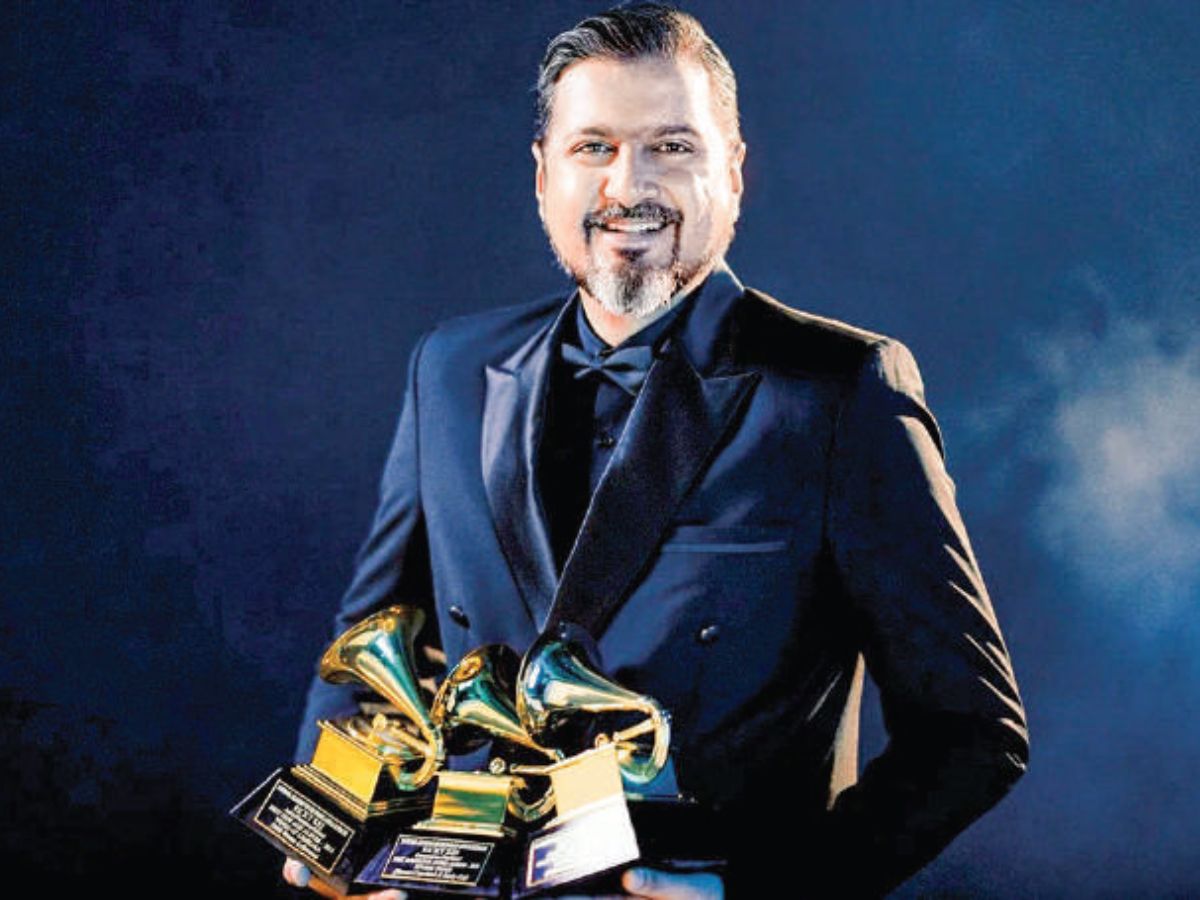
Three-time Grammy Award winner, a US Billboard Number One artist, UN Goodwill Ambassador, and Padma Shri awardee, Ricky Kej spoke to The Sunday Guardian on his latest album, “Gandhi: Mantras of Compassion”. This new age album is a musical tribute to the Mahatma and is in collaboration with Nobel Peace Prize winner Kailash Satyarthi.
Q: I was listening to your album and found it quite fascinating. I watched two of the music videos. My first question is: why Gandhi, and why now?
A: Like most Indians, Gandhi has always been a lifelong hero of mine. In fact, all three of my previous Grammy-winning projects had a song dedicated to Gandhi. I have always had this desire to create an entire album about him. Very few people outside India actually realize how much of Gandhi’s influence they have felt in their own societies.
For example, in America, Martin Luther King Jr. was heavily inspired by Gandhi. Nelson Mandela, too, was deeply influenced by Gandhi in his fight against apartheid. So many world leaders drew from Gandhi’s principles of non-violence to start movements in their own countries.
In 2024, I had the opportunity to work with Nobel Peace Prize laureate Kailash Satyarthi. We did a concert tour across four Indian cities—I would perform for 90 minutes, and he would speak for 30 minutes. It was hugely successful. We travelled together, spent a lot of time at his ashram in Jaipur, and during those days we had many discussions about Gandhi.
Mr. Satyarthi has often said that his entire life of activism is based on Gandhian principles. So together, we decided that the world needed a refresher on Gandhi—and what better way to do that than through music? That’s how this album was born.
Q: Why did you choose to collaborate with Kailash Satyarthi? What attracted you to him in particular?
A: I’ve been following his work for a very long time. It has been ten years since he won the Nobel Peace Prize in 2014. I admired everything he had been doing, but I had never had the chance to properly meet him. The only brief encounter was at the UN General Assembly in 2016—just a quick photograph and a “hello.” He wouldn’t even remember that.
So when the opportunity came to actually collaborate with him, it was a huge blessing. Spending time at his ashram, which is an extraordinary centre in Jaipur, was very inspiring. I call it an “incubation centre”—he brings rescued children there for rehabilitation and education. Many of the staff members at the ashram are themselves children who were once rescued by him.
To me, Satyarthi is carrying forward Gandhi’s ideals in the modern era, keeping that legacy alive. So he was an obvious choice for this project. I’m grateful we could take this journey together.
Q: I was particularly impressed by one of the music videos, which ends with the phrase “March with me.” The music plays in the background while Mr Satyarthi speaks. How did that idea come about? Was this also part of the stage presentation?
A: That video is called Compassion Karuna, and it was the first video we released from the album. We wanted to showcase Kailash Satyarthi as a living embodiment of Gandhi—in how he lives, in his activism, in his efforts for humanity and the environment.
For this video, we were fortunate to work with Oscar-winning filmmaker Davis Guggenheim, who directed An Inconvenient Truth with Al Gore. He also made a documentary on Kailash Satyarthi called The Price of Free, which won the top award at Sundance. I reached out to him and told him I wanted to create this video around Mr Satyarthi, and he agreed. That’s how the film came together.
Q: Shooting such videos must have been tough. The second one I watched involved so many people and children. How difficult was the process, and how long did it take?
A: The second video you’re referring to is We Are One: Raghupati Raghava. The song itself is inspired by the timeless bhajan Raghupati Raghava Raja Ram. Gandhi himself had modified the lyrics to make it more inclusive, and we used his version.
This track features musicians from all over the world. For instance, Tina Guo, the brilliant Chinese-American cellist—she’s the most recorded cellist on Earth and has played for films like The Dark Knight, Inception, Interstellar, Dune, Kung Fu Panda, and Wonder Woman. Then there’s Masa Takumi, a Grammy Award-winning shamisen player from Japan, an absolute legend. We also had an opera singer from New York, Adelmo, and an orchestra from Los Angeles conducted by an extraordinary female conductor.
For the music video, my friend and longtime collaborator, filmmaker Samir Raju, and I spent nearly two years filming at sacred sites around the world, but especially across India. We shot at Ajmer Dargah, the Kumbh Mela, the Mahakumbh this year, temples, churches in Kolkata and Bengaluru, and multiple sites in Rajasthan and the Northeast. It was an incredible experience capturing the diversity of faiths and traditions, which became the video.
Q: I was going through the list of songs on your album. Some are hymns. How would you describe the album as a whole? You’ve called it a New Age experience. Give us a sense of what kind of music it contains.
A: The album has 11 songs. Out of these, five are hymns that Gandhi loved during his lifetime and often sang himself. Kailash Satyarthi and I chose them together including Raghupati Raghava, Vaishnava Jan Toh and Abide By Me. Alongside these, there are six original compositions inspired by Gandhi’s life. So it’s a mix of reinterpretations of Gandhi’s favourite hymns and new music created in his spirit.
Now, about the “New Age” label. New Age music is defined not so much by its sound but by its intent. It is music meant for mindfulness, spirituality, and relief from stress and anxiety. That is the kind of experience this album is designed to provide. Even if someone knows nothing about Gandhi, if they listen to the album, they will come away in a better frame of mind than when they started.
Q: Is your primary audience international, or is this album mainly for Indians?
A: Everyone, everywhere. That’s reflected in the diversity of musicians we brought in. The album features more than 200 musicians from 40 countries. There’s a charango player from Argentina, a dan bau player from Vietnam, various folk instruments from across the world, orchestras from Europe and America, and singers of different traditions. To me, Gandhi is not just an Indian figure—he is a global phenomenon. So this album had to be international. Analytics from Spotify, Apple Music, and YouTube already show listeners from virtually every corner of the globe.
Q: Would you say this album is different from your earlier work, or a continuation of your journey?
A: It definitely bears my musical stamp—like my previous albums Shanti Samsara, Divine Tides, or Winds of Samsara. Music, for me, is always an extension of my own personality. But this is also my most ambitious and, I believe, my most important work. Ambitious because of the scale: the number of musicians, the countries, the engineers, the technicians, and the scale of the videos. And important because it is 100% independent—self-funded, no record label, no corporate involvement.
We are even placing these songs in Creative Commons, effectively the public domain, so anyone can use the music freely without permission or copyright. The idea is to spread the message as widely as possible.
Q: You’ve been appreciated often by Prime Minister Narendra Modi. What has your association with him been like?
A: The first time I met him was in 2015, after my first Grammy win. I was told it would be a quick five-minute photo op, but it turned into an hour-long conversation—mostly about the environment. He was preparing to attend the Paris Climate Change Conference that December, the largest gathering of world leaders in history, and he wanted to discuss ideas.
That conversation inspired me to create the album Shanti Samsara, which he later launched by gifting a copy to then French President François Hollande at the conference.
Since then, I’ve met him on multiple occasions—after my second Grammy, when I won the Padma Shri, and even at state events like the dinner hosted by President Macron at the Louvre in 2023. At that dinner, I was seated beside Prime Minister Modi and President Macron for two hours—it was surreal.
What inspires me about him is not just his words but his presence. Every time I meet him, I feel energized to do more for the country. He also directly inspired me to dedicate all my future music to social and environmental causes.
Before his recognition, my audience was mostly international. But after he tweeted about me, my career in India took off. For that, I am very grateful.
Q: Do you have any anecdotes from those meetings?
A: A couple stand out. At the Louvre dinner, Prime Minister Modi told me he had noticed me in the audience at an event in Mount Abu two months earlier and had even waved at me. I was stunned—how could he remember something like that?
Another was at the Padma Awards. He met all the family members of the awardees before entering the hall. When he came to me, he held my hand and joked warmly about how proud my parents must be. It was such a simple but uplifting moment.
Q: Speaking of your parents, you studied dental surgery before music. How did that transition happen?
A: Actually, there was never a “transition.” I always knew I would be a musician. My parents, however, wanted me to have a secure profession. My father, a third-generation doctor, insisted I complete a degree. So we reached a compromise: I would finish my dental degree, and after that, my life would be my own.
I did just that. I completed five years of dental school while pursuing music in the evenings. By my third or fourth year, I already had my own recording studio, funded by my own earnings, and had even bought a car. My parents realised I was doing well. I got my certificate but never practiced dentistry a single day. Music was always the plan.
Q: Would you say your music has become more spiritual now?
A: I wouldn’t, because I am an atheist. I don’t believe in God, spirituality, or anything that cannot be explained. But I do understand why people describe my music as spiritual. Sometimes, when we are overwhelmed by beauty—a sunset, a piece of music—our brain struggles to process it, so we attribute it to a higher power. That feeling of awe is what many call spirituality. If my music overwhelms someone in that way, then I’ve succeeded in connecting with them deeply, even if I myself don’t see it as spiritual.
Q: Are you already planning your next album?
A: Not yet. I’ve invested so much time and energy into this one that I want to devote at least a year to promoting it. This isn’t a pop album that depends on first-week sales. It’s about sustaining the message and reaching as many people as possible.
Of course, I have many ideas, but if I start something new too quickly, this album would be forgotten. I want to give it the attention it deserves.
Q: Are you expecting another Grammy?
A: Awards are great because they provide a platform to reach more people, but my hope is simply that this music resonates with listeners and spreads Gandhi’s message. If recognition comes, it will be a blessing.




