
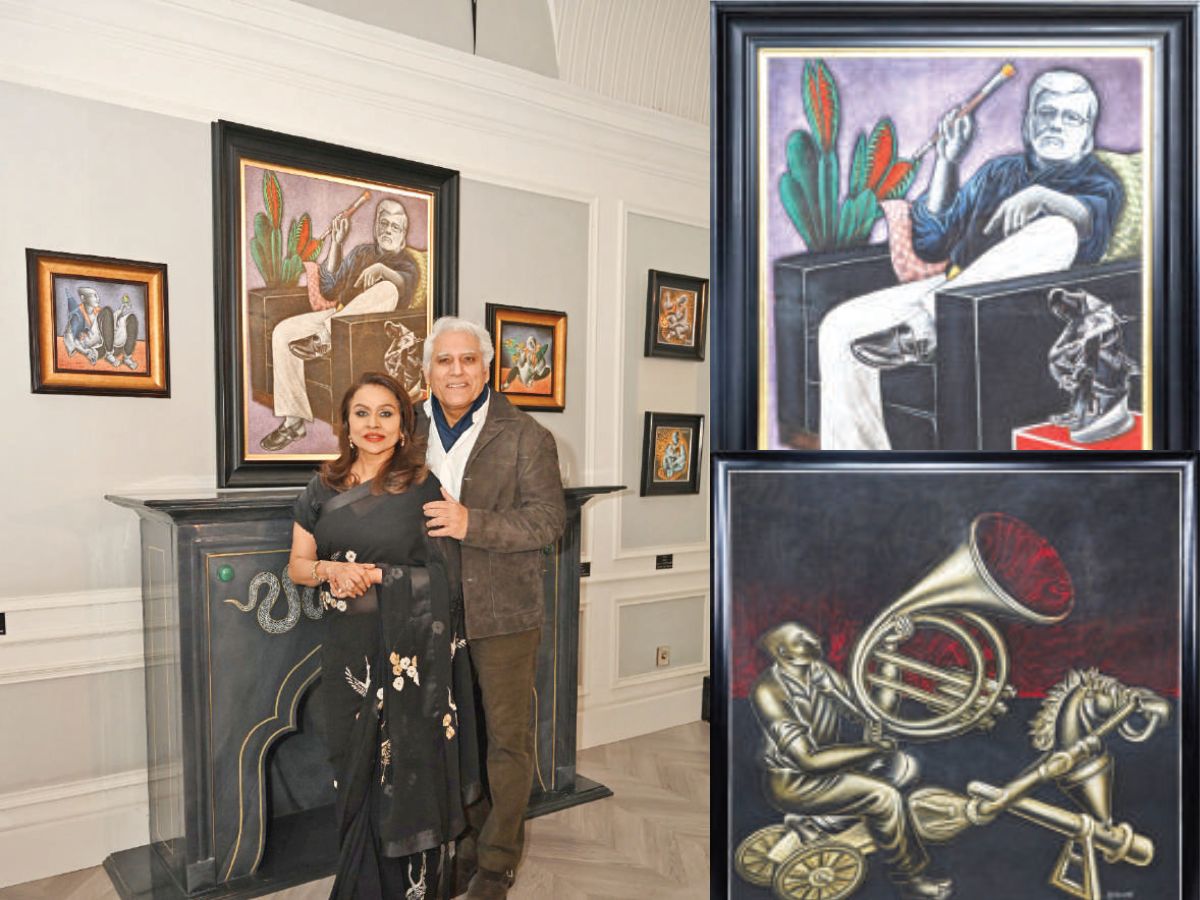
That artist Satish Gujral was a maverick cannot be denied. He overcame adversity to reach the highest echelons of the art world and made a name for himself in the Indian art canon. To commemorate his centenary year, numerous events and exhibitions are being organised. ‘Gujral Within: An Introspection’ is an acquisition-led exhibition of his works presented by RGAL | Raseel Gujral Art Legacy, in collaboration with Dhoomimal Art Centre, at Bikaner House. Drawing from the private collection of the artist’s daughter Raseel Gujral Ansal, these works have been made available to the public for acquisition for the first time. There are original paintings, drawings and sculptures from Gujral’s later practice that have neither been exhibited nor offered previously. Hence, it’s a rare chance for collectors to engage with these historically significant works.
“Conceived not as a retrospective but as an inward and highly edited curatorial exercise, Gujral Within focuses largely on the final decade of Satish Gujral’s artistic journey, a period defined by restraint, concentration and an increasingly distilled formal language. The exhibition reflects a moment of artistic maturity in which form was reduced, gesture became deliberate and meaning was carried with quiet authority,” shares Raseel.
She adds, “The preoccupations that shaped Gujral’s life, identity, displacement, political conscience, architecture and the human condition continue to surface here, though with a deepened inwardness. These works speak less through declaration and more through internal resonance. They are reflective, uncompromising and acutely aware of the space between the artist and the world he observed. Drawn entirely from a private collection, the works on view are assembled not for spectacle, but for proximity. These are pieces that were lived with; returned to over time and chosen for their capacity to hold thought, memory and moral tension within their surfaces. The exhibition invites viewers to look closely, to linger and to encounter Gujral not as an icon, but as a thinking, questioning presence.”
Another rare offering is the centenary limited-edition release of reproductions on archival paper drawn from works that have not been previously editioned. The first edition comprises nine reproductions per artwork, with a total of 99 per work to be released in measured phases over time. Individually numbered and authenticated, each work is accompanied by formal certification issued under the aegis of RGAL | Raseel Gujral Art Legacy. A limited number of Artist’s Proofs and institutional copies are retained within the archive and do not form part of the commercial edition.
Raseel shares, “These prints are not conceived as reproductions alone, but as extensions of an inner vocabulary. Works shaped by reflection, memory and lived experience. In keeping with the spirit of Gujral Within, the edition seeks to extend access to a master’s work while remaining anchored in authenticity, provenance and curatorial care. This centenary release is positioned as an act of stewardship rather than scale, allowing Satish Gujral’s work to continue its inward dialogue while entering new collections with integrity and intent.”
“Compelled by silence, Gujral created these works as a way of leaving proof of being through form. For me, Gujral Within articulates what I inherited from him as an internal vocabulary rather than an archive: a grammar of restraint, an ethics of material, and a way of listening before declaring. It is a vocabulary shaped by attention to weight, proportion, and silence where form is not expressive flourish, but evidence of thought. For my father, art was not meant for intellectual dissection or consumption. The work was complete once the form had found its integrity. Its purpose was not explanation, but to encounter an engagement with the viewer’s own sensibility and state of being. Accordingly, the exhibition does not attempt to analyse or interpret. It simply invites the viewer to immerse, engage and absorb the work on their own terms allowing meaning to arise through presence rather than instruction. Gujral Within offers not a monument to legacy, but a contemplative encounter where form continues to act quietly, inwardly and with enduring relevance.”
On the occasion, Raseel Gujral Ansal joined the Sunday Guardian for a chat. Excerpts from an edited interview:
Q. What does RGAL | Raseel Gujral Art Legacy have planned for the Gujral centenary year?
Raseel Gujral Ansal (RGA): The centenary year (2025–26) has been conceived as a layered, year-long reflection on my father’s life and work, rather than a single commemorative event. Key initiatives include: • Gujral Within — a major exhibition drawn from my private collection. • A companion publication, Gujral Within: Memory as Legacy. • Centenary limited-edition print releases. • Institutional partnerships and outreach. • Voices Within public conversations. • Educational and legacy initiatives through RGAL. As part of this commitment, we have also instituted the Satish Gujral Award for Contemporary Interpretations of Vernacular Architecture at SPA, New Delhi (January 2026), and the Kiran Gujral Award for Multidisciplinary Art and Craft at Delhi College of Art. Together, these initiatives present Satish Gujral as a living cultural presence.
Q. What was the process of bringing the exhibition to life?
RGA: Gujral Within represents a year-long process and a first step toward exploring the world of Satish Gujral at an intimate rather than monumental level. All the works are drawn from my private collection, with nearly 95 percent being previously unseen and unexhibited. These belong largely to his later practice, a period during which no major solo exhibition was mounted to showcase his evolving work. The exhibition is conceived as an act of introspection – an attempt to segment and present smaller, focused bodies of work that allow for deeper engagement with distinct phases of his life and practice. Rather than offering a sweeping retrospective, the intention is to create proximity and understanding, enabling viewers to encounter his creative journey in a more reflective and personal manner.
Q. What do you feel is Satish Gujral’s most lasting legacy?
RGA: Satish Gujral’s most lasting legacy is his fearlessness and his absolute surrender to the act of creation. He created with complete authenticity, guided by an inner compulsion rather than by external validation. His work was never shaped by trends, accolades, or contemporary critique. He was concerned with history, with time, and with the larger arc of human experience. For him, art was not a career but a calling. He worked with urgency and integrity, driven by a need to give form to thought, memory and conscience. This lifelong compulsion to create—beyond recognition, beyond approval, beyond fashion—is what defines his true legacy.
Q. Do you feel he was a social anthropologist?
RGA: My father did not think in terms of “phases.” His work evolved organically, in response to lived experience rather than historical categories. Having lived through Partition, displacement, disability, and nationbuilding, he carried within him a deep awareness of fragility, resilience, and human dignity. These experiences did not belong to one period—they informed his entire life and practice. Across decades, his work remained engaged with people: with labour, migration, memory, mythology, and belonging. Sometimes this appeared overtly political, sometimes symbolic, sometimes deeply inward. But it was always rooted in observation and empathy. In his later years, this engagement became quieter and more distilled. The work turned inward, less concerned with representation and more with essence—what remains when narrative falls away. Seen in this way, his practice reads not as a sequence of stylistic phases, but as a continuous inquiry into what it means to be human within history.
Gujral Within: An Introspection is on at Arzaani at Bikaner House, New Delhi till February 28.
Noor Anand Chawla pens lifestyle articles for various publications and her blog www.nooranandchawla.com.




