At IFFI 2025, Anupam Kher revisits his cinematic journey with renewed emotional clarity.
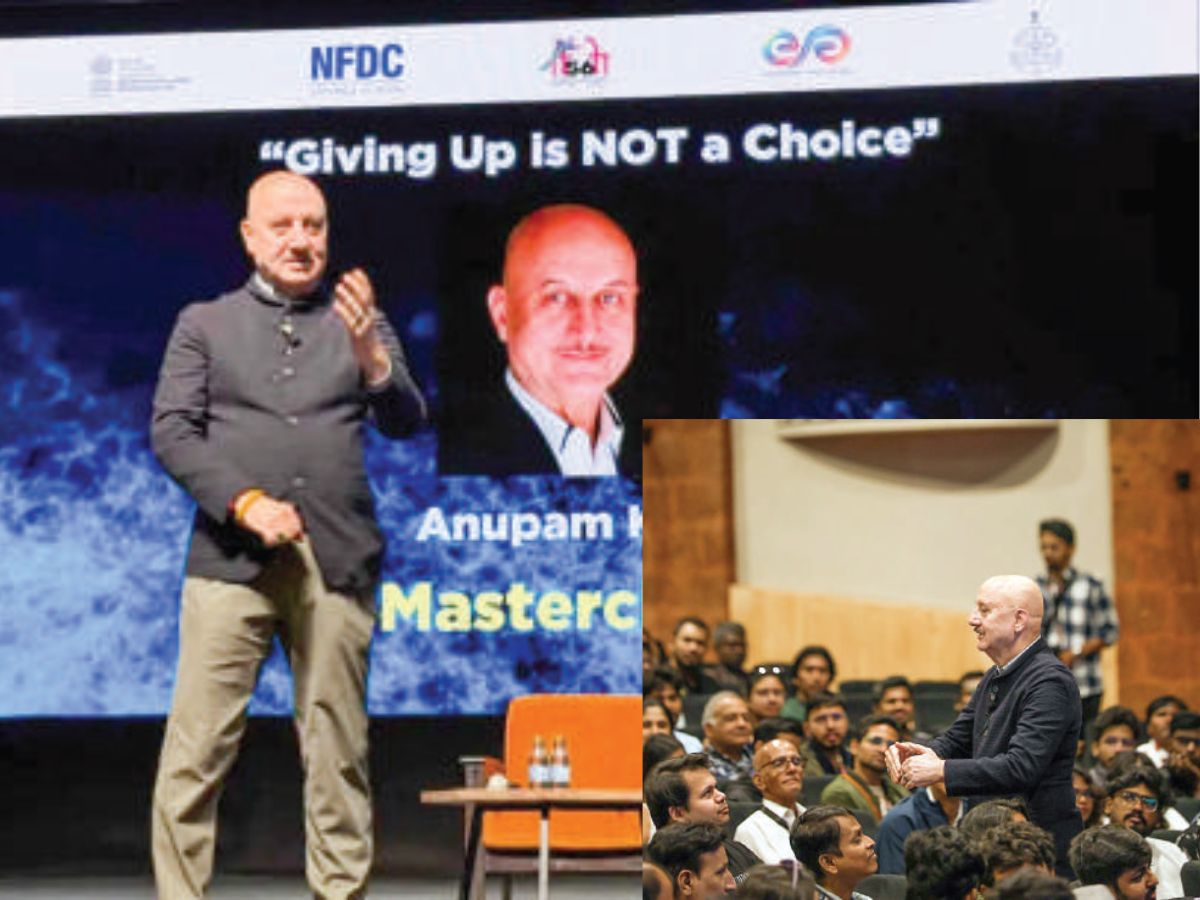
Anupam Kher IFFI Masterclass
same openness, warmth, and unfiltered honesty that have long defined him. But this year carried a special resonance. With ‘Tanvi the Great,’ ‘1942: A Love Story,’ ‘Calorie,’ and ‘The Bengal Files,’ all screening across festival sections, IFFI 2025 hosted what may be described as an unofficial Anupam Kher retrospective. For Kher, who began his career at 28 playing an elderly father mourning the loss of his only son in ‘Saaransh,’ the festival became not just a showcase of his cinematic journey but a moment of reflection—on craft, choices, risks, and the sheer miracle of staying passionately engaged with life.
Kher’s latest directorial venture, ‘Tanvi the Great’ emerged from a deeply personal space. “I needed to tell a story that comes from my whole being,” Kher revealed. It wasn’t originally in his plans to return to direction—until a spark arrived from within the family. “This idea came from my niece, whose name is Tanvi,” he recalled. “I thought it was very important to make a film in today’s time about goodness. I come from a family that believed in goodness.” He describes ‘Tanvi the Great’ as a father–daughter story where an autistic daughter attempts to fulfil her father’s unfinished dream—a narrative that demanded sincerity more than spectacle.
The journey to make the film was anything but easy. Financing was delicate, the logistics daunting, yet Kher embraced the challenge with characteristic optimism. “I get more motivated if there are difficulties,” he said. “At the end of it, you do things you believe in.” Perhaps most moving is the ethos he cultivated on set. “I told my unit of 240 people that the film is about goodness, that for the next 70 days we will all believe in goodness. Nobody used to get angry. If they did, they remembered—what is the film about? Goodness. Unfortunately, and ironically, you needed an autistic person to teach us goodness.”
After four decades in cinema, what keeps him going? “There is no bigger thing than life—zindagi,” he said. “Motivation is all over your face. You need to be looking for it.” Kher explains that he never sees people merely through their professions. “Behind their job name, there is a father, there is a mother, there is a son… I relate to the person that he or she is rather than their designation.” This philosophy is why he avoids security entourages. “I don’t carry bodyguards because I feel claustrophobic. They are a hindrance between me and people.” His father’s wisdom remains his compass. “The easiest thing in the world is to make somebody happy. I just follow that diktat.”
“I represent my country unofficially.” Even as he works across continents, Kher maintains a patriotic emotional compass. “Sportspeople get to officially represent their country. But I am an unofficial ambassador. Every shot I give, I think: I represent my country well. So I have to give my best.” Risk, he insists, is essential. “If you try, you risk failure. If you don’t, you ensure it.”
For Kher, IFFI carries a lifetime of memories—long before global fame, before ‘Saaransh,’ before any film credit. “In 1976 when I was a drama school student, three giants of world cinema—Kurosawa, Fellini, and Elia Kazan—came to IFFI. I got to see them and hear them. It was unbelievable.” This year, walking through the festival, he felt the vibrancy anew. “I think International Film Festival of India is one of the finest festivals in the world. Look at the festivities, the love you get.” But most importantly, he believes festivals matter more than ever. “It’s a great platform for writers, filmmakers, and the production people. The magnitude has gone to another level with Waves Bazaar… electrifying atmosphere.”
Kher has always refused to be boxed—neither by genre nor by geography. “I like to be popular. I like to do all kinds of genres,” he says, recalling how he has shot in Goa with both Vijay Mehta and David Dhawan. “To me, the journey is important, and it should be full of joy.” Even happiness, he claims, is a practice. “You have to decide that you want to be happy. Then practice it for three months. After that, you get used to it.”
Even at this stage of a storied career, he is far from slowing down. He is currently shooting for Sooraj Barjatya’s next film, preparing for ‘Khosla Ka Khosla 2,’ and working simultaneously on another script he hopes to direct. As audiences flocked to screenings of ‘Tanvi the Great,’ discovered the restored ‘1942: A Love Story,’ engaged with ‘Calorie,’ and debated ‘The Bengal Files,’ a quiet realisation settled across IFFI 2025: Few actors have navigated as wide a cinematic ocean—and with such unbroken sincerity—as Anupam Kher. He may not call it a retrospective. But in many ways, the festival created one for him. And as he stood before young filmmakers, film lovers, and admirers in Goa, sharing wisdom peppered with laughter and life lessons, one thing was unmistakable. That he remains what he has always been—an eternal optimist, a lifelong student of people, and an artist who believes that goodness, above all, deserves a place on screen.
Beyond Bollywood and Indian cinema, Anupam Kher’s global footprint is just as remarkable, with acclaimed roles in international projects such as ‘Silver Linings Playbook,’ ‘The Big Sick,’ ‘Sense8,’ ‘Lust, Caution,’ and ‘New Amsterdam,’ making him one of the few Indian actors to truly bridge multiple cinematic cultures. His long-standing friendship with Hollywood legend Robert De Niro—who personally attended the New York premiere of ‘Tanvi the Great’—speaks to the admiration he commands in creative circles as a global Indian artist whose contributions extend far beyond the screen.
