Polish cinematographer Artur Zurawski on filmmaking across borders, Indian cinema, and 25 years of visual storytelling.
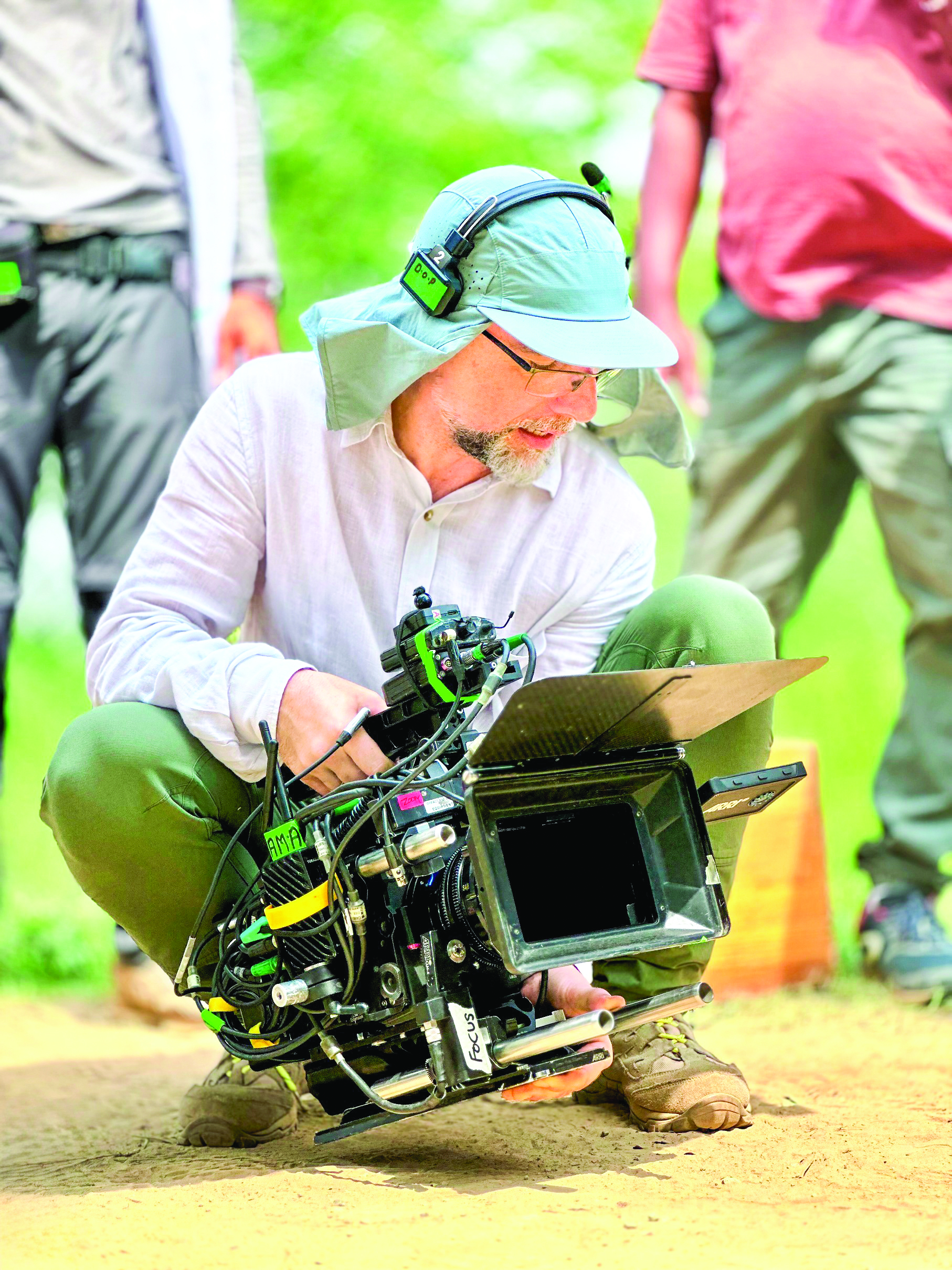
Still, I am the same person—whether I shoot in Poland or India,” asserts Polish cinematographer Artur Zurawski, quietly capturing the essence of a global artist: rooted, yet adaptive; humble, yet visionary. Best known in India for his hauntingly intense work in Mardaani (2014), Zurawski’s cinematic journey is one of poetic persistence, childhood serendipity, and transcontinental storytelling.
Born in Szczecin, a Baltic port city in northwestern Poland, Zurawski’s introduction to images came not through cinema, but through a forgotten box of his father’s old photographic equipment. “Nobody told me, ‘Oh son, maybe you will use this someday,’” he laughs. “It was just there, and I picked it up.” A home darkroom followed, and by the age of 14, he was developing his own black-andwhite stills. But the real tipping point came in his teenage years, in the small town of Chojna. Lars von Trier had arrived to shoot Europa (1991), using the town’s crumbling church as a setting for a wedding sequence. “All the townspeople were extras. I went, took pictures, sent them to him, and he sent me a handwritten letter in reply,” Artur recalls, visibly moved. “I think that was the moment I realized – filmmaking is something truly magical.”
Though initially torn between photography and film, Zurawski eventually chose motion pictures. He attended the Academy of Visual Arts in Poznań, then the National Film School in Łód, a crucible for Polish cinematic legends. “It’s extremely difficult to get in – only a few places every year, and everyone wants them. But once you are in, you get everything: access, resources, directors, and time to explore.” In those formative years, Zurawski worked extensively with foreign students—from Denmark, Germany, and the U.S.—attracted by their diverse perspectives and the promise of borderless storytelling. These formative collaborations still shape his career. “Just two years ago, I shot the Polish leg of a Korean film with a director I studied with 25 years ago,” he says. “We had never worked together before, but school relationships last a lifetime.”
His first tryst with Indian cinema came via Jackpot, a lesser-known film that nonetheless opened doors. “It was during Jackpot’s post-production that my agent connected me with Pradeep Sarkar. He had a pile of Polish DOP showreels on his desk, and I was in Mumbai, so he said, ‘Come in.’ The meeting was short—and we decided to work together.” That led to Mardaani, a gritty crime drama starring Rani Mukerji.
The film’s final sequence—where female characters mete out punishment to male perpetrators—initially jarred Zurawski. “As a European, that scene felt strange. It’s not about understanding or not understanding. It’s about cultural intuition,” he says. “In Poland, that scenario would simply never exist. But in India, it’s possible, and perhaps even necessary. So I had to trust the story’s truth.”
Now, as he shoots for Mardaani 3, Zurawski continues to approach his Indian projects with a blend of openness and technical rigor. “You have to accommodate—geographically, culturally. But as an artist, your core doesn’t change.” Zurawski’s love for film stock is evident. At Łód, students worked primarily on 35mm, and he recalls with pride the austere 1:3 shooting ratio imposed on them. “It trained us in discipline. You had to think before shooting.” Even today, he campaigns for film when possible. “In Poland, we still have a functioning lab. London and Prague are just a day’s courier away. If you shoot economically, film is viable.” Still, he acknowledges the advances in digital. For Mardaani 3, he chose the Alexa 35 for its wide dynamic range and the Cooke lenses to retain softness. “The story is very modern, but I wanted the visuals to feel familiar—not aggressive or hyperreal.” His work on Sultan, a Salman Khan starrer centered around MMA fighting, was groundbreaking. “The ring fights were something Indian cinema hadn’t done like this before.
We had real fighters from Chile, America, the UK—even our action director was from the U.S.” What stands out is a technical choice that reveals his meticulousness. “I decided to shoot on anamorphic lenses—but I didn’t want the typical flares. We needed a wide anamorphic zoom, 19-35mm, which only ARRI produced. So we asked them to build one for us, specifically. It was expensive, but Yash Raj Films went ahead.
In Poland, no one would even dream of that. I felt wow, we are really doing this.” When asked about his influences, Zurawski hesitates, not out of modesty, but because his connection with cinema is visceral. “Cinema Paradiso—that film always makes me cry. My best friend’s father was a cinema operator. We would watch films every Sunday. Like the little boy in the film, I felt cinema was something intimate, something I belonged to.” He also speaks of Jan Jakub Kolski, a Polish filmmaker whose quiet village dramas had long-lingering impact. “Nothing fancy. Long shots, wide frames, slow edits—maybe even boring to some. But I felt close to those stories.” For all his globe-trotting, Zurawski has continued a deeply personal photographic project for over 25 years—a visual chronicle of his eldest daughter, started when she was a child. “I wasn’t aware why I started. But now, it feels like a family and social archive.”
This year, the project may culminate in exhibitions in both Amsterdam and Delhi. “I even want to send a journalist to interview her—I won’t do it myself. I want her to speak freely about what this project means to her.” Zurawski belongs to that rare breed of professionals who carry a European eye but are also gifted with a childlike curiosity keen on assimilating anything and everything that they come across. Whether it’s a meticulously lit action sequence or a black-and-white portrait developed in a childhood bathroom-darkroom, his imagery echoes with emotion and craft. “Being on a film set is always an adventure,” he says, eyes lighting up.
For Artur Zurawski, every frame is a journey. And for those lucky enough to watch, it›s an invitation to see the world—softly lit, precisely framed, and always full of feeling.
