
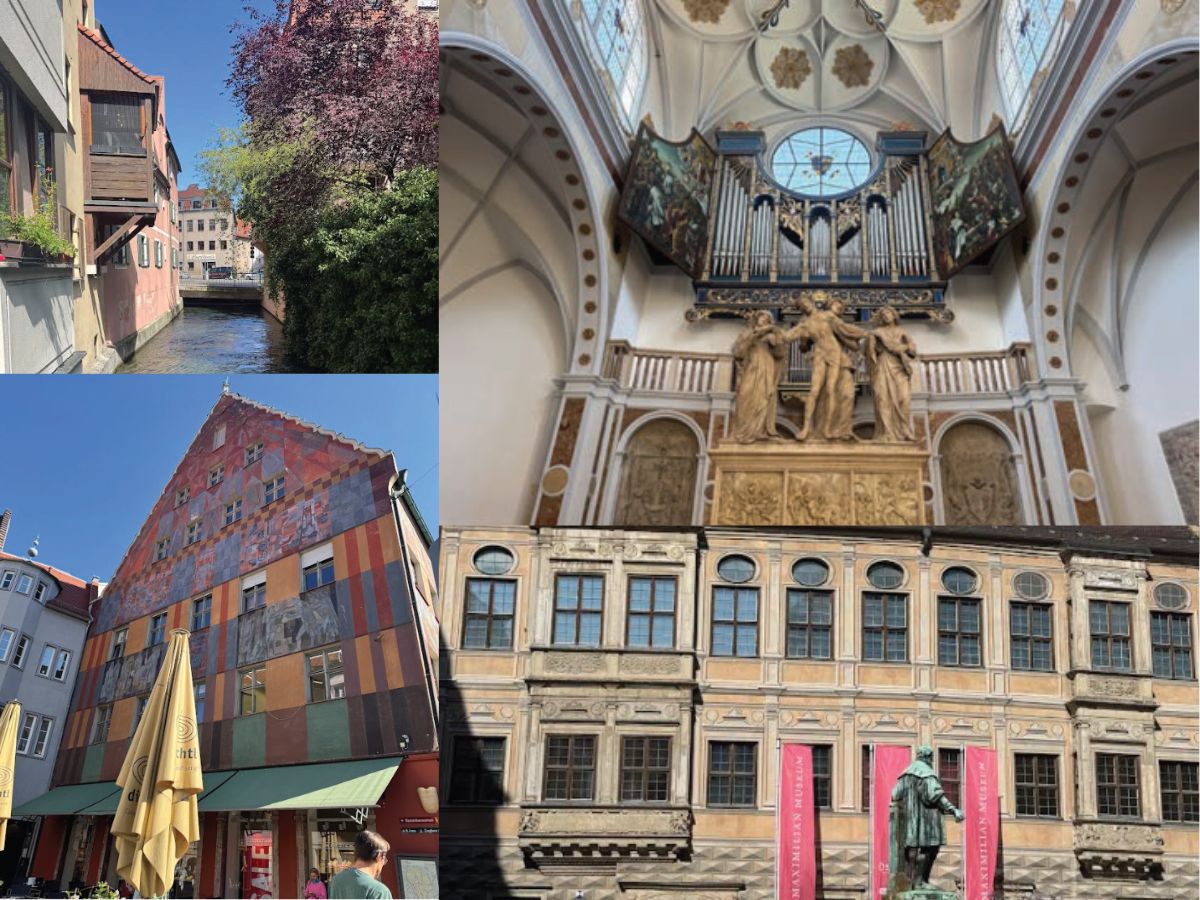
Tucked away in Bavaria, Augsburg invites exploration with stories woven through time, this underrated city whispers the tales of emperors, bankers, and artisans, inviting you to uncover its rich tapestry. Admittedly, I didn’t know much about Augsburg before my trip. Bavaria’s third largest city had always been a bit of a wallflower compared to showstoppers like Munich or Nuremberg. All I really knew was that its water management system had earned UNESCO World Heritage status. But within hours of arriving, I realized Augsburg wasn’t just old, it was ancient, layered, and full of stories begging to be told.
Founded around 14 BC by Emperor Augustus as ‘Augusta Vindelicorum’, this is one of Germany’s oldest cities. But it wasn’t just the Romans who left their mark. By the 15th century, Augsburg was Europe’s equivalent of Wall Street, booming thanks to the Fugger family, a banking dynasty that rivalled the Medicis. Jakob Fugger, whose name alone feels like a chapter in history, built the ‘Fuggerei’, the world’s oldest functioning social housing complex. (The rent? A mind-bending 0.88 euros per year, provided you say three daily prayers on Fugger’s behalf.) But what really got me was the World War II bunker hidden beneath it, a haunting time capsule that practically echoes under your feet. Wandering Augsburg’s old town feels like stepping into a Renaissance painting. The ‘Rathaus’, with all its goldleaf grandeur, dominates the square, while the ‘Perlachturm’ tempts climbers with panoramic views of the city’s maze of medieval canals, waterways that still pulse with life and earned Augsburg its UNESCO nod.
Amidst the charm lies ‘Fuggerei’, the world’s oldest social housing complex. It’s no museum piece, people still live here, but tucked behind its ivy-draped walls are three small yet insightful museums, offering vivid snapshots of centuries past: life, work, and survival through the ages. Walking through feels like time travel, without the fuss of fussing with a dial. Augsburg isn’t just history; it’s alive in every cobblestone and canal.
WHISPERS OF TIMELESS ELEGANCE
The cobblestones hum with the whispers of Roman sandals, while canals, silver veins of the city, murmur their medieval symphony. And the architecture? A bold mashup of Gothic spires, Renaissance stateliness, and Rococo decadence that somehow all clicks together. Start at ‘Weberhaus’, a rainbow-hued peacock of a building that’s survived more reinventions than a pop star since its 1389 debut. The murals on its facade are the showstopper, though there’s a buzz of shops inside for those curious to dive deeper.
Nearby, the ‘Schaezlerpalais’ hides its opulent heart, a Rococo ballroom dripping in gold, behind a deceptively plain exterior. Sundays are free entry, but even on paid days, it’s worth it to feel like you’ve waltzed into a royal dream. Stroll down ‘Maximilianstraße’, the city’s main artery, and soak up its architectural patchwork: Gothic windows nodding to Rococo flourishes, flanked by modern facades. The road naturally leads to ‘Augsburg Cathedral’, a Romanesque-Gothic hybrid whose medieval stained glass is sublime, even to the church-fatigued. Not every stop sparkles, though. ‘Hofgarten Park’, welcomed me with grey skies, empty benches, and stark trees, a melancholic poem to the unpredictability of travel moods.
Nearby, ‘Augsburg’s Town Hall’ commands attention, its Imperial Eagle glaring from the facade. Inside, the Golden Hall outshines most Renaissance interiors with its gilded splendour. For literary buffs, ‘Brecht’s House’ offers a peek into the life of one of Germany’s greatest playwrights, while music lovers can explore ‘Leopold Mozart’s home’, a surprising chapter in Augsburg’s story.
FLOWING THROUGH TIME
Augsburg’s water management system isn’t just a UNESCO World Heritage Site, it’s a masterpiece of engineering that’s been quietly sustaining the city for over 800 years. Think of it as the backstage crew of Augsburg’s history, diverting, channelling, and powering the city with the Lech River’s flow since the 14th century. Exploring the 22-site network can be overwhelming, so start in the old town, where the ‘Lech Canals’ weave through like liquid veins. With 77 kilometres of waterways and about 500 bridges, wandering the canals feels like uncovering a hidden, aquatic side of the city, though people’s comparisons to Venice might be stretching it.
For a deeper dive (pun intended), head to ‘Hochablass’, a centuries-old weir that’s been steering the Lech into the canals since medieval times. Located just 5 kilometres from the city centre, it’s the perfect blend of history and innovation, especially if you catch a guided tour. This isn’t a showstopper UNESCO site, it’s a quiet, working marvel. But isn’t that refreshing? Initially built to tame icy currents, the ‘Eiskanal’ evolved into the world’s first Whitewater canoe course for the 1972 Olympics. Today, it’s where history and adrenaline collide.
You can explore Augsburg in just half a day if you’re all about ticking off highlights, but give it a full day, and the city’s layers unravel beautifully, from Roman roots to Renaissance glories. For history buffs or slow travellers, Augsburg rewards curiosity with its canals, golden halls, and quiet charm. Spring and early fall are the sweet spots, think sunny strolls without the tourist crush. But even in winter, Augsburg’s museums and Christmas markets make it worth bundling up for. It’s funny, Augsburg wasn’t on my radar, but now, I can’t stop talking about it. Some cities quietly charm you; Augsburg grabs your curiosity and refuses to let go.
(Akanksha Dean, is a food & travel writer, culinary researcher, and independent chef who blends global culinary experiences with award-winning creativity in concept curation.)




