Col Danvir Singh rebuts claims of political ‘usurpation’ of India’s military, arguing it reflects strategic maturity—integrating politics and defence in a nuclearised era.
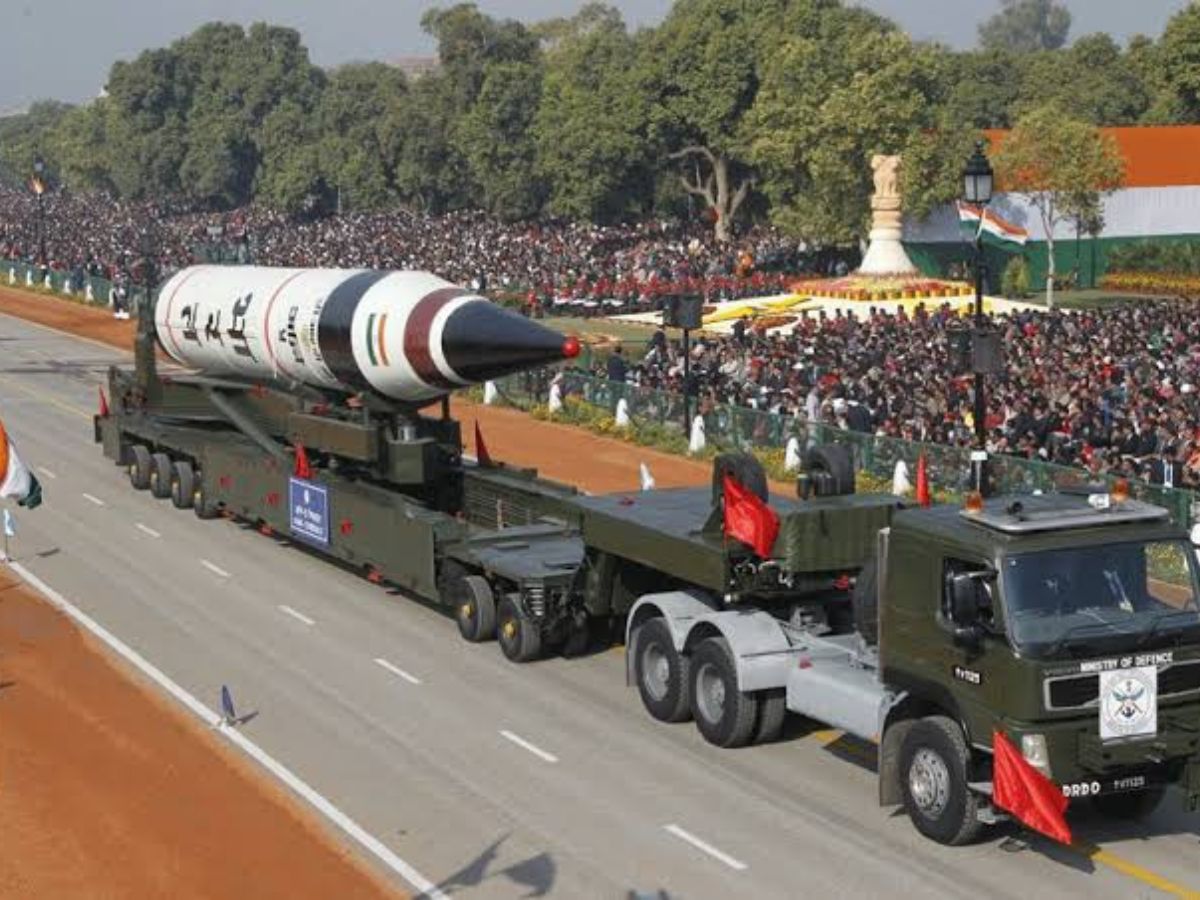
Beyond Bitter Grievance: Why the ‘Usurpation of Command’ Narrative Fundamentally Misreads India’s Nuclear-Age Military Strategy (Image: X/@VivekSi85847001)
A corrosive argument has crept into recent commentary on Indian defence affairs: that the political leadership has ‘usurped’ military command, reducing the Armed Forces to executors of tactics and builders of hollow narratives. This claim—most loudly expressed in analyses asserting that “PM Modi serves as Strategic & Operational Commander” while service chiefs are relegated to the margins—is not only poor strategy; it is a dangerous misreading of how modern conflict functions in the nuclear age.
This rebuttal dismantles that thesis. What critics label ‘usurpation’ is, in fact, an evolved and necessary form of political–military integration suited to hybrid warfare, sub-conventional contingencies, and escalation management in a nuclearised environment. The charge that India’s military leadership has atrophied or retreated into irrelevance betrays nostalgia for a model of war that the 21st century has rendered obsolete.
The ‘usurpation’ narrative relies on an anachronistic view of civil–military relations, drawn from pre-nuclear conventional wars and a tidy three-tiered separation of strategy, operations, and tactics. Critics portray the Prime Minister’s direct engagement with operational decisions as a failure of military autonomy and professional expertise. This is a categorical error.
In a nuclear-threshold environment, the boundaries between strategic, operational, and tactical levels blur. Clausewitz’s dictum that war is politics by other means is truer than ever in the India–Pakistan–China triangle. When adversaries wield nuclear weapons, the idea of ‘purely military’ objectives becomes illusory: every tactical action carries strategic weight, and every operational move risks escalation with civilisational consequences.
Political executive involvement is therefore not usurpation but essential strategic control—managing escalation risk and ensuring political aims dominate military means. This is not weakness; it is strategic maturity. The alternative—granting unfettered operational autonomy to pursue conventional military logic—would be reckless in South Asia’s nuclear context.
Consider the much-maligned ‘no escalation’ constraint. Far from being debilitating, it is the supreme strategic objective. The 2016 surgical strikes and the 2019 Balakot operation were not failed conventional campaigns; they were deliberate acts of coercive signalling: demonstrating capability, resolve, and willingness to act, while calibrating force to avoid breaching Pakistan’s nuclear thresholds or inviting Chinese intervention. The post-2016 model of swift, punitive, precisely measured strikes followed by controlled de-escalation reflects sophistication, not emasculation.
Dismissing the 2016 surgical strikes as ‘shallow counter-terror operations’ misunderstands both purpose and achievement. They pioneered the overt use of limited force as a political instrument—breaching Pakistani territory, striking with precision, and returning under escalation control.
Their value was never to be tallied in body counts or terrain captured, but in signalling and political will. India established a new template: terrorist attacks would draw direct military response on Pakistani soil, not merely diplomatic protests or passive mobilisations. This undermined Pakistan’s assumption that nuclear weapons provided complete sanctuary for its proxy war.
Those who grade these operations by penetration depth or infrastructure destroyed apply the wrong calculus. The metrics were political: Did India achieve its coercive objective? Did Pakistan’s behaviour require recalculation? Did India demonstrate resolve at home and abroad? By these measures, the operations recast the strategic narrative and widened India’s operational space.
Balakot refined this further. Striking deep by air, India demonstrated escalation control while leaving room for both sides to step back. That is crisis management of a high order, not failure.
The alternative—unrestricted conventional retaliation—would either have marched to the nuclear brink or, more likely, been deterred from the outset by that risk, leaving India inert. The current model threads the needle between passivity and catastrophe. That is higher-order strategy.
The claim that India’s military leadership is stagnant—citing an emphasis on ‘new war domains’ and multi-domain operations (MDO)—misreads the global evolution of warfare. Integrating cyber, electronic warfare, information, and space with the kinetic domains is not an Indian eccentricity; it is the prevailing direction of modern military thought.
The U.S. military’s pivot to MDO, NATO’s focus on hybrid defence, and China’s ‘intelligentised warfare’ all recognise that contemporary conflict spans domains simultaneously, often with non-kinetic effects generating strategic leverage that brute firepower cannot. Mocking cyber, EW, and information operations as distractions is to fight the last war—or rather, to imagine one that will no longer be fought in isolation from these spheres.
The PLA’s systems-disruption approach, anti-satellite capability, and sophisticated cyber/EW are designed to target the nervous system of modern forces—C4ISR, satellite links, and integrated air defence. India’s attention to these areas is not evasion of conventional development; it is recognition that conventional strength without non-kinetic resilience is brittle. Integrating these domains into planning is evolution, not decay.
Likewise, sustained focus on internal security—particularly in Jammu & Kashmir—is not an ‘addiction’ to sub-conventional conflict but strategic prudence. Stabilising the rear, denying adversaries internal vectors, and blunting proxy warfare are prerequisites for credible external deterrence. A force distracted by internal disorder cannot project power outward with confidence.
Assertions that Operation Sindoor ‘shattered’ post-1971 beliefs in India’s conventional superiority—and that Pakistani and Chinese assessments show India as obsolete—demand scrutiny. A coordinated China–Pakistan contingency is India’s most serious military challenge; the PLA’s modernisation is significant; and China’s hypersonics, SEAD/DEAD, and cyber/EW pose real tests.
But claims that these developments have already rendered India conventionally outclassed are premature and serve adversarial information objectives. Pakistan’s self-assessment of air and rocket force superiority is regularly inflated for morale and deterrence. Its economy, defence industrial base, and technological depth trail India’s markedly. The Pakistan Air Force remains proficient and motivated, but it lacks the numbers, technological breadth, and sustainment to achieve lasting air supremacy over India.
The 2019 aerial engagement over Kashmir—where India lost a MiG-21 but plausibly downed an F-16—does not support narratives of Pakistani dominance. More broadly, Pakistan’s strategic depth and industrial capacity remain inferior for a prolonged conventional contest, nuclear risks notwithstanding.
China’s prowess is more consequential, yet the notion that hypersonics instantly nullify Indian air defences, or that cyber/EW would produce immediate paralysis, rests on worst-case assumptions. Hypersonics are not magic; detection, cueing, and terminal effects in Himalaya-like terrain are non-trivial. Cyber/EW is contested space for both sides; redundancy and resilience matter and are never one-way advantages.
India retains substantive strengths: a larger economy and industrial base, accelerating defence manufacturing under Atmanirbhar Bharat, geographic advantage in home-terrain defence, and a military with sustained operational experience. The gap has narrowed, but obituaries for India’s conventional relevance are strategic messaging, not settled fact.
There is a legitimate concern embedded within the ‘usurpation’ argument: tighter political control demands better civil–military mechanisms, clearer translation of political aims into executable missions, and a military leadership adept at operating within constraints while maximising effect.
That is a case for refinement, not for re-erecting walls between politics and war in a nuclear age. The task is to cultivate military leaders who grasp the political grammar of limited war, and political leaders who appreciate military capabilities and limits well enough to set coherent constraints.
The Chief of Defence Staff, theatre-command reforms, and the emphasis on jointness reflect this institutional need. Progress is uneven, and criticism of pace is fair. But this is far removed from the claim that the current model is strategic failure. The true requirement is deeper integration: military counsel informing political decisions, and political objectives framed as achievable missions with suitable resources. That demands intellectual growth on both sides, not separation.
The ‘usurpation’ narrative offers a superficially sharp critique that indulges a longing for simpler wars—and, more insidiously, corrodes confidence in India’s defence posture. India’s current political–military structure is a necessary and mature response to a nuclearised neighbourhood. Fused decision-making at strategic and operational levels is a feature, not a flaw: it manages escalation, enables coercive effect short of catastrophic war, and ensures military means remain subordinate to political ends.
The claim that the military has retreated to ‘tactics and narrative building’ misconstrues modern conflict. In an era where perception, signalling, and escalation control are strategic effects in their own right, strategic communication and information operations are force multipliers—enablers of advantage, not substitutes for capability.
India’s test is not to mirror adversary systems one-for-one, but to craft asymmetric advantages, harden critical domains, and retain the strategic acuity to fight today’s and tomorrow’s wars—rather than refight yesterday’s.
Col Danvir Singh (Retd) is a decorated infantry officer, strategic affairs analyst, and host of a leading television show on India’s military and security issues. He can be reached by Email: danvirsingh34@yahoo.in and posts on X: @danvir_chauhan.
