Vanitha Datla’s journey reveals hidden struggles women face within India’s family-run enterprises.
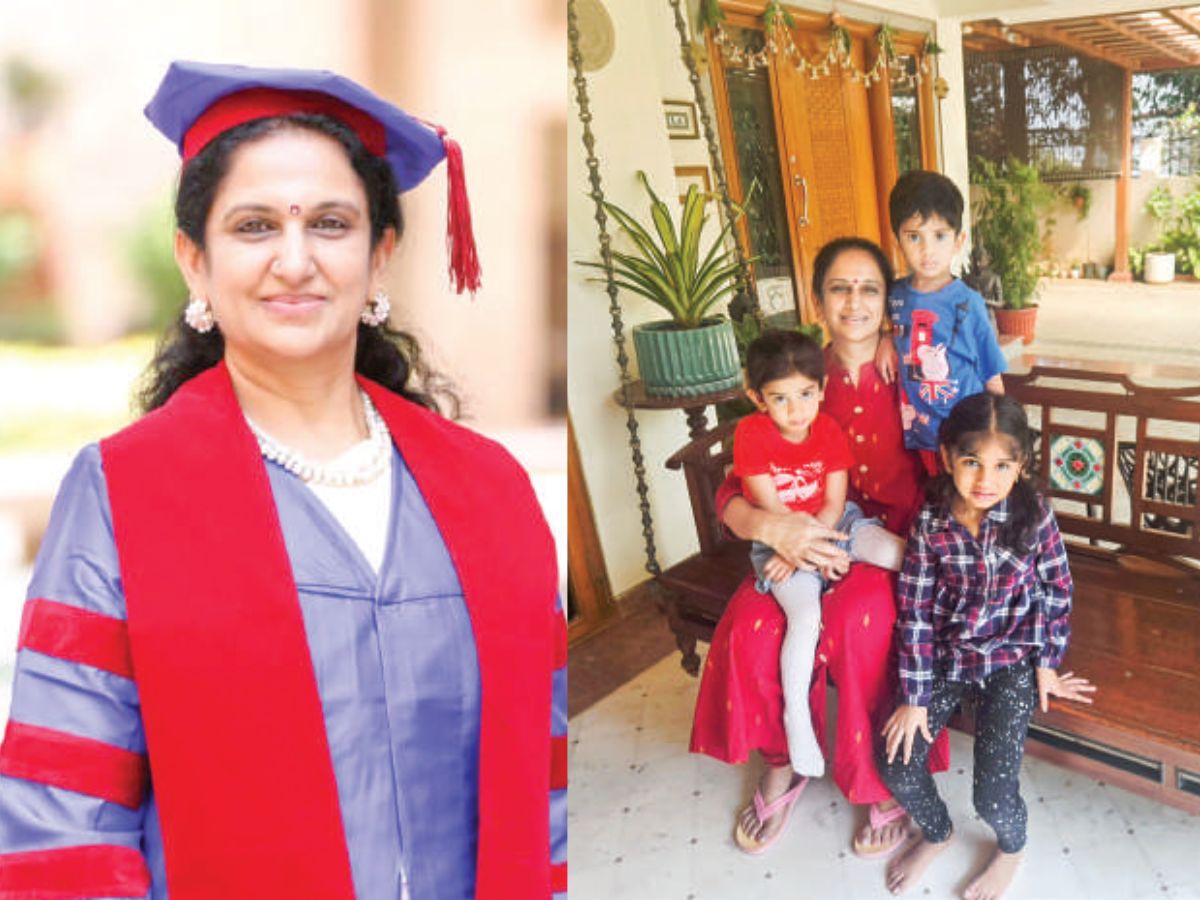
Vanitha at her convocation at ISB
It’s a balmy Saturday morning in Hyderabad, and we are sitting on the verandah of a lovely bungalow in the plush Jubilee Hills. I am in the city to conduct interviews for a book, and when I reach out at short notice, Vanitha Datla graciously invites me to her home on a Saturday morning. I first met Vanitha some years ago at the launch ‘Bold and Brilliant - stories that inspire’, which our company published for the CII-IWN, and was struck by her dignified and direct manner.
At our second meeting, she juggles grandma duty and the professional interview, multitasking with aplomb and ease. I had always viewed her as coming from a place of privilege and was surprised to learn that the privilege came with its own pain. When Vanitha first entered her family’s business over thirty years ago, she confronted a paradox that defines the experience of countless women in family enterprises: “privilege actually boxes you.” Born into a prominent business family, Vanitha had dreamed of becoming a doctor. When that path closed, she refused to accept the expected alternative—sitting at home as a homemaker. But here lay the cruel irony of her situation: “Because of gender, patriarchy and the social conditioning, women are not expected, nor are they even invited to be part of the family business.”
She was an outlier, attempting to enter a space designed to exclude her. With no qualifications and zero experience, she found herself in an impossible bind. “Who else would give me an opportunity?” she asks, explaining why she turned to her grandfather, Dr BV Raju, who headed the family business, Raasi Cements. He agreed—but what followed reveals how hollow such opportunities often are for women. While her grandfather placed her in roles of executive director, then managing director, the positions were purely symbolic. “I was a puppet without substantive powers,” she says. She found herself excluded from the grooming and career development automatically extended to male relatives. “I was not given a bottom role,” she explains, describing how she was placed at the top without the foundational experience or authority that should accompany such positions.
It was the same when she joined her brother’s new company after the group’s flagship company was subjected to a hostile takeover. “I was never taken seriously by the professionals because I was always the chairman’s granddaughter, then the chairman’s sister,” she recalls. People were deferential, but dismissive of her actual capabilities. It took fifteen years for Vanitha to find her voice. The breakthrough came when her husband invited her to join ELICO part-time, recognising what others had overlooked: she was wasting her potential. What began as part-time work evolved into a full-scale leadership role as Vanitha immersed herself in industry forums. Her election as CII (Confederation of Indian Industry) vice chairperson for the combined state of Andhra Pradesh marked a turning point.
The position, traditionally held by stalwarts of Indian industry, thrust her into unfamiliar territory: dealing with bureaucrats, government officials, and politicians. She faced resistance from her mother and grandmother, who questioned why she needed to take up such a post, but Vanitha persevered. When the state split shortly after her election, she was elected chair of Telangana CII role without the customary year of preparation as vice chairperson. The experience was transformative. “I realised that there was a lot of discrimination against women even at most senior levels,” she says. As she travelled across six southern states, she became synonymous with advocating for women’s inclusion. “People thought, when they saw me, ‘Oh, Vanitha is going to talk about women and empowerment and inclusion.’”
Through her work with the Indian Women Network (IWN), Vanitha confronted the condescension that women leaders routinely face. She recalls inaugurating an IWN chapter where a senior male member dismissively asked: “You women have kitty parties. Why do you want such an organisation?” The incident crystallised the challenge: men in their 50s and 60s, conditioned by decades of patriarchy, often view women’s professional networks as unnecessary—or worse, as quotas that compromise merit. Yet Vanitha remains certain about IWN’s impact. The organisation showcases role models who have navigated obstacles to reach senior positions, providing pathways for younger women. Through programs like Eve Empower, senior women mentor those at various career stages, addressing the critical dropout point when young professionals’ dreams get set aside amid family responsibilities.
She articulates the impossible standard women face with particular clarity, quoting a female IPS officer: “As women, we are expected to work as though we don’t have a family. We are expected to take care of a family as though we don’t work, and the world expects us to look as though we don’t have a family or we don’t have a career.” The corporate world, she notes, was designed during wartime for men who could spend unlimited hours outside without domestic responsibilities. There is hope, however. Vanitha believes COVID-19 has institutionalised flexible work arrangements, creating new avenues for women to maintain careers. “Corporations have realised that women can be flexible and multitask,” she notes.
Vanitha is a duathlete, having completed full marathons, ultra walkathons, and bicycle events up to 200 kilometres; the stamina required to push through those final kilometres mirrors the persistence needed to break through decades of being underestimated and sidelined. The paradox that defined her early career became the subject of her academic inquiry. At the Executive Doctoral Program at the Indian School of Business, Vanitha chose as her thesis topic: “Navigating Family Business: An Exploratory Study on Women’s Roles and Contributions in Indian Family Enterprises.”
As our conversation winds down and her grandchildren settle down to the Zepto-delivered popcorn, I reflect on what her story truly represents. It’s one thing to get a place at the table and another to actually earn it and own it. Vanitha Datla did it, and now she’s making sure other women know they can too.
Sandhya Mendonca, author, biographer, podcaster, and publisher at Raintree Media, offers a distinct female gaze of the world in this column.
